%201.avif)
Business Lending Software: What It Is, How It Works, and Why Lenders Need It
A regional bank receives a $2 million equipment financing request. The credit team pulls data from the core system, the relationship manager digs through email threads for tax returns, and underwriting waits three days for a risk model to run. The borrower? Already talking to two other lenders who promised an answer by the end of the week.
The problem isn't that lenders lack technology; most have digitized origination, credit decisioning, and portfolio monitoring. The problem is that none of them talks to each other. In a market where business borrowers expect consumer fintech speed with relationship banking sophistication, fragmentation, and efficiency isn’t acceptable.
Business lending software has evolved from back-office necessity to strategic differentiator: a unified platform connecting origination, underwriting, servicing, and portfolio management.
What Is Business Lending Software?
Business lending software is a digital platform managing the end-to-end lifecycle of commercial loans from application intake and credit assessment through approval, disbursement, servicing, and portfolio monitoring.
It's the connective layer eliminating the gap between what lenders know and what they can act on. Traditional commercial lending ran on relationship memory. Modern business lending runs on unified data, automated workflows, and real-time risk intelligence.
The market changed: According to the Federal Reserve, 23% of small businesses now approach online lenders, while applications to large banks have declined. However, their satisfaction rates with online lenders have gone down.
Business borrowers expect digital processes to match their B2B SaaS procurement experience. Loan portfolios grew more complex across asset-based lending, equipment financing, and commercial real estate. Regulatory scrutiny intensified with CECL compliance and fair lending audits.
Patchwork systems held together by Excel no longer support growth. Business lending software consolidates what used to take six tools into one platform.
Challenges Without Business Lending Software
Most lenders don't fail because they make bad credit decisions. They fail because fragmented systems create operational drag that compounds into strategic paralysis. Here's what that looks like:
- Operational inefficiency: A mid-market lender reported that loan officers spent 40% of their time on administrative tasks that should have been automated.
- Inconsistent credit decisions: Without standardized workflows, approval quality varies by underwriter. Risk models live in individual Excel files, creating regulatory exposure.
- Poor customer experience: Borrowers submit documents multiple times. Loan modifications take weeks. When fintech competitors close deals in 48 hours, relationship banking alone isn't enough.
- Blind spots in portfolio risk: Without real-time monitoring, credit deterioration goes unnoticed until payments stop. The OCC’s review shows a clear pattern. The Federal Reserve’s review of Silicon Valley Bank shows this clearly. As the bank expanded, management lost sight of growing interest rate and liquidity risks. Weak visibility across the balance sheet meant these issues built up quietly, then surfaced all at once when stress hit.
- Compliance exposure: Manual documentation creates gaps. CECL calculations rely on unverifiable spreadsheets.
- Scalability limits: Adding volume means adding headcount proportionally.
Lenders with fragmented systems lose because competitors with modern platforms move faster and serve customers better.
How Business Lending Software Works
Modern business lending software operates as a unified workflow engine.
Borrowers submit applications through web portals or API integrations. The system automatically pulls financial data, validates documents, and routes submissions to appropriate credit teams. The platform aggregates internal and external data into a single credit profile, triggers risk models, and surfaces exceptions requiring review.
Once approved, the system generates loan agreements and documentation automatically. Electronic signatures eliminate paper bottlenecks; closings that took 10 days now take 48 hours. The platform manages disbursement, tracks repayments, and monitors covenants in real time. Exceptions trigger immediate alerts.
Credit teams get real-time dashboards showing exposure by industry, geography, and risk rating. The platform runs stress tests, calculates CECL reserves, and generates regulatory reports on demand.
Key Features of Business Lending Software
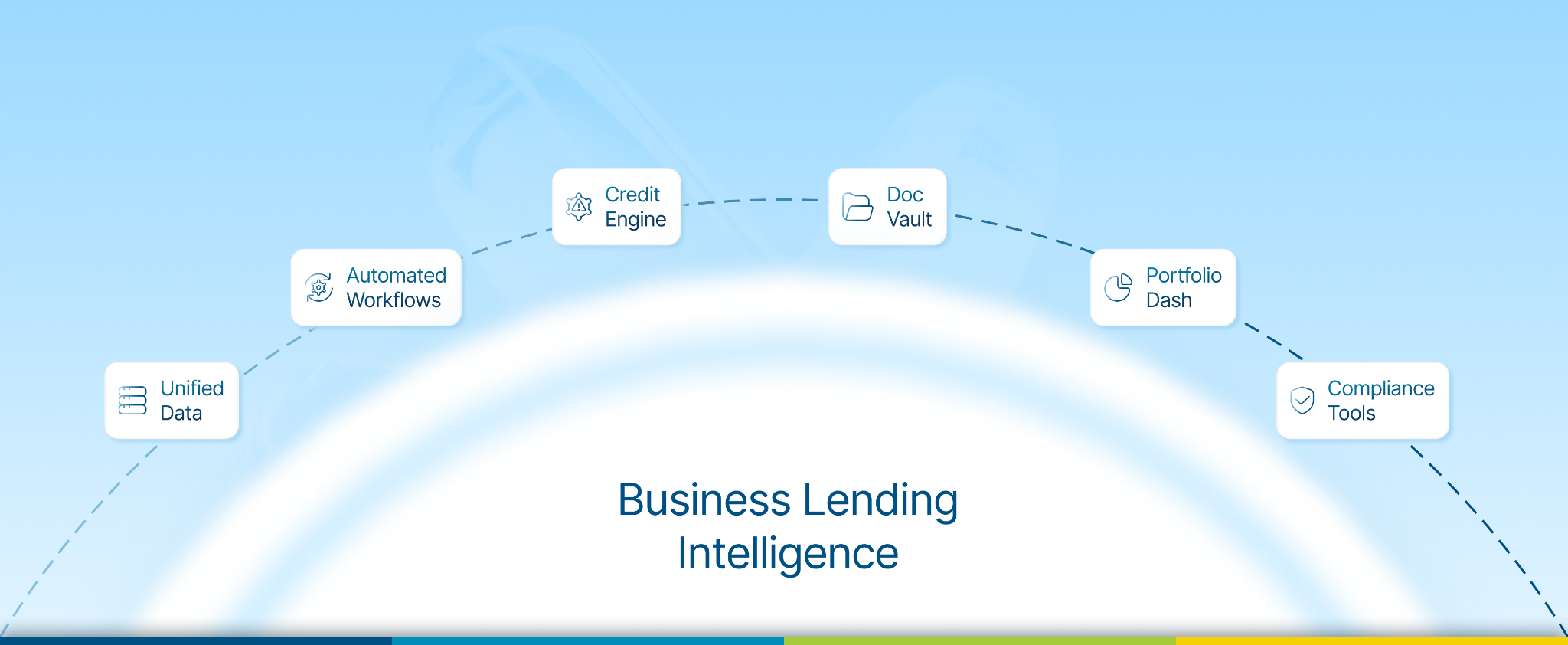
Lending intelligence is the key to success for online business lenders. Here’s how a business lending platform boosts lender performance and borrower experience:
- Unified data layer: All loan data lives in one system. Updates appear instantly across teams.
- Automated workflows: Rule-based automation handles document validation, payment processing, and compliance checks.
- Credit decisioning engine: Integrated risk models calculate ratios and score deals. Credit teams can adjust model weights and track decision quality.
- Document management: Digital vaults store every loan file with version control and audit trails. OCR extracts data automatically.
- Real-time portfolio monitoring: Dashboards surface past-due rates, concentration risk, and yield. Alerts trigger when covenants breach.
- API connectivity: Platforms integrate with core banking systems, credit bureaus, and accounting software.
- Regulatory compliance tools: Built-in workflows enforce fair lending requirements and automate CECL modeling.
These features create lending intelligence: connected systems surfacing the right information at the right time.
Benefits of Business Lending Software
SME lending software connects systems that were handled in isolation. When data is available in real-time, loan servicing naturally improves. Here are the top benefits for lenders using commercial loan software:
- Faster deal velocity: Applications that took weeks now close in days. Electronic documentation cuts closing timelines by 60-70%.
- Better credit decisions: Unified data shows complete borrower relationships. Automated calculations eliminate errors. Standardized models reduce inconsistency, resulting in lower default rates.
- Improved customer experience: Borrowers get transparency through self-service portals. Relationship managers spend more time advising clients.
- Operational cost reduction: One regional bank cut loan operations costs by 35% by redeploying teams to higher-value activities.
- Stronger portfolio performance: Real-time monitoring catches deteriorating credits before default. Automated covenant tracking prevents breaches from going unnoticed.
- Regulatory confidence: Complete audit trails reduce exam stress. When regulators request files, lenders produce them instantly.
- Scalability: Launch new products without separate systems. Growth doesn't require proportional infrastructure increases.
How to Implement Business Lending Software
Often, lenders struggle with digital business lending solution implementation because they treat it like a software deployment instead of a business transformation. Here's what successful rollouts actually require:
- Start with process documentation: Map current workflows and document pain points specifically.
- Define success metrics: Pick 3-5 metrics that matter and track them from day one.
- Prioritize data migration: Allocate 30-40% of project time to data quality work.
- Configure, don't customize: Heavy customization creates technical debt. Adapt processes to platform best practices.
- Train before go-live: Change management matters more than technical training.
- Phase the rollout: Start with one product or branch before enterprise deployment.
Implementation timelines: 3-6 months for focused deployments, 12-18 months for enterprise transformations.
Choosing the Right Provider
The market is crowded with vendors claiming to solve commercial lending complexity. Most fall into one of three categories: legacy systems with modern interfaces, point solutions pretending to be platforms, or true unified platforms built for modern lending workflows.
Here's how to tell the difference:
- Look for End-to-End Coverage: The platform should handle origination, underwriting, servicing, and portfolio management natively, not through bolt-on acquisitions or third-party integrations. Ask vendors: "Can I track a loan from application through final payoff in your system without exporting data?" If the answer involves multiple modules with separate logins, keep looking.
- Demand API-First Architecture: Modern platforms expose core functionality through APIs, enabling seamless integration with your existing tech stack. Check whether the vendor's API documentation is public, comprehensive, and actively maintained. Vendors who hide their APIs behind "contact sales" pages usually have something to hide.
- Evaluate Configuration Flexibility: Credit policies vary by lender. Risk appetites differ. Approval hierarchies reflect organizational structure. The platform should adapt to your processes through configuration, not require engineering resources for every workflow change. Request a live demo where you describe a unique approval scenario and watch the vendor configure it in real time.
- Assess Data Model Sophistication: Can the system handle complex commercial structures? Multi-entity borrowers? Cross-collateralized facilities? Participations and syndications? Portfolio lenders have different data requirements than volume SME lenders. Simple data models work until they don't. Then they become migration nightmares.
- Verify Compliance Capabilities: Ask how the platform handles fair lending documentation, CECL calculations, and regulatory reporting. Request examples of audit trail reports and stress testing outputs.
- Check Customer References: Talk to lenders similar to your institution with the same asset size, same product mix, same geographic footprint. Ask them what surprised them during implementation, what they wish they'd known, and whether the vendor delivered on promises.
- Understand the Total Cost: Licensing fees are just the start. Factor in implementation services, data migration costs, training, ongoing support, and system administration overhead. Some vendors quote low upfront fees, then hit you with expensive change requests during implementation. Cheap platforms become expensive when you add up the true cost of ownership.
- Evaluate Vendor Stability: Commercial lending platforms are long-term commitments. Is the vendor well-funded? Do they have a track record of product investment and customer support? Check their release cadence platforms that haven't shipped meaningful updates in 18 months are dying slowly.
This is where platforms like Finspectra stand out: unified architecture that covers the full lending lifecycle, API-first design that integrates with existing infrastructure, and configuration flexibility that adapts to unique credit policies without custom code.
Finspectra's Prizm Lending Suite delivers the connected visibility and automated workflows that modern business lenders need, without the fragmentation that plagues legacy systems.
But regardless of vendor, the principle remains: business lending software is too critical to your growth strategy to choose based on feature checklists alone. Choose based on architectural soundness, implementation track record, and vendor commitment to continuous innovation.
Future of Business Lending Technology
The next wave of business lending software won't just automate existing workflows. It will fundamentally reshape how lenders assess risk, serve customers, and allocate capital.
Business lending will increasingly happen at the point of need: embedded in accounting software, procurement platforms, and ERP systems. APIs will enable instant credit decisions based on real-time financial data pulled directly from borrower systems.
This shift is happening now. Platforms like Stripe Capital and Shopify Capital already offer embedded lending to their merchant customers. B2B lenders will need software that supports API-based origination or risk becoming irrelevant.
Machine learning models will augment (not replace) underwriter judgment by identifying patterns human analysts miss. Predictive models will flag deteriorating credits months before traditional metrics show stress. Natural language processing will extract risk signals from unstructured data borrower emails, news articles, and social media sentiment.
As open banking regulations expand beyond consumer lending, business lenders will access borrower financial data directly from bank accounts (with permission), eliminating the need for bank statements and financial statement spreading.
Alternative data sources (payment processing history, utility bills, supply chain data will enable credit decisions for businesses with thin credit files. Platforms that integrate these data sources natively will win the SME lending market.
Not every vendor is ready for these shifts. Legacy platforms built on 20-year-old architectures can't adapt fast enough. But lenders who choose modern, API-first platforms position themselves to capitalize on these trends rather than scramble to catch up.
Conclusion
The defining challenge in business lending isn't credit risk, but it's operational fragmentation. Lenders lose deals because systems can't deliver answers fast enough, because data lives in six places, because workflows require manual intervention at every step.
Modern business lending software eliminates fragmentation by connecting origination, underwriting, servicing, and portfolio management. It gives credit teams visibility to make better decisions and automation to make them faster.
Finspectra's Prizm Lending Suite delivers end-to-end business lending software that unifies workflows and scales with your portfolio. Book a demo to see how Prizm enables faster decisions and better risk management.
FAQs
- Is business lending software suitable for NBFCs and fintech lenders?
Yes, modern lending systems are designed for any institution originating commercial loans, banks, NBFCs, fintechs, and credit unions. Cloud-based platforms eliminate infrastructure costs once prohibitive for non-bank lenders. Look for API-first architecture integrating with your existing stack.
- What regulatory compliance features should business lending software support?
Essential regulatory compliance features in business lending solutions include automated fair lending documentation, CECL calculation engines for reserve modeling, complete audit trails for every data change, regulatory reporting modules, covenant monitoring with breach alerts, and customer data protection controls meeting privacy regulations.
- Can business lending software handle multiple loan products in one system?
Yes, modern commercial loan software is a single system that can manage equipment financing, working capital lines, commercial real estate, asset-based lending, and SME term loans. Look for platforms that support product-specific requirements, different collateral types, covenant structures, and repayment schedules through configuration.
- How does business lending software improve portfolio risk management?
Modern platforms provide real-time visibility into portfolio composition by industry, geography, and risk rating. Automated covenant monitoring flags breaches immediately. Stress testing models portfolio performance under adverse scenarios. Early warning systems identify deteriorating credits before defaults.
- What is the typical ROI of implementing business lending software?
Lenders typically see a 30-40% reduction in manual processing costs, 20-30% faster deal closings, and 15-25% lower default rates through better underwriting consistency. Most mid-sized lenders report payback periods of 12-18 months, with ongoing benefits exceeding implementation costs.
.png)

.png)
.png)


