%201.avif)
CRE Lending Momentum Is Returning. Are Your Processes Ready for 2026?
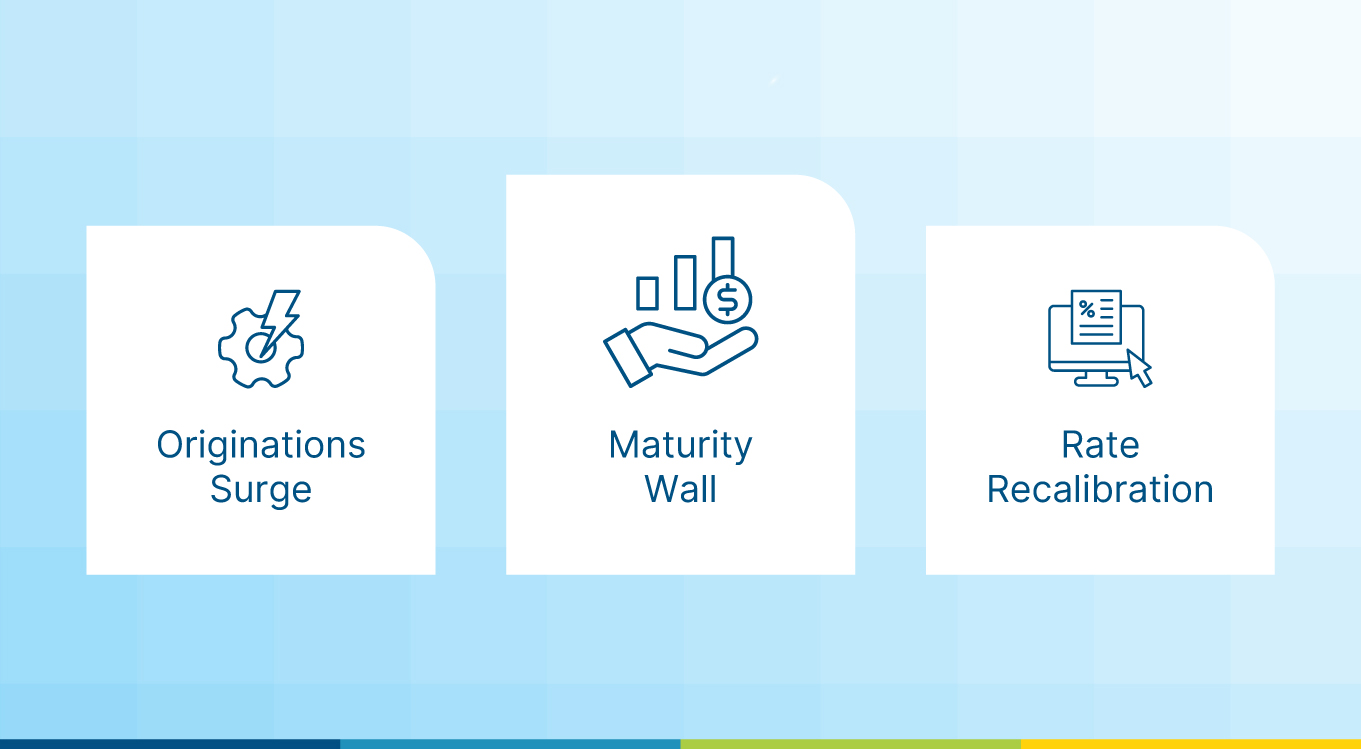
If you want to understand what 2026 means for commercial real estate lending, don't look at headlines about rate cuts. Look at your maturity calendar.
CRE lending originations surged 36% year-over-year in Q3 2025, driven by a 48% spike in refinancing activity. Office lending jumped 181%. The momentum is real, but so is the pressure.
Nearly $936 billion in CRE loans are scheduled to mature in 2026, with average refinancing rates climbing from 4.76% to 6.24%. That's not a reset. That's a structural recalibration.
The extend-and-amend playbook bought time, but it didn't solve the problem. Loans once due in 2024 and 2025 have been pushed to 2026, creating the largest maturity wave in a decade. Up to 15% of maturing loans may fail to qualify for refinancing due to insufficient debt service coverage ratios. That's billions in loans requiring restructuring, fresh capital, or workouts.
For CRE lenders, this isn't about saying yes or no to more deals. It's about having the infrastructure to assess risk accurately, move quickly on strong opportunities, and monitor exposures in real time as portfolios scale. The next phase of commercial real estate lending will reward lenders whose processes can handle complexity at scale, not just speed.
Where Legacy CRE Loan Origination Breaks Under Pressure
Commercial mortgage lending is operationally heavier than C&I or consumer lending. It requires ingestion and analysis of heterogeneous data sets—rent rolls, operating statements, appraisal reports, environmental assessments. In legacy environments, analysts manually key rent rolls into Excel to calculate Net Operating Income (NOI).
This creates three specific failure points when volume surges:
- Data Latency: Real-time credit decisions are impossible when data is stuck in static spreadsheets. When you're competing against lenders with automated data extraction and real-time credit analysis, every manual step costs deals.
- Version Control Risks: Multiple stakeholders, credit, legal, closing working from different versions of deal structures create inevitable errors in Loan-to-Value (LTV) or Debt Service Coverage Ratio (DSCR) calculations. When origination volumes spike 36% year-over-year, these errors multiply.
- Appraisal Friction: Managing bid and review processes for third-party reports outside core systems creates compliance blind spots. By the time appraisal issues surface, deals are already delayed.
Modern CRE loan origination requires automated rent roll ingestion, dynamic loan sizing based on real-time cap rate adjustments, and integrated collateral management with third-party valuation workflows. Manual spreading is the bottleneck that kills speed. Automation eliminates low-value work so underwriters can focus on analysis, not data entry.
The Handoff Problem: Where Data Degrades
The most significant operational leakage occurs during the transition from closing to servicing. In many institutions, CRE loan servicing operates on a completely different tech stack than origination.
This disconnection is costly. Complex loan structures, construction loans with multi-stage draws, participations, and cross-collateralization require seamless data continuity. If servicing teams manually rebuild loan structures in their system based on PDF credit memos, efficiency collapses and errors compound.
Lenders modified $11.2 billion in loans in a single quarter recently, with two-thirds involving maturity extensions. Servicing systems designed for steady portfolios with low modification frequency weren't built for this volatility. When servicing teams manually track payment schedules, covenant compliance, and escrow requirements across hundreds of loans, borrowers get contradictory information and compliance teams can't pull clean audit trails.
A unified commercial lending solution ensures that complex data models built during underwriting flow directly into the servicing engine without degradation. That's not just efficiency, it's risk mitigation.
CRE Lending Credit Risk as a System Outcome
Regulators are laser-focused on CRE credit risk, specifically regarding concentration limits and portfolio health. As volume increases, so does scrutiny. But most lenders only update risk assessments quarterly because their systems don't support continuous monitoring.
By the time a loan flags in your quarterly review, you've already missed early warning signals: declining occupancy, expiring rate caps, deferred maintenance. Reactive risk management in 2026 means you're always behind.
Commercial real estate risk management in 2026 demands systems that enable:
- Dynamic Stress Testing: Instantly shock portfolios by asset class (Office vs. Multi-Family) or geography to see capital reserve impacts. Borrowers underwriting deals today make assumptions about rent growth and exit cap rates that may not hold. Lenders need platforms that stress-test those assumptions dynamically.
- Automated Covenant Monitoring: If property occupancy drops, systems should trigger workflow alerts immediately—not wait for annual review. Rule-based monitoring replaces spreadsheet tracking.
- Concentration Management: Hard-coded policy limits prevent origination teams from issuing term sheets that violate portfolio caps. Risk becomes a system outcome, not a periodic exercise.
Just 9% of banks are tightening lending standards as of June 2025, down from 67.4% in April 2023. That's good news for deal flow. But it also means lenders are taking on more volume in a compressed window, with borrowers whose cash flow assumptions no longer match reality. Real-time portfolio surveillance becomes non-negotiable.
The Architecture Requirement: Cloud-Native, API-Integrated Systems
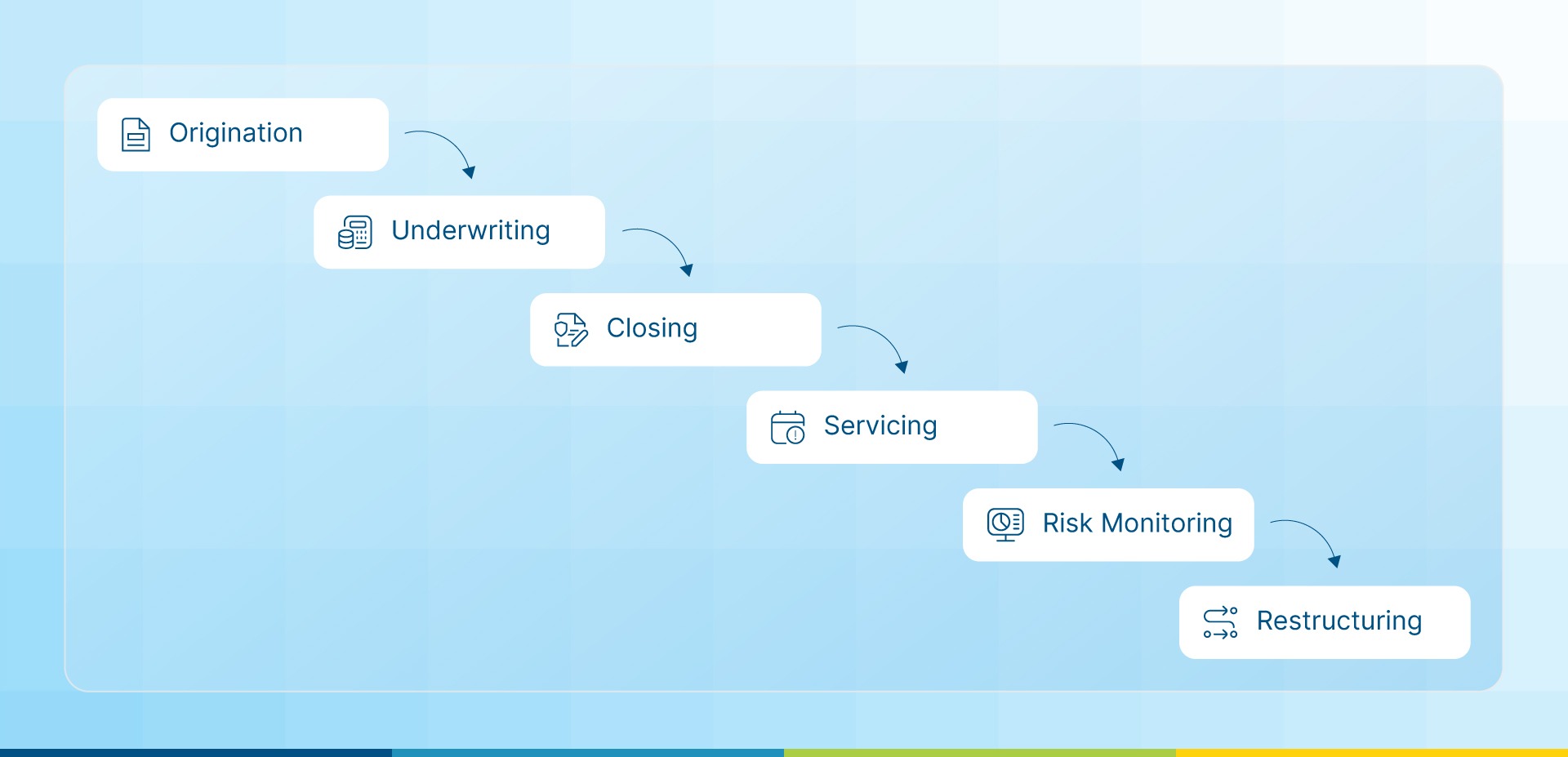
Preparing for 2026 requires a platform approach, not point solutions. To capture returning momentum in commercial property loans, lenders must adopt a data-first architecture.
This means moving from closed, on-premise servers to cloud-native ecosystems that support API integration. Your commercial lending operations should pull data from tax services, push data to core banking ledgers, and interface with valuation vendors, all within a single pane of glass.
Platforms that unify CRE loan origination, underwriting, servicing, and collections eliminate data reconciliation work and enable single-source-of-truth reporting. That's not just operational efficiency—it's the foundation for scaling without proportional headcount increases.
What Process-Ready for 2026 Actually Looks Like
Being ready for the next CRE cycle isn't about replacing everything. It's about how systems connect and govern the lifecycle.
Process-ready CRE lenders operate with:
- A single, authoritative loan record from origination to payoff
- Automated financial spreading with AI-driven data extraction
- Parallel verification workflows that don't create approval bottlenecks
- Integrated servicing with covenant monitoring and early warning systems
- Continuous credit risk visibility across the portfolio
- Portfolio-level analytics that update in real time
- Controlled handoffs into restructuring or recovery when needed
This structure absorbs complexity instead of amplifying it. Risk intelligence flows continuously from servicing back into underwriting assumptions—creating a feedback loop that improves decision quality over time.
The Infrastructure Differentiator
CRE lending momentum is returning, but the cycle ahead will not forgive operational weakness. Lenders that rely on fragmented systems will feel strain as deal flow increases. Risk will surface late. Costs will rise quietly.
The lenders winning in 2026 won't necessarily be those with the biggest balance sheets. They'll be those with the operational agility to underwrite faster, monitor smarter, and service more efficiently than competitors still running on spreadsheets and email.
Finspectra's Prizm Lending Suite was built for this moment. It unifies CRE loan origination, underwriting, servicing, and collections into a single platform—automating financial spreading, enabling real-time portfolio surveillance, and eliminating the data fragmentation that slows decisions. When refinancing volumes surge and maturity walls compress timelines, it gives lenders the infrastructure to scale without chaos.
Ready to see how modern CRE lending infrastructure handles 2026's volume and complexity? Book a demo to explore how Prizm enables automated commercial lending operations.
FAQs
- Is CRE lending expected to grow in 2026?
Yes, refinancing activity and originations are accelerating into 2026, driven by maturing loan volumes creating compressed timelines for lenders to restructure and deploy capital efficiently.
- What challenges do CRE lenders face as volumes return?
Lenders encounter data latency from manual processes, version control errors across teams, and appraisal delays that amplify when deal flow surges, eroding competitive speed.
- How should lenders prepare underwriting processes for CRE growth?
Streamline heterogeneous data ingestion like rent rolls and appraisals through automated extraction, enabling dynamic loan sizing that adapts to cap rate shifts without spreadsheet bottlenecks.
- What technology supports scalable CRE loan origination?
Cloud-native platforms with API integrations unify origination through servicing, automating financial spreading and collateral workflows to absorb volume without proportional staffing increases.
- How can CRE lenders manage risk while increasing loan volume?
Implement continuous portfolio surveillance with dynamic stress testing by asset class and automated covenant alerts, turning periodic reviews into real-time system governance.
.png)

.png)
.png)


