%201.avif)
The Hidden Operational Costs of Manual Asset Financing
.png)
To understand the real cost of manual asset financing, look at the hours analysts spend extracting data from PDFs, the days borrowers wait for approvals, and the compliance gaps hidden across fragmented systems.
The asset finance industry is growing rapidly: the leasing market is projected to grow from $2079.5 billion in 2025 to $3,291.98 billion by 2030. Yet many lenders operate with manual workflows built for a fraction of that volume.
Lenders need to find out where operational costs hide in manual asset financing, and we explain how digital platforms eliminate these drags on profitability.
Why Asset Financing Still Relies on Manual Processes
Legacy infrastructure runs deep. Many lenders built operations when loan volumes were manageable through spreadsheets. Credit teams maintained their own databases. Operations tracked assets separately. Finance reconciled manually at month-end.
Three factors keep manual processes entrenched:
System fragmentation across departments creates bottlenecks at every handoff. Asset-specific workflows for residual value calculations, maintenance schedules, and remarketing don't fit generic loan systems, so lenders patch solutions with spreadsheets. And decision-makers view digital platforms as expensive overhauls, not realizing manual processes cost more with every application.
The "Expertise Trap" compounds this inertia. Organizations rely on veteran staff whose manual oversight feels like risk protection but actually creates bottlenecks that prevent modernization.
Meanwhile, there is increasing pressure from digital competitors who process applications in hours, not days.
Where Operational Costs Actually Build Up
Manual asset financing accumulates costs where finance teams rarely track them: embedded in workflows, hidden in processing times, and buried in error cycles.
Traditional manual processing requires 7-10 days for loan turnaround. FinTech lenders process applications 20% faster. That's revenue velocity. Every delay means abandoned applications and lost deals.
As per industry benchmarks, manual invoice handling costs $12.88 per invoice, reaching $25 for complex transactions. Factor in the 3.6% error rate triggering rework cycles. A single typo in an engine serial number can trigger weeks of rework when registration documents don't match loan records.
Staff spending hours on data entry can't focus on credit analysis. Analysts toggling between platforms lose 20-30% of productive time to context switching. When errors surface, correction consumes 4-6 hours across teams.
Impact of Manual Asset Financing on Profitability
Automation can cut operational costs by up to 30%. Manual processes mean accepting inefficiency as permanent overhead.
Manual workflows inflate the Cost-to-Income (C/I) ratio, a critical banking efficiency metric. Scaling portfolio by 2x requires 2x operational headcount, which results in linear cost growth with zero leverage. Digital competitors scale logarithmically, with marginal cost per application approaching zero.
Poor asset lifecycle management creates margin erosion. When tracking insurance renewals, inspections, and valuations happens manually, lenders miss critical events. Failed repossessions or unrecovered value from depreciating assets can wipe out an entire branch's interest margin.
Every day a deal sits in processing, competitors can close it. Borrowers prioritize speed over price. Manual workflows create 7-10 day turnarounds; automated platforms deliver 24-48 hours. At that point, speed determines who keeps the borrower.
Risk and Compliance Gaps in Manual Workflows
Regulatory complexity is intensifying. IFRS 16 requires all leases to be on the balance sheet with complete documentation. The detailed measurement and disclosure rules have pushed many companies in markets such as Australia and Europe to overhaul lease identification, systems, and controls to avoid misclassification and reporting errors. In the United States, the similar ASC 842 standard closes many of the gaps that once allowed large operating leases to remain off-balance sheet, further tightening global comparability of lease obligations.
When data lives across email chains, spreadsheets, and disconnected systems, assembling audit trails becomes archaeological work. Manual Basel III risk-weighting calculations introduce errors. A miscalculation on a $50 million portfolio creates material capital misstatements. IFRS 16 compliance requires capturing every lease contract and maintaining records over time. Manual tracking creates compliance exposure.
Spreadsheets emailed between departments create data breach vulnerabilities, but modern platforms enforce role-based access and audit logs that manual processes can't replicate.
What Digital Asset Financing Looks Like
Modern asset financing lending software unifies origination, credit decisioning, asset management, and servicing in a single system.
Borrower information, credit scores, asset details, payment histories, and compliance documentation flow into one unified data layer. OCR and machine learning extract data from financial statements. What requires hours of reconciliation happens in minutes. Processing speed can scale up to 10 times faster with 98% error reduction.
Credit models run automated checks and surface recommendations instantly. Algorithmic underwriting applies knock-out criteria that automatically reject non-compliant applications, allowing underwriters to focus on complex cases. Straight-Through Processing (STP) handles standard assets from application to disbursement with zero human intervention.
Platforms track complete asset lifecycles: acquisition through disposal, maintenance schedules, insurance renewals, and residual values. Automated alerts trigger when maintenance is due or insurance lapses. Built-in compliance monitoring tracks regulations and maintains audit-ready documentation. This is lending intelligence: clear answers, complete visibility.
How Automation Reduces Operational Costs
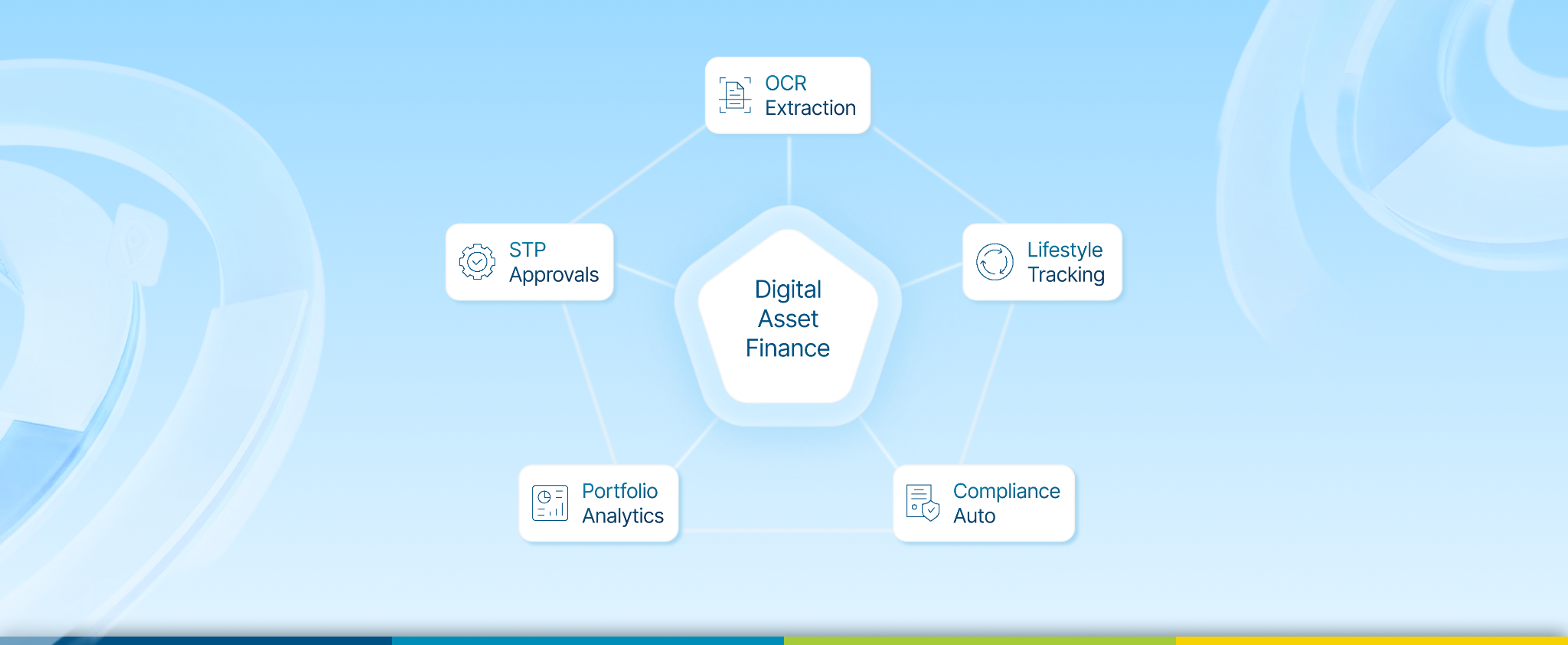
Reducing manual data entry by 70% frees staff for higher-value work. A team of 10 operating at 30% higher efficiency effectively adds three employees without hiring. Cutting invoice errors from 3.6% to near-zero eliminates rework cycles and compliance exposure.
Shrinking processing from 7-10 days to 24-48 hours means 5-8 more days of interest income per loan. Digital platforms handle 10x volume without proportional cost increases. Automated audit trails cut compliance preparation by 60-80%. Real-time analytics identify underperforming segments immediately, improving yield and reducing losses.
Business Benefits of Modern Asset Financing Systems
Beyond cost reduction, digital platforms enable strategic advantages. Delivering 24-48 hour turnarounds has become a competitive survival. Lenders at 7-10 days lose deals before they realize they're competing.
Dealer partnership advantage creates sustainable deal flow. Dealers and vendors originate most asset finance transactions and prefer lenders offering quick approvals. Digital portals for document upload and real-time payout tracking transform lenders into preferred partners, securing deal flow competitors can't access.
Real-time portfolio monitoring surfaces deterioration early. Predictive analytics identify which borrowers need proactive outreach before delinquency. Complete audit trails make regulatory examinations routine. Modern platforms scale elastically, whether processing 100 or 10,000 monthly applications; growth doesn't require proportional operational expansion.
Platforms like Finspectra Prizm Lending Suite connect workflows, credit decisioning, asset tracking, and servicing for asset finance complexity, processing more volume with better risk management at lower cost.
How Lenders Can Move Away from Manual Processes
Start with the highest-pain workflows: application intake, credit decisioning, or payment reconciliation. Quick wins build momentum. Clean up data first: deduplicate records and standardize classifications. Modern platforms integrate via APIs for a reliable connection with third-party systems.
Train teams with hands-on support. Frame automation as empowering staff, not replacing them. Show how eliminating data entry allows focus on portfolio analysis and relationship management. Track KPIs: turnaround time, error rates, labor hours per loan.
Partner with specialists who understand equipment leasing to automate complete asset financing workflows with ease.
Conclusion
Manual asset financing does not fail overnight. Costs accumulate quietly through slower processing, higher error rates, duplicated effort, and fragile compliance controls. As asset finance portfolios grow, these weaknesses stop being operational inconveniences and start becoming structural constraints on profitability.
The takeaway is simple. Scale exposes systems. Lenders who rely on manual workflows absorb rising costs as permanent overhead. Those who modernize operations turn speed, control, and compliance into durable advantages.
Reduce the operational drag in asset financing. Get in touch with Finspectra to scale without linear cost growth.
FAQs
- How does manual asset financing affect loan turnaround time?
Manual processing typically requires 7-10 days for loan approvals due to document review, data entry, and cross-system reconciliation. Automated platforms reduce this to 24-48 hours by eliminating manual handoffs and enabling real-time credit decisions, allowing lenders to close more deals faster.
- Can small lenders afford to automate asset financing?
Yes, small lenders can use modern lending solutions to automate asset financing. Modern cloud-based platforms offer subscription pricing that scales with volume, eliminating large upfront investments. The ROI typically appears within 6-12 months through reduced labor costs, faster processing, and fewer errors, making automation financially accessible even for smaller operations.
- What compliance risks exist in manual asset financing?
Manual workflows create audit trail gaps, calculation errors in Basel III risk-weighting, IFRS 16 lease accounting inconsistencies, and data security vulnerabilities. These expose lenders to regulatory findings, capital misstatements, and potential fines that automated compliance monitoring prevents.
- How do digital systems reduce asset finance errors?
Automated data extraction via OCR eliminates manual entry mistakes. Built-in validation rules catch errors before they propagate. Real-time calculations ensure consistency across systems. Studies show automation reduces reconciliation errors by 98% compared to manual processes.
- What KPIs show operational inefficiency in asset financing?
Some of the KPIs that show operational inefficiency in asset financing are cost per loan disbursed (total operational spend divided by number of loans), application-to-disbursement conversion ratio, percentage of files requiring rework, and relationship manager productivity (active cases per RM). High costs, low conversion rates, and frequent rework signal manual friction requiring automation.
.png)

.png)
.png)


