%201.avif)
How Intelligent Lending Is Transforming Modern Lending Operations
Ask any fintech or SME lender what their day looks like, and you’ll get the same tired laugh.
The kind that says: “We survived… barely.”
One team is chasing documents across five systems. Another is rebuilding the same portfolio report for the fourth time this month. Someone in collections is manually drafting follow-up emails. And the COO is staring at numbers that were outdated before they even loaded.
According to McKinsey, a significant percentage of lending operations effort today is still tied to manual processes — processes that break, delay decisions, and quietly bleed money.
This is the backdrop of modern lending.
Complex. Fast-moving. High stakes.
And way too dependent on teams doing heroic work just to keep the engine running.
But a shift is happening, a move from reactive operations to what the industry is starting to call intelligent lending: decision-making powered by clarity, automation, and real-time data instead of guesswork and fragmented systems.
This isn’t about speed for speed’s sake.
It’s about operating with precision in an environment where uncertainty is expensive. Below is the blueprint of how intelligent lending is reshaping modern lending operations — one layer of intelligence at a time.
End-to-End Portfolio Visibility: Seeing the Whole Picture, Not Just the Parts
Most lenders don’t have a portfolio problem.
They have a portfolio visibility problem. Origination data lives in one platform. Servicing details live in another. Collections is its own island entirely.
By the time leadership stitches everything together, patterns are missed, risk signals are stale, and everyone is making “informed guesses” instead of real decisions.
Intelligent lending changes that. It brings everything into one unified view — every account, every stage, every product, in real time.
This level of visibility does three things instantly:
- Exposes risk concentrations early
- Reveals repayment behavior as it evolves
- Gives lenders a live pulse on exposure, performance, and product health
This isn’t reporting. This is clarity — the foundation of every transformation that follows.
(And if lenders want to understand how digital lending reshaped this shift, they’ll naturally gravitate to earlier resources like How Is Digital Lending Changing the Way Lenders Operate?)
Automated, Configurable Workflows: Where Intelligence Starts Doing the Work
If visibility is the brain, automated workflows are the muscle.
Most lending operations are an unpredictable mix of: 70% automation, 30% “Can you approve this real quick?” And that 30% is where delays, errors, and compliance headaches are born.
Intelligent lending replaces manual bottlenecks with automated, configurable workflows that adapt to each lender’s risk appetite, product rules, and compliance needs.
Think:
- Instant credit decisioning based on real-time risk profiles
- Automated reminders and repayment nudges personalized by borrower segment
- Built-in compliance checks that run in the background
- Pre-configured workflows that eliminate back-and-forth
Automation isn’t about going faster but about redefining the steps. It’s about operating with precision — consistency at scale without adding headcount or risk.
Configurable Product Analytics: No More “Launch and Hope” Lending Products
Lending products often outlive the assumptions they were built on. Markets shift. Borrowers change. Regulations get rewritten. But most lenders only refresh products when something breaks.
Intelligent lending makes product innovation a continuous, controlled process:
- Loan stages become configurable
- Repayment schedules become tailored
- Pricing or eligibility tweaks can be tested and measured
- Performance dashboards reveal what’s working — and what’s not
Instead of launching and hoping, product teams can refine, experiment, and adapt in real time.It’s agility without chaos. Innovation without blowing up the tech stack.
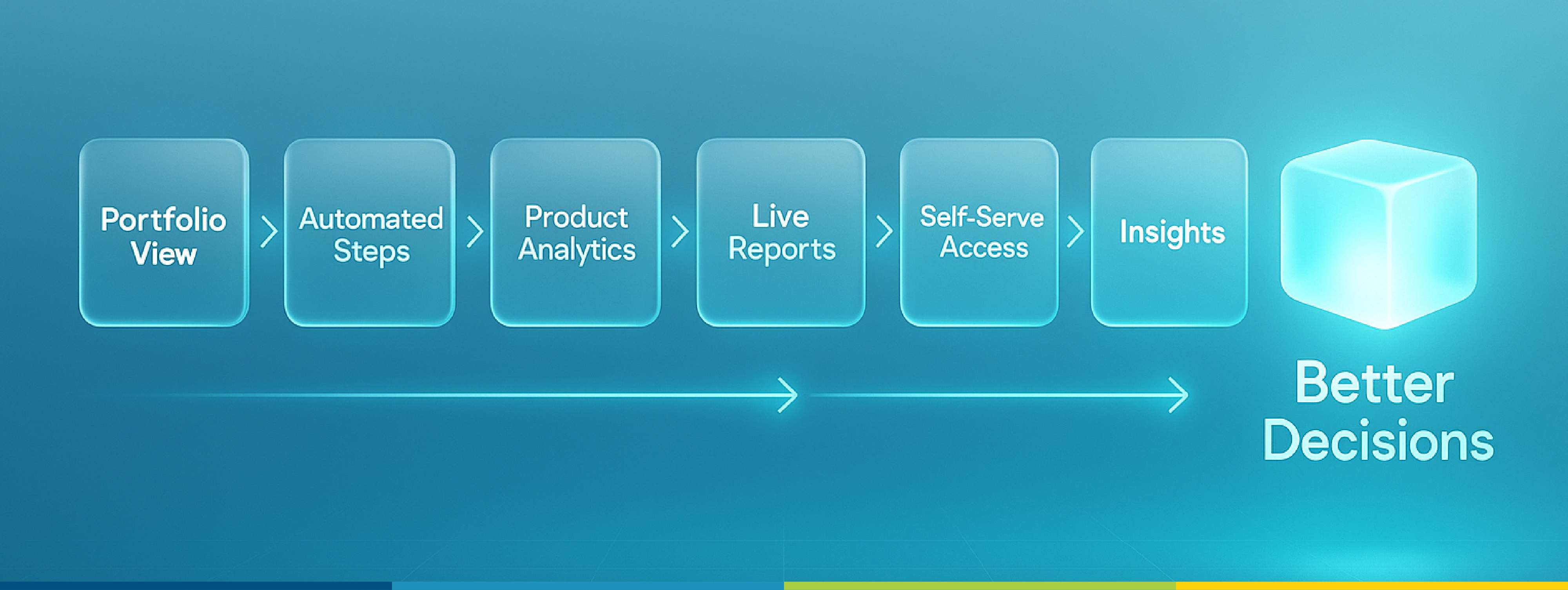
Portfolio Reporting: A Single Source of Truth for Today, Not Last Month
Here’s a simple truth: You can’t run a high-velocity lending business on end-of-month summaries.
Yet that’s how many lenders still operate. Intelligent lending transforms reporting into a real-time capability:
- Live outstanding amounts
- Segment-level delinquency trends
- Exposure by product
- Current risk signals
- Operational bottlenecks surfaced instantly
Teams no longer wait for spreadsheets. Underwriters, compliance officers, and leadership operate from the same live dataset — not interpretations of it. In modern lending operations, this kind of alignment isn’t just helpful. It’s non-negotiable.
Self-Serve Data Accessibility: Transparency That Builds Trust (and Cuts Support Tickets)
Borrowers don’t want to call support. Brokers don’t want to chase information. Teams don’t want to spend hours answering basic questions.
Intelligent lending extends internal clarity outward through self-serve access:
- Borrowers can view repayment schedules, statements, and performance
- Brokers can track applications and portfolio updates
- Notifications reduce ambiguity and improve engagement
Transparency is quickly becoming a competitive advantage.
It builds trust, reduces friction, and makes servicing smoother and more reliable.
This is also where modern lending operations intersect with borrower experience — a theme explored in our resource The Complete Guide to Digital Lending Solutions Across Industries, which touches on this shift in user expectations.
Actionable Insights & Intelligence in Action: From Reporting to Readiness
This is where everything comes together. When lenders can see clearly, act automatically, adapt products, and share data transparently…
They unlock the final layer of intelligent lending: actionable insights. Not predictions but precision signals that matter now:
- Early warnings for potential delinquencies
- Cash-flow forecasting grounded in real repayment behavior
- Product-level performance trends
- Operational bottlenecks surfaced automatically
- Real-time triggers for fee waivers, offers, nudges, or interventions
AI agents even make operations conversational.
Ask the system:
“Show outstanding balance by product” → You get it instantly.
“Trigger a reminder for this borrower” → Done.
“Check exposure for SME unsecured loans” → It’s there.
This is intelligence in motion — the system helping teams act, not just observe.
Why This Matters for You
Banks can afford inefficiency. They can hide behind layers of legacy systems and slow decision cycles.
Fintech and SME lenders? They live in the deep end of competing on speed, clarity, trust, and customer experience.
Intelligent lending gives them:
- The operational efficiency of a much larger institution
- The precision needed to scale without increasing risk
- The transparency borrowers expect today
- The resilience lenders need when markets shift
In a crowded ecosystem, it’s no longer enough to move fast.
You need to move fast without losing control.
That’s what intelligent lending unlocks.
The Future of Modern Lending Operations
Within a few years, intelligent lending won’t be innovative.
It’ll be expected.
Real-time visibility.
Automated workflows.
Configurable products.
Unified reporting.
Transparent borrower experiences.
Actionable operational intelligence.
This is the new baseline.
Fintechs and SME lenders that build on this foundation will run tighter, smarter, more resilient operations than those still managing through intuition and spreadsheets.
The future belongs to lenders who treat intelligence as infrastructure — not an add-on. Speak to our experts at Finspectra to learn more.
Conclusion
Modern lending can’t scale on manual workflows, siloed systems, or lagging data.
Intelligent lending turns raw information into clarity, clarity into action, and action into resilience.
Lenders who embrace this shift will grow faster, operate cleaner, and build deeper trust — without inviting fragility. If you’re rethinking your lending stack, start by rethinking the intelligence behind it.
FAQs
1. What is intelligent lending?
Intelligent lending means using real-time data, automation, and simple decision rules to run lending operations with more clarity, speed, and accuracy.
2. How does intelligent lending improve daily operations?
It removes manual work, connects scattered data, and helps teams make faster, more confident decisions across origination, servicing, and collections.
3. Why are data silos a problem for lenders?
When information is split across multiple systems, lenders get incomplete or outdated insights — leading to delays, risk blind spots, and inconsistent decisions.
4. What are the main components of intelligent lending?
Clear portfolio visibility, automated workflows, configurable products, live reporting, self-serve access for customers, and simple, actionable insights.
5. Can fintech and SME lenders adopt intelligent lending without disrupting operations?
Yes — modern platforms let lenders upgrade step-by-step, integrating with existing tools and improving processes without stopping daily operations.
.png)

.png)
.png)


