%201.avif)
Why Commercial Lending Breaks at Scale and How Modern Systems Fix the Gaps
.png)
Most commercial lenders hit a wall not because they lack capital or market opportunity, but because their infrastructure can't keep up. Legacy systems built for relationship banking now face transaction volumes, regulatory complexity, and risk exposure they were never designed to handle. According to McKinsey, origination costs have increase by 8% in 2023, in 10 years, but efficient lenders were able to cut down that cost by 60% by streamlining and simplifying the process using modern systems.
As commercial lending shifts from relationship-driven processes to platform-based operations, the systems that got you here won't get you there. Let’s find out where traditional commercial lending systems fail at scale, what modern platforms do differently, and what to look for when your growth depends on infrastructure that won't buckle under pressure.
Why Commercial Lending Becomes Fragile at Scale
Commercial lending differs fundamentally from retail lending. Deal sizes vary wildly, from $50K equipment loans to $50M working capital facilities. Each transaction involves multiple stakeholders: borrowers, guarantors, third-party valuers, credit committees, and legal teams. Collateral is complex: real estate, inventory, receivables, equipment, and IP. Covenants require ongoing monitoring. Risk assessment depends on business performance, not just credit scores.
This complexity is manageable in low volumes. Problems emerge when volume increases without infrastructure evolution.
Commercial lending faces tighter scrutiny post-financial crisis. Anti-money laundering checks, beneficial ownership verification, environmental risk assessment, and industry-specific compliance requirements all demand documented trails.
As portfolios grow, hidden correlations emerge. Geographic concentration. Industry exposure. Interconnected guarantor networks. Legacy systems lack real-time portfolio visibility, making concentration risk invisible until it materializes. A single economic shock can cascade through what appeared to be diversified exposures.
Together, these forces create a breaking point where manual workarounds stop working, and growth becomes operationally dangerous.
Where Traditional Commercial Lending Systems Fail
Most commercial lenders operate on infrastructure cobbled together over decades: a core banking system for accounts, separate origination software, Excel for credit analysis, email for documentation, and manual processes for monitoring. These components never communicate properly.
Legacy systems encode processes from a different era. They assume linear workflows: application → credit → approval → disbursement → monitoring. Real commercial lending rarely follows this path.
Each stage transition requires human intervention. Every handoff risks delay, error, and information loss. At low volumes, this feels like thoroughness. At scale, it's chaos.
Executives need portfolio-level insights: sector exposure, covenant compliance rates, early warning indicators, pipeline conversion metrics. Legacy systems provide loan-level data but lack aggregation logic. Reporting becomes a monthly exercise in manual data extraction and spreadsheet consolidation, producing insights too late to act on.
Operational and Risk Impact of Scaling Issues
These system failures aren't abstract problems. They manifest as measurable operational drag and risk exposure.
Processing time balloons. A deal taking five days at low volume requires three weeks at scale due to coordination overhead and queue management. Turnaround time becomes a competitive disadvantage.
Error rates climb. Manual data entry across disconnected systems introduces mistakes. A miskeyed collateral value or missed covenant triggers cascading issues. Industry data shows error rates double when transaction volumes increase 10x without system upgrades.
Staff scaling becomes non-linear. Adding capacity requires more than headcount—you need coordinators, supervisors, and quality control layers. Revenue per employee drops while cost per deal rises.
Compliance gaps widen. Audit trails fragment across systems. Proving regulatory compliance requires forensic reconstruction rather than system-generated evidence. This limits growth options when regulators question operational controls.
Concentration risk goes undetected. Without real-time portfolio analytics, you can't spot interconnected exposures until collection issues surface. By then, provision requirements spike and capital ratios suffer.
Recovery costs multiply. When defaults occur, fragmented information slows remediation. Finding collateral documentation, understanding guarantee structures, and coordinating recovery actions takes weeks instead of hours.
The hidden cost? Strategic paralysis. Lenders avoid new products, markets, or partnerships because existing systems can't handle additional complexity. Growth becomes too operationally risky.
What Modern Commercial Lending Systems Do Differently
Modern commercial lending platforms address fragmentation, rigidity, and opacity through architectural principles that traditional systems can't retrofit.
- Unified data architecture: Every data point, such as customer information, financial analysis, collateral details, covenant terms, and payment history, exists in a single system of record. Credit teams see the complete borrower context instantly. Compliance audits pull complete trails automatically. Reporting aggregates real-time data without reconciliation.
- Configurable workflows: Digital platforms separate process logic from system code. Business users configure workflows using visual designers, not development sprints.
- API-first integration: Modern platforms expose all functionality through APIs, enabling integration with accounting systems, credit bureaus, valuation services, document management, and core banking. Data flows automatically between systems.
- Real-time analytics: Portfolio dashboards update continuously. Risk managers see concentration exposure by geography, industry, and borrower group in real-time. Collection teams identify early warning signals like covenant violations, payment delays, and financial deterioration as they emerge. Pipeline analytics show conversion rates, approval timing, and bottleneck stages.
This is what lending intelligence looks like when it's working: clear answers, zero guesswork, actionable insights when decisions matter.
How Digital Platforms Fix Commercial Lending Gaps
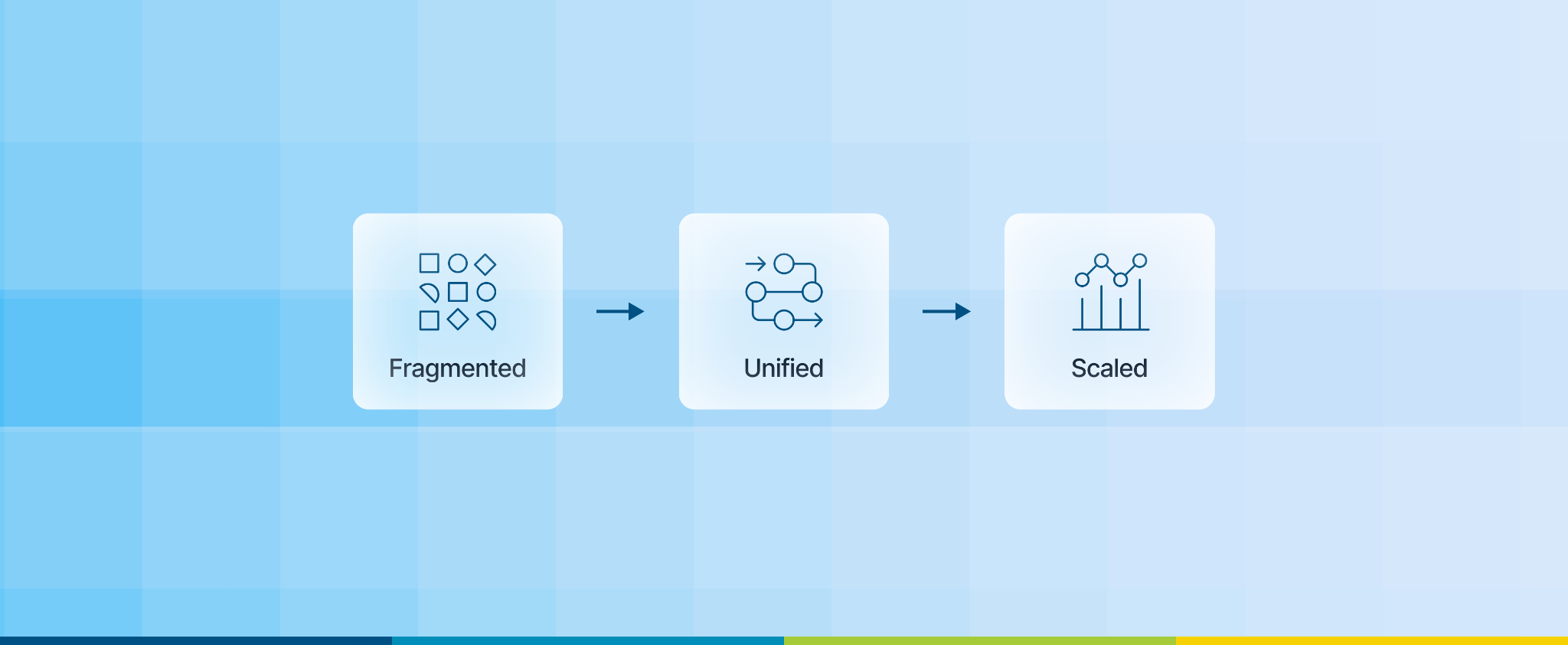
Modern platforms deliver specific operational improvements.
End-to-end commercial lending platforms reduce deal processing time by 40-60%. Automated data gathering eliminates manual searches. Workflow orchestration removes handoff delays. Straight-through processing handles standard deals without intervention. Credit teams analyze rather than gather. Operations execute rather than coordinate.
Real-time portfolio monitoring surfaces issues before they become problems. Automated covenant tracking flags breaches immediately. Financial spreading integrates borrower-submitted data into risk models. Concentration reports highlight correlated exposures. Early warning systems identify deteriorating accounts based on payment patterns, financial trends, and external signals.
Document checklists enforce completeness. Digital signatures maintain legal validity with audit trails. Regulatory reporting pulls required data automatically. Role-based access controls limit information exposure. Activity logs track every system action for audit purposes.
Digital platforms handle volume growth without proportional cost increases. The same system processes 100 deals or 10,000 deals with identical efficiency.
Platform efficiency enables faster responses, clearer communication, and more reliable execution, which can be a competitive advantage in commercial markets where relationship still matters.
Business Benefits of Modern Commercial Lending Technology
The operational improvements translate to measurable business outcomes.
- Cost reduction: Automation eliminates repetitive tasks. Workflow efficiency reduces processing time. System integration removes reconciliation overhead. Lenders report 30-50% reductions in operational costs per deal after platform modernization.
- Revenue growth: Faster processing increases deal flow capacity. Better risk management supports portfolio expansion. Product flexibility enables new offerings. Lenders handle higher volumes without proportional staff increases, improving profitability.
- Risk mitigation: Real-time monitoring reduces portfolio losses. Automated compliance limits regulatory exposure. Better data supports smarter credit decisions. Early intervention minimizes default impact.
- Strategic flexibility: Modern platforms support new business models: marketplace lending partnerships, embedded finance offerings, sector specialization, geographic expansion. You can pursue opportunities that legacy systems made operationally impossible.
- Capital efficiency: Better portfolio management reduces provision requirements. Lower operational risk supports favorable capital treatment. Improved analytics enable optimized capital allocation across exposures.
What to Look for in a Scalable Commercial Lending System
Not all digital platforms deliver equal scalability. Effective commercial lending technology requires specific capabilities.
Business users must modify workflows, create new products, and adjust rules without developer intervention. If changes require release cycles, the platform can't adapt to market demands.
The system must aggregate deal-level data into portfolio insights automatically. Concentration reports, covenant compliance dashboards, early warning indicators, and pipeline analytics should refresh continuously without manual data extraction.
Every action, such as data changes, approvals, document access, and workflow decisions, must generate time-stamped, user-attributed logs. Regulatory compliance depends on proving what happened when and why.
Open APIs should enable connections to credit bureaus, accounting systems, core banking, document repositories, and valuation services. Pre-built connectors accelerate implementation, but custom integration capability ensures future flexibility.
Commercial lending involves exceptions. The platform must accommodate off-standard deals without breaking workflows: non-standard collateral, unusual structures, complex guarantees, and manual overrides with documented justification.
Different users need different access: credit analysts see financials but not pricing; operations teams handle documentation but not credit decisions; executives view portfolios but not individual customer details. Granular permissions enforce segregation while enabling collaboration.
Cloud-native platforms handle volume growth through horizontal scaling. Processing 10x volume shouldn't require infrastructure redesign or performance degradation.
This is where platforms like Finspectra stand out. Prizm's commercial lending capabilities deliver unified data models, configurable workflows, and real-time portfolio analytics specifically designed for volume and complexity. The platform handles everything from origination through monitoring without forcing deals through rigid processes.
Future of Commercial Lending at Scale
Several trends will amplify the importance of scalable infrastructure.
Commercial banking increasingly connects with ERP systems, accounting platforms, and industry-specific software. Lenders providing capital through embedded channels need APIs that support instant decisioning, automated servicing, and real-time monitoring without manual intervention.
Machine learning models analyze alternative data, identify risk patterns, and recommend terms. Effective implementation requires clean, structured data from unified platforms, something legacy systems can't provide.
ESG reporting, climate risk assessment, beneficial ownership verification, and sector-specific rules continue expanding. Compliance automation becomes a competitive necessity rather than a nice-to-have feature.
As commercial lenders pursue capital markets funding, pool analytics, performance tracking, and investor reporting require system-generated data, not manually assembled reports.
Modern commercial lending demands modern infrastructure. The systems that handled relationship banking can't support transaction-based, regulation-intensive, data-driven operations at scale.
Conclusion
Commercial lending breaks at scale because traditional systems fragment data, rigidify workflows, and obscure risks. Modern commercial lending platforms fix these gaps through unified data, configurable workflows, automated compliance, and real-time analytics. They make growth operationally sustainable and risk-manageable.
Finspectra's Prizm Lending Suite delivers commercial lending infrastructure built for scale: end-to-end workflow automation, portfolio-level intelligence, and integration flexibility that supports volume growth without operational breakdown.
Book a demo to explore how Prizm enables scalable commercial lending operations.
FAQs
- Can commercial lending systems handle high transaction volumes reliably?
Yes, modern cloud-based commercial lending platforms scale horizontally to handle volume increases without performance degradation. Unlike legacy systems that require infrastructure upgrades, digital platforms process 100 or 10,000 deals with identical efficiency through automated workflows and unified data architecture.
- How do modern systems reduce operational risk in commercial lending?
Modern systems reduce operational risk in commercial lending with a unified platform that offers end-to-end lending intelligence. Real-time portfolio monitoring surfaces covenant breaches, concentration exposure, and early warning signals immediately. Automated compliance tracking maintains audit trails, while unified data eliminates reconciliation errors. These capabilities reduce portfolio losses and regulatory exposure compared to manual processes.
- Are cloud platforms better for commercial lending scalability?
Yes, cloud infrastructure eliminates capacity planning constraints and enables instant scaling. Security concerns have largely resolved—major cloud providers meet banking regulatory requirements. Cloud platforms also support remote teams and API integrations that on-premise systems struggle to accommodate efficiently.
- How long does it take to modernize commercial lending systems?
Implementation timelines vary based on portfolio complexity and integration requirements. Typical deployments range from 3-6 months for core functionality. Phased approaches start with origination or monitoring modules before expanding. Data migration and workflow configuration drive the timeline more than technology deployment.
- What KPIs indicate commercial lending scalability issues?
Watch processing time per deal increasing with volume, error rates climbing, staff-to-deal ratios rising, and turnaround time degrading. Portfolio reporting delays, compliance documentation gaps, and credit team time spent gathering data versus analyzing also signal infrastructure limitations requiring platform modernization.
.png)

.png)
.png)


