%201.avif)
Consumer Lending Explained: Key Features, Benefits & Implementation for Modern Lenders
.png)
A customer applies for a $15,000 personal loan at 9:47 AM. By 9:52 AM, they've received conditional approval, personalized rate options, and a digital agreement ready to sign. Funds hit their account the next business day.
Not a fintech unicorn. Not a niche direct lender. A regional bank in Ohio.
This is consumer lending in 2026, and if your institution still measures loan decisions in days instead of minutes, you're not just behind. You're invisible to the customers you're trying to reach.
Here's the uncomfortable truth: The consumer lending market isn't slowing down to let legacy systems catch up. In Australia, outstanding private credit reached AUD $40 billion in 2024. The US personal loans market is forecast to reach around USD 1,521.91 billion by 2024, highlighting strong ongoing demand for unsecured consumer credit. These aren't customers willing to wait three weeks for a loan decision while you manually verify income documents.
Here, we break down what modern consumer lending actually looks like: the systems driving instant decisions, the features separating leaders from laggards, and what lenders need to compete when "fast enough" is no longer enough.
What Is Consumer Lending?
Consumer lending is the practice of extending credit to individuals for personal, household, or family purposes. This includes personal loans, auto loans, credit cards, student loans, and point-of-sale financing.
There was a time when consumer lending meant three things: a branch visit, a credit check, and a handshake. Then digital banking happened. Then mobile-first customers happened. And suddenly, consumer lending went from a weeks-long manual process to a minutes-long automated one.
Modern consumer lending is built on speed, data precision, and seamless digital experiences. It's not just about saying "yes" or "no" faster; it's about making smarter decisions with more data, delivering personalized offers in real time, and managing the entire loan lifecycle without customers ever stepping into a branch.
The shift matters because consumer expectations have changed permanently.
McKinsey’s recent research shows that customers now spend most of their financial lives on digital and mobile channels, and they expect banking experiences to match that pace. People want interactions that are instant, personalized, and friction-free. They don’t want to be saddled with long, paper-heavy processes. Banks that fall short risk losing relevance to faster, more digitally native competitors.
Those expectations apply across every consumer lending product, even though each one operates very differently in practice.
Types of Consumer Lending Products
Consumer lending isn't a monolith. Different products serve different needs and require different operational approaches.
Personal Loans are unsecured, fixed-term loans for debt consolidation, home improvement, or major purchases. It’s a fast-growing segment driven by digital origination and embedded finance models.
Auto Loans are secured loans for vehicle purchases. These require integration with dealer networks, real-time valuation data, and title management workflows.
Credit Cards support revolving credit lines. These are complex to manage due to ongoing credit monitoring, interest calculations, and fraud detection requirements.
Education financing through student loans comes with unique regulatory requirements, deferment options, and income-driven repayment structures.
Buy now, pay later models are commonly embedded at checkout. Lenders offering these must enable instant decisioning, merchant integrations, and seamless UX.
Each product type demands different underwriting logic, risk models, servicing workflows, and compliance controls. The best consumer lending platforms don't force lenders to pick one; they support the full product mix within a unified system.
How the Consumer Lending Process Works
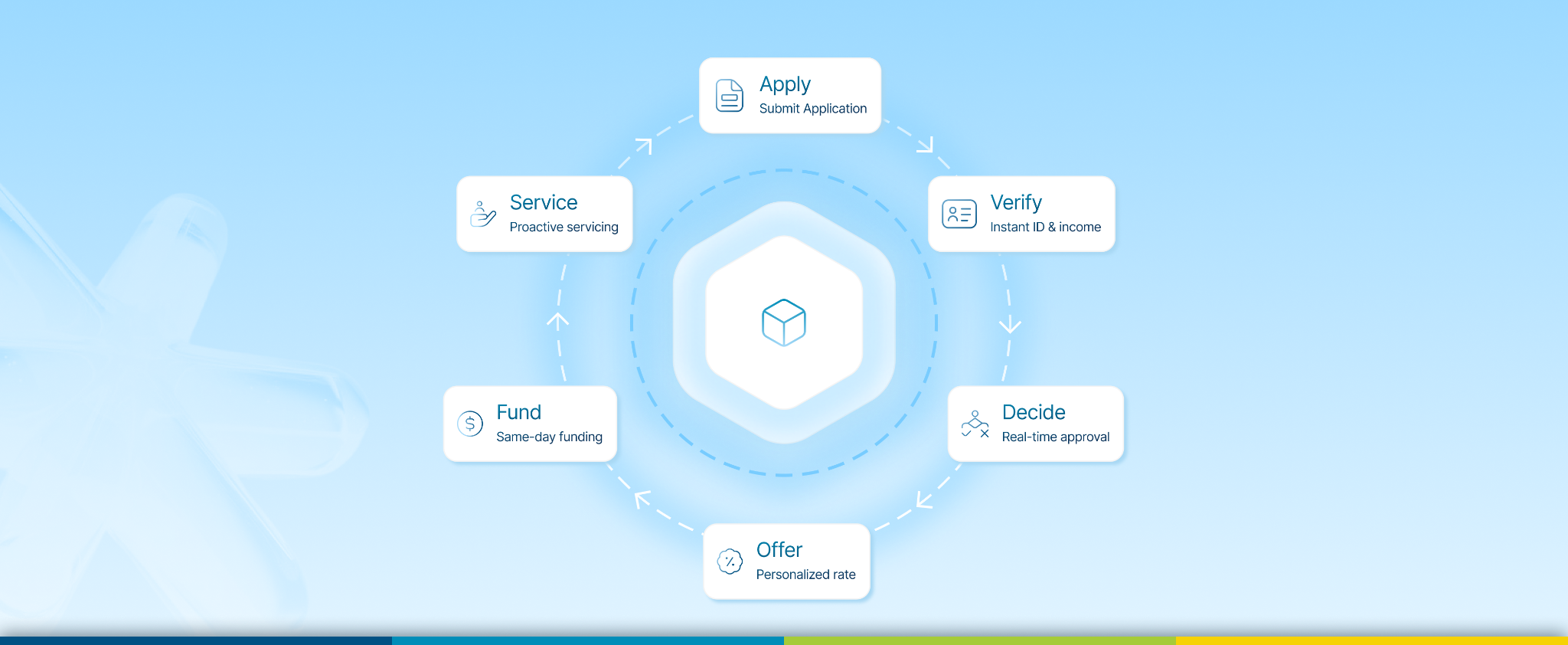
Modern consumer lending compresses what used to take weeks into minutes. Here's how:
Customer submits application via web, mobile, or embedded widget. Best systems prefill data, validate in real time, and surface errors instantly, eliminating back-and-forth.
Automated identity checks pull credit bureau data, verify income through open banking integrations, and cross-reference against fraud databases. No manual document chase.
Rules engines evaluate creditworthiness using credit scores, debt-to-income ratios, cash flow analysis, and custom risk models. Decision returned in seconds, not days.
System calculates personalized rates based on risk tier, regulatory constraints, and competitive positioning. Customer sees tailored offer, not generic rate sheet.
Loan agreements, disclosures, and terms auto-populate. Customer signs digitally, and compliance audit trails are captured automatically.
Approved loan triggers automated funding workflows, direct deposit, wire transfer, or merchant payment. Typically, same-day or next-day disbursal is possible for quick personal loans.
Automated payment processing, proactive communication, and early delinquency interventions are managed through integrated servicing modules.
When these stages are connected end to end, you get what modern consumer lending is supposed to deliver: instant clarity for customers, zero manual handoffs for staff, and real-time visibility for risk teams.
Delivering this kind of speed and consistency requires more than automation. It depends on the capabilities built into the lending platform itself.
Key Features of Modern Consumer Lending Systems
Not all consumer lending software is built the same. Here's what separates modern platforms from digitized legacy systems:
- Instant Decisioning Engines: Real-time credit evaluation using multi-bureau data, alternative credit scoring, and machine learning models delivers approve/deny/counter-offer decisions in under 30 seconds.
- Open Banking & Data Aggregation: Direct integrations with bank accounts, payroll systems, and financial data providers eliminate document uploads and manual income verification.
- Configurable Product & Pricing Logic: No-code tools to define loan products, underwriting rules, rate tables, and fee structures enable rapid product launches without IT dependency.
- Omnichannel Origination: Unified application flow across web, mobile, call center, and partner channels allows customers to start on mobile, finish on desktop without any data loss.
- Automated Compliance & Audit Trails: Built-in controls for TILA, ECOA, Fair Lending, and state-specific regulations ensure every decision, communication, and document change is logged automatically.
- Embedded Analytics & Reporting: Real-time dashboards show approval rates, portfolio performance, channel effectiveness, and risk trends instantly. No waiting for quarterly reports.
- API-First Architecture: Modern consumer lending solutions expose APIs for third-party integrations with credit bureaus, fraud tools, core banking systems, and fintech partners.
Together, these features create lending intelligence: a connected decision layer that unifies data, automation, and insights across the entire operation. This is what separates platforms that digitize old processes from those built for modern lending from the ground up.
When these features work together, the impact goes beyond faster approvals. They reshape the economics of consumer lending.
Benefits of Digital Consumer Lending for Lenders
Switching from manual, branch-dependent processes to digital consumer lending platforms is not just about keeping up. It fundamentally changes lending economics.
Faster time to funding reduces loan turnaround from days to hours. This leads to higher conversion rates, lower application abandonment, and more volume handled per underwriter.
Lower cost per loan comes from automation that removes 60–80% of manual touchpoints. With fewer staff hours required per loan, lenders can scale originations without scaling headcount.
Better risk management emerges through real-time data and advanced credit models that surface risks traditional methods miss. This improves portfolio performance and helps reduce default rates.
Improved customer experience follows from instant approvals, personalized offers, and mobile-first interfaces that align with customer expectations. Higher satisfaction drives stronger retention and more referrals.
Regulatory confidence improves through automated compliance controls and complete audit trails. These features reduce exam findings, fair lending risk, and the burden of manual oversight.
The best part? You don't have to be a fintech to deliver fintech-grade experiences. Modern consumer lending platforms bring enterprise-grade capabilities to lenders of all sizes.
For more details on consumer loan management systems, explore our loan management system guide.
The contrast becomes clearer when you look at what traditional consumer lending still struggles with.
Challenges in Traditional Consumer Lending
If you still rely on legacy consumer lending systems, the impact shows up every day. Manual underwriting creates bottlenecks because underwriters spend hours chasing documents, reconciling data, and entering information by hand. Each delay increases the risk of losing customers to faster competitors.
Fragmented systems make the problem worse. Origination sits in one system, servicing in another, and collections in a third. This setup forces duplicate data entry, creates reconciliation issues, and removes any real end-to-end visibility across the loan lifecycle.
Compliance exposure rises when processes remain manual. Documentation gaps, inconsistent decision-making, and incomplete audit trails turn every regulatory exam into a risk event rather than a routine check.
The customer experience suffers as well. Multi-day approval timelines, repeated requests for the same information, and unclear status updates frustrate applicants. Many abandon the process or move to another lender before the underwriting even finishes.
Scaling becomes another constraint. When loan volumes increase, the only option is to hire more staff. Costs rise in direct proportion to originations, which makes profitable growth difficult to achieve.
These are structural disadvantages that compound quarter after quarter when modernisation is delayed.
The good news is that overcoming these challenges does not require starting from scratch.
How to Implement a Modern Consumer Lending Platform
Moving to a modern consumer lending platform does not require a disruptive rip-and-replace approach. A phased, practical transition delivers better results.
The first step is to audit your current state. Mapping existing workflows helps identify bottlenecks and quantify manual touchpoints, giving clarity on what truly needs to change.
Next, define your product strategy. Decide which consumer lending products you want to offer and which customer segments you plan to serve. The platform should support your roadmap rather than restrict it.
Integration requirements come next. Core banking systems, credit bureaus, identity verification services, fraud tools, and open banking providers must connect easily. Modern platforms support these connections through APIs rather than custom builds.
Implementation works best when it starts with origination. Digitizing applications and enabling instant decision-making delivers immediate impact. Servicing, collections, and analytics can follow in later phases.
Running new and legacy systems in parallel reduces risk during transition. This allows teams to validate data accuracy, decision consistency, and compliance controls before moving fully to the new platform.
Finally, invest in training and performance monitoring. Tracking metrics such as time to decision, approval rates, cost per loan, and customer satisfaction helps teams refine processes and improve outcomes.
Lenders that succeed treat this shift as a business transformation. They do not approach it as a standalone IT project.
Execution matters, but outcomes depend heavily on the technology partner you choose.
What to Look for in a Consumer Lending Technology Partner
Selecting the right technology partner matters as much as choosing the platform itself. Experience in consumer lending should be non-negotiable. Providers need proven expertise in areas such as personal loans, auto finance, or point-of-sale lending, rather than generic systems adapted after the fact.
Configurability is another priority. The platform should allow teams to adjust products, rules, and workflows without writing code. Heavy custom development increases dependency and slows change.
An API-first architecture supports long-term flexibility. Every function should integrate cleanly with fraud tools, identity providers, core systems, and future partners.
Regulatory compliance must be built in from the start. Requirements such as TILA, ECOA, fair lending standards, and state-level rules should be native capabilities, not add-ons managed manually.
Scalability also needs attention. The platform should support significant growth in loan volumes without driving unexpected infrastructure changes or pricing renegotiations.
Brand control remains essential. White-label capabilities across web, mobile, and communications allow lenders to deliver a consistent experience that reflects their identity, not the software provider’s.
This is where Finspectra fits naturally. It was built specifically for modern consumer lending, with configurable decisioning, open banking integrations, and embedded compliance controls from the outset. There is no need to retrofit legacy systems or commit to multi-year implementations.
Choosing the right platform is not just about solving today’s problems. It determines how well lenders can adapt to what comes next.
Future of Consumer Lending
The forces reshaping consumer lending are already active across leading institutions. Embedded finance continues to expand as lending moves beyond bank websites into merchant checkouts, employer benefit platforms, and B2B marketplaces. Lenders that succeed will enable credit wherever transactions occur.
Decisioning and personalization will become increasingly data-driven. Advanced models analyze transaction histories, cash flow patterns, and alternative credit signals to tailor offers and pricing more precisely.
Income and cash-flow verification is shifting toward real-time access. Open banking connections replace document uploads, allowing faster decisions, lower fraud exposure, and stronger risk assessment.
Servicing and collections are becoming proactive rather than reactive. Predictive analytics help identify early signs of delinquency, triggering timely interventions such as payment plan adjustments and targeted outreach.
Lenders preparing for this future are not waiting for perfect certainty. They are building the infrastructure now, knowing that speed, visibility, and adaptability define the next phase of consumer lending.
Taken together, these shifts point to a clear direction for consumer lending over the next few years.
Conclusion
Consumer lending in 2026 isn't about incrementally improving manual processes. It's about fundamentally rethinking how loans get originated, underwritten, priced, and serviced. The lenders winning this market share must have three things: instant decisioning powered by real-time data, seamless digital experiences across every channel, and unified platforms that connect origination to servicing without manual handoffs.
Finspectra's Prizm Lending Suite delivers exactly that: a modern consumer lending platform with embedded compliance, configurable decisioning, and open banking integrations that compress loan approvals from days to minutes.
Ready to see how it works? Book a demo and explore how Prizm enables faster decisions, better risk management, and consumer lending experiences customers actually want.
FAQs
- Is consumer lending suitable for small and mid-sized lenders?
Yes, consumer lending is suitable for small and mid-sized lenders. Modern platforms level the playing field by providing capabilities previously available only to large institutions. Cloud-based systems eliminate infrastructure costs, while automation reduces staffing requirements. Small lenders can compete on speed and service without matching big-bank budgets.
- What compliance requirements apply to consumer lending platforms?
Consumer lending must comply with the Truth in Lending Act (TILA), Fair Credit Reporting Act (FCRA), Equal Credit Opportunity Act (ECOA), Fair Debt Collection Practices Act (FDCPA), and various state licensing laws. Modern platforms build these requirements into workflows, automating disclosures, audit trails, and reporting.
- How does consumer lending impact customer acquisition costs?
Digital channels dramatically reduce acquisition costs compared to branch networks and traditional marketing. Automated decisioning means lower per-loan processing costs, allowing lenders to compete on price while maintaining margins. Faster approvals improve conversion rates, maximizing return on marketing spend.
- Can consumer lending systems integrate with core banking software?
Yes, modern lending platforms offer API connections to major core banking systems, enabling seamless data exchange for account verification, funding, and payment processing. Integration quality varies by vendor, so evaluate connectivity during selection.
- How do lenders measure success in consumer lending portfolios?
Key metrics include origination volume, approval rates, time-to-funding, portfolio yield, delinquency rates, loss rates, customer acquisition cost, and net interest margin. Modern platforms provide real-time dashboards tracking these KPIs, enabling proactive portfolio management and strategic adjustments.
.png)

.png)
.png)


