%201.avif)
From Fragmented to Unified: How Centralized Loan Management System Eliminates Data Silos

A long-time business customer requests a new working capital loan. They already have a mortgage and two equipment leases with you.
In a perfect world, your loan officer pulls up a single dashboard, sees the customer's entire history, and moves to closing in hours.
But in fragmented legacy systems, the story differs. The mortgage data lives in one system, the leases in another, the new application in a third. Your team spends days manually re-entering data and cross-referencing spreadsheets. The customer waits.
This is the data silo problem. When each stage operates on its own snapshot, continuity breaks. Decisions slow. Confidence drops.
Centralized loan management systems solve this by establishing one authoritative loan record that persists across the full lifecycle.
For a broader look at how modern LMS platforms operate end-to-end, see our Complete Guide to Loan Management System.
Where Data Silos Actually Form
Silos appear as lenders grow through acquisitions and add best-in-class point solutions for each function. The problem emerges at handoffs. When a loan moves from origination to servicing, context doesn't follow cleanly.
The issue is not missing data. It is disconnected state. Updates sync overnight. Covenant breaches sit in one system only. Teams operate on different "current" views of the same loan. That’s why traditional loan management fails.
This fragmentation isn't just operational inefficiency, it's a strategic risk that affects decision-making at every organizational level. Decisions rely on partial truth, reconciliation consumes capacity, and risk compounds silently before becoming visible.
What a Centralized Loan Management System Actually Does
A centralized loan management system establishes one authoritative loan record where data, regardless of which platform originally captured it, flows into one auditable platform.
- One borrower record: Not five versions across five systems. One record aggregating origination details, servicing history, payment behavior, collections interactions, and covenant status.
- One loan timeline: Every event from application through closure is logged, timestamped, and visible to teams that need context.
- One source of truth: When portfolio managers ask "what's our exposure to commercial real estate?", they get answers in seconds, not after weeks of data gathering.
Centralization removes interpretation gaps. Underwriting assumptions, servicing actions, and recovery steps operate from the same foundation, at the same moment, without translation or delay.
How Unified Data Changes Daily Operations
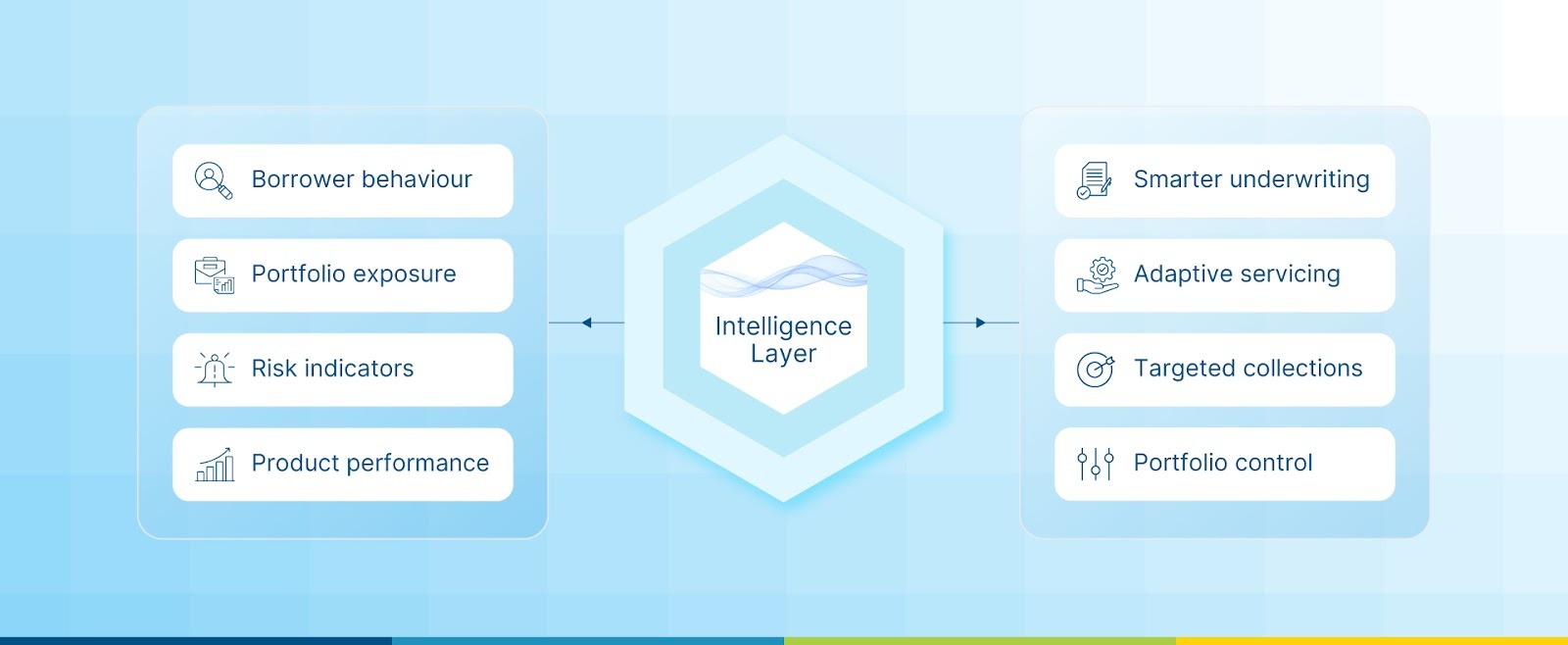
The shift from fragmented to centralized data changes how lending teams work.
- Underwriting with complete context: Credit teams see full relationships, not just current applications, but payment consistency across facilities, deposit balances, covenant trends, and hardship discussions. Decisions improve because the context is complete.
- Servicing that anticipates problems: Centralized systems surface early warning signals automatically: Borrowers making minimum payments on one loan while missing another. Covenant ratios trending toward breach months before deadlines. Teams intervene proactively instead of reacting to crises.
- Collections that preserve relationships: When agents see delinquent borrowers hold substantial deposits or pending applications, conversations shift. Recovery becomes relationship management.
- Portfolio management that reflects reality: Leadership sees concentration risk, product performance, and delinquency trends in real time.
This changes unit economics without dramatic restructuring. Credit teams handle higher volumes without parallel trackers. Servicing resolves issues faster. Collections prioritize effectively because risk signals remain intact from origination onward.
Centralization and Compliance Control
Compliance failures rarely stem from intent. They stem from fragmentation. When records live in multiple systems, proving what happened becomes harder than doing the right thing. Fragmentation forces compliance teams to reconstruct audit trails, exposing institutions to regulatory risk.
A centralized loan management system embeds compliance into daily operations. Every decision, disclosure, and communication carries a timestamp and owner. Policy checks trigger within workflows. Audit trails form automatically as loans progress.
This structure supports continuous control. Compliance teams monitor live conditions instead of preparing static evidence. Reporting reflects current exposure, not last quarter's reconciliation.
As regulatory expectations shift toward ongoing oversight, centralization ensures defensibility. Lenders can explain outcomes with confidence using complete, consistent records from a single source of truth.
How Intelligence Emerges from Unity
Unifying loan data creates conditions for lending intelligence to function. When origination, servicing, and monitoring share the same record, insights travel forward instead of resetting at each stage.
Patterns become visible. Early stress in one segment informs credit policy elsewhere. Servicing behavior feeds underwriting refinement. Portfolio strategy reflects lived performance.
This feedback loop only works when data remains connected end-to-end. Isolated systems break learning. Centralized platforms preserve it.
Modern platforms like Finspectra's Prizm Lending Suite illustrate this approach keeping loan data, workflows, and decisions aligned across the lifecycle. The outcome isn't just faster lending. It's lending that adapts with clarity, where unified systems absorb complexity rather than amplifying it.
The Bottom Line: Control Comes from Coherence
Data silos fail quietly through delayed insight, uneven decisions, and rising operational strain. Centralized loan management systems restore coherence across the lending lifecycle. When teams work from one source of truth, judgment improves. Compliance becomes continuous. Scale stops eroding control.
The shift from fragmented tools to unified systems determines whether growth increases risk or refines it. That's what Finspectra delivers: not just software that consolidates data, but an intelligence layer that turns unified information into clarity, precision, and confidence.
Want to see how a single source of truth simplifies your lending workflow? Checkout out Finspectra Prizm Suite in action.
FAQs
- What is a centralized loan management system and how does it work?
A centralized loan management system manages loans through one shared platform, maintaining a single record from origination to closure.
- How does a centralized loan management system help eliminate data silos?
A centralized loan management removes silos by keeping origination, servicing, and collections on the same system. All the updates happen once, reflect everywhere instantly, and no team relies on exports, spreadsheets, or delayed integrations.
- Why do lending institutions struggle with data silos in the first place?
Silos emerge as teams adopt different tools for speed, compliance, or growth. Over time, integrations lag, ownership fragments, and each function maintains its version of the loan instead of context.
- What are the benefits of moving from legacy loan systems to a unified platform?
A unified platform improves decision speed, reduces manual reconciliation, strengthens compliance, and lowers operating costs. Teams see loan context instantly, act earlier on risk, and scale portfolios without adding complexity.
- Is a centralized loan management system secure for handling borrower data?
Yes, centralized loan management systems use role-based access, encryption, audit trails, and monitoring to enhance security.
.png)

.png)
.png)


