
Credit Union Lending Software vs. Bank Lending Software: What Actually Differs
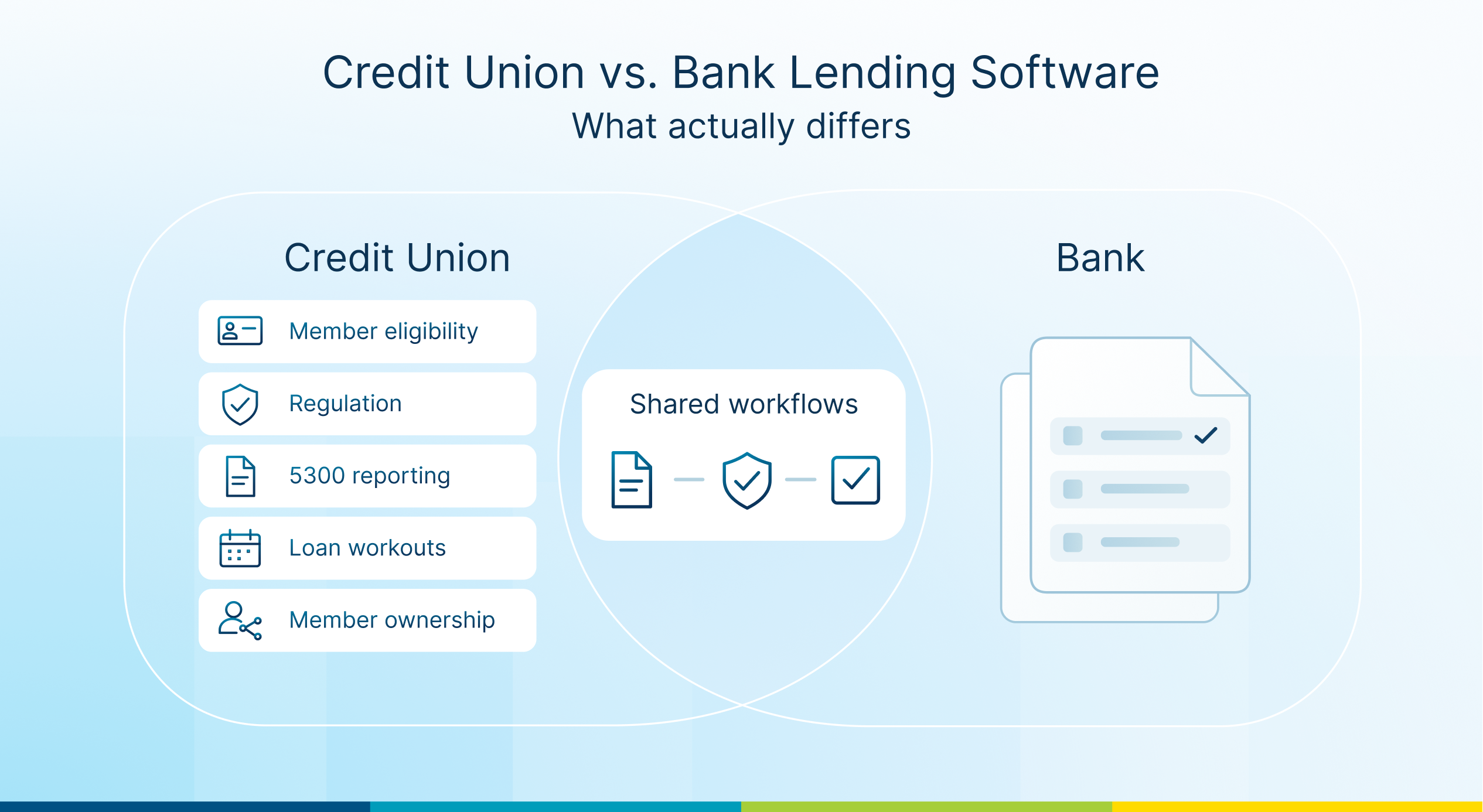
Put a credit union and a community bank through the same lending software demo and the screens will look almost identical: an application, a credit pull, a decision, a document package, a funded loan. That resemblance is why most comparisons of credit union lending software vs. bank lending software stop at feature checklists, and why some credit unions only find the real gaps after go-live.
The gaps live in daily operations. An applicant qualifies because her mother works for one of the credit union's Select Employee Groups, and under the charter's immediate-family provision the system has to record that basis before the application can move. The quarterly 5300 is due on the 30th and expects loans sorted into NCUA's categories. A member asks for a third extension in four years, and examiners will expect the file to show the first two. Meanwhile, the core has to pass share balances to the lending system in real time. None of this appears on a basic feature list, and all of it decides whether a platform fits.
Quick answer
Credit union and bank lending software share most core workflows: origination, decisioning, document handling, servicing, and payment processing. They differ in five areas: the member ownership model, NCUA versus federal banking agency rules, field of membership eligibility, NCUA 5300 reporting, and the workout rules in 12 CFR Part 741. Core system integration sits alongside these as a technology consideration that determines how much a platform handles without custom work.
Credit Union vs. Bank Lending Software: What's the Same?
Takeaway: Most of what a loan origination system or loan management system does works the same way at a credit union and a bank. We describe that split as 80/20, which is an editorial shorthand rather than a measured industry figure.
A consumer auto loan follows the same arc wherever it gets booked. Someone applies, the system pulls a bureau file, a decision engine scores the request against policy, documents are generated and signed, funds move, and a servicing record accrues interest until the final payment posts. Truth in Lending, Equal Credit Opportunity, Fair Credit Reporting, and HMDA apply on both sides of the charter line, so disclosure engines and adverse action logic look alike as well. If the line between an LOS and an LMS is blurry, our guide on when lenders need both draws it.
We call this an 80/20 split. Nobody has measured the ratio, and we aren't suggesting anyone has; it's our way of saying that most of the workflow is shared while a smaller set of requirements decides fit. Finspectra serves both charters, and that framing matches what we see across both.
The smaller set falls into five differences, which organize the rest of this article:
- Ownership and the member relationship
- Regulatory framework: NCUA vs. the federal banking agencies
- Field of membership eligibility
- Regulatory reporting: NCUA 5300 vs. FFIEC Call Report
- Workouts and collections under 12 CFR Part 741
Core system integration follows them as a technology consideration. It isn't a regulatory or operational difference in its own right, but it determines how cheaply a platform can handle the five.
Table 1: Credit union vs. bank lending software, the differences at a glance
Table 2: What's actually the same
Ownership and the member relationship
Takeaway: The structural difference is ownership. A credit union borrower is a member-owner whose shares, eligibility, and loans are legally connected, and credit union lending software has to carry those connections in the borrower record.
Credit unions are not-for-profit cooperatives. Each member holds at least one share, has one vote in board elections regardless of balance, and shares in earnings through dividends or loan pricing. Banks come in more shapes. Most are stock companies owned by shareholders, while mutual savings banks and mutual savings associations are owned by their depositors. Banks also work within real constraints of their own, from legal lending limits to CRA assessment areas and capital rules, so the useful contrast here is structural rather than cultural.
Ownership doesn't decide the quality of the experience on its own. In the ACSI Finance Study 2026, credit unions scored 78 and banks 80; credit unions led on staff courtesy and branch efficiency, while banks led on mobile app performance and website satisfaction.
Where ownership shows up inside the software:
- The borrower record. A member record links to share accounts, joint owners, a membership date, and the basis on which the person qualified to join. Under 12 CFR 701.39, a federal credit union may enforce a statutory lien on a member's shares to the extent of loans outstanding, so payoff, collections, and charge-off logic all need live visibility into share balances. Share-secured and certificate-secured loans are everyday products.
- Eligibility on file. The membership basis stays attached to the person for as long as they bank with the credit union, because it determines who may borrow and who may join through them. The field of membership section covers how that works.
- Relationship management. A federal credit union lends to its members, so its prospect pool is bounded by its charter. Relationship tools tend to center on existing members and eligible prospects: membership history, joint ownership, and product events such as a maturing certificate or a paid-off auto loan. Banks manage relationships too; their prospect pool simply isn't defined by a membership rule.
- Language. Credit union notices refer to members, dividends, and share drafts. A template that says "customer" ends up on every adverse action notice, statement, and collections letter the system generates, which is why compliance teams flag it early.
Credit union vs. bank regulation: NCUA and the federal banking agencies
Takeaway: Consumer protection law is largely shared. Prudential rules differ, and those are the rules that change what lending software has to calculate, cap, and record.
Federal credit unions are chartered and supervised by NCUA. State-chartered credit unions are chartered and supervised by their state regulator, and most are also insured by NCUA, which applies the rules listed in Part 741 to every federally insured credit union. Banking divides the work among three federal agencies. The OCC charters and supervises national banks and federal savings associations. The Federal Reserve supervises state-chartered banks that are Fed members, along with bank holding companies. The FDIC supervises state-chartered banks that are not Fed members and insures deposits at every insured bank, which gives it backup authority across the system. State regulators share supervision of the banks they charter.
Above $10 billion in assets, the CFPB holds supervisory authority over banks and credit unions alike. H.R. 10184, introduced in 2026, would raise that threshold to $30 billion; as of this writing it remains a proposal.
Five prudential differences reach directly into the software.
Capital comes from earnings. A stock bank can raise capital by issuing shares. A credit union builds net worth mainly through retained earnings, and under Part 702 it needs a net worth ratio of at least 7% to be well capitalized. Complex credit unions, those with more than $500 million in assets, also meet a risk-based capital requirement unless they opt into the complex credit union leverage ratio (CCULR). Every loan's margin and loss rate feeds that net worth directly, so portfolio reporting that ties concentrations back to capital earns its keep.
Business lending is capped, and the cap depends on the capital framework. Under 12 CFR 723.8, a federally insured credit union's net member business loan balance may not exceed the lesser of 1.75 times its actual net worth or 1.75 times the net worth required to be well capitalized. NCUA's risk-based capital FAQs explain how that plays out:
- For most credit unions, the well-capitalized minimum is 7% of total assets, so the cap works out to 12.25% of assets once actual net worth exceeds 7%.
- A complex credit union under the risk-based capital framework uses the greater of 7% of total assets or 10% of risk-weighted assets as its required net worth.
- A complex credit union that has opted into the CCULR uses 9% of total assets, which puts its cap at 15.75% of assets.
- A credit union whose actual net worth falls below the well-capitalized minimum is capped at 1.75 times the net worth it actually has.
Credit unions with a low-income designation, CDFI participants, credit unions chartered to make business loans, and those with a pre-1998 history of primarily commercial lending are exempt from the cap. The definition also matters. Fully government-guaranteed loans, non-member participations, and loans fully secured by a 1-to-4 family dwelling are excluded, while a household vehicle used for business counts once the member's aggregate net business balance reaches $50,000. The net balance includes unfunded commitments, less any portion secured by shares, insured or guaranteed by a government agency, or sold without recourse. That is too much logic to run from a spreadsheet, so lending software should calculate it continuously.
Federal credit unions have a rate ceiling. The Federal Credit Union Act caps federal credit union loan rates at 15% and lets NCUA set a higher temporary ceiling for up to 18 months when statutory conditions are met. NCUA has held that ceiling at 18% since 1987 and in February 2026 extended it through September 10, 2027, with payday alternative loans permitted up to 28%. State-chartered credit unions follow state law. Banks have no federal numeric ceiling: a national bank may charge the rate permitted in the state where it is located and apply it to borrowers elsewhere (12 U.S.C. 85), and insured state banks have similar parity (12 U.S.C. 1831d). A federal credit union's pricing engine should block any rate above the current ceiling and flag when the ceiling itself is due to expire.
Banks face per-borrower limits instead of an aggregate cap. National banks and federal savings associations follow the OCC's lending limits in 12 CFR Part 32, generally 15% of capital and surplus to one borrower, plus an additional 10% for loans fully secured by readily marketable collateral. State banks follow their state's limit. None of these work like the aggregate portfolio cap in Part 723.
The Community Reinvestment Act applies to banks only. CRA geocoding and assessment-area reporting built into bank software has no use at a credit union.
This is also why "NCUA-compliant lending software" is a slippery phrase. NCUA examines credit unions, and it currently lacks authority to examine their technology vendors. Software can make compliance easier to demonstrate, but the compliance obligation stays with the credit union. We've written about why software that looks compliant often fails across multiple regulators, and the same logic applies here.
Table 3: Lending-relevant rules compared
Field of membership: the eligibility rule with no bank equivalent
Takeaway: Field of membership has no counterpart in banking, and it has to run before an application exists. That timing is what bank-built workflows most often get wrong.
Banks carry plenty of lending constraints, but none of them define who may become a customer in the first place. Credit unions have exactly that rule: they can serve only people within their field of membership. Since the Credit Union Membership Access Act of 1998, the Federal Credit Union Act has recognized three federal charter types, detailed in NCUA's Chartering and Field of Membership Manual: a single common bond (one occupational or associational group), a multiple common bond (several groups, each with its own bond), and a community charter covering a well-defined local community, neighborhood, or rural district. Multiple common bond credit unions can also add underserved areas. State-chartered credit unions follow state statutes, which vary.
Family eligibility is narrower than it sounds. Where a federal credit union's charter includes the immediate family or household provision, a relative qualifies through a primary individual who is within the field of membership. That primary individual doesn't have to be a member, but NCUA legal opinions have held that they must be within the field of membership when the relative joins. The manual separately allows spouses of people who died while within the field of membership. Other relatives don't automatically inherit eligibility from someone who has died, so software can't treat a family link as a permanent pass.
For credit union lending software, that translates into four requirements:
- Eligibility before intake. The applicant has to qualify and join before a federal credit union can lend to them. The workflow should capture the basis for eligibility (an employer or Select Employee Group, an association, an address, or a relationship to a named primary individual) and store it as evidence on the member record.
- SEG management. Multiple common bond credit unions add Select Employee Groups through NCUA's CAPRIS system. Each approved group expands who qualifies, so the employer list in the software has to change the day the approval lands.
- Geography. Community charters and underserved areas turn eligibility into an address question, which calls for boundary validation that matches the charter's approved definition.
- Effective dating. Mergers add the merged credit union's field of membership, charters convert, and credit unions that adopt a "once a member, always a member" policy keep members eligible after they leave the group. Eligibility rules need start dates, end dates, and a history.
We see this pattern often: when bank software is retrofitted for a credit union, field of membership is usually the first place it breaks. The common workaround is a manual eligibility screen bolted onto the front of the application flow, which leaves the evidence trail outside the system examiners actually review.
Regulatory reporting: the NCUA 5300 vs. the FFIEC Call Report
Takeaway: The NCUA 5300 and the FFIEC Call Report ask similar questions in different shapes. Lending software should produce 5300-ready loan data from the system of record, with no spreadsheet in between.
Every federally insured credit union files the NCUA 5300 Call Report each quarter. Filings are due by 11:59:59 p.m. Eastern on the 30th of January, April, July, and October, NCUA may assess civil money penalties for late filing, and Part 749 requires a copy in the credit union's permanent records. NCUA turns those filings into system-wide data: as of the second quarter of 2026, 4,214 federally insured credit unions served 146.1 million members and held $1.76 trillion in loans.
Banks file one of three FFIEC forms. The FFIEC 031 covers banks with foreign offices or $100 billion or more in assets, the FFIEC 041 covers domestic-only banks below that size, and the streamlined FFIEC 051 is available to domestic-only banks under $5 billion. The categories, definitions, and delinquency cutoffs on those forms differ from NCUA's, so a report built for one cannot simply be relabeled for the other.
The lending pages of the 5300 break loans out by product (new vehicle, used vehicle, credit card, real estate, commercial, and more), report delinquency by product and days past due using NCUA's own bucket boundaries, and carry separate detail on commercial loans, member business loans, indirect lending, and loans purchased, sold, or participated. Loan modifications need care as well: under Part 741, Appendix B, past-due status follows the contract terms as amended by any formal restructure, and the Call Report reflects that.
Lending software that supports the 5300 well handles three things at the data level:
- Every loan product maps to its 5300 account codes at product setup, so new products never fall into an unmapped bucket at quarter end.
- Commercial loans carry a member business loan flag that follows NCUA's definitions, which feeds both the 5300 and the Part 723 cap calculation.
- Modification history, nonaccrual status, and participation details travel with the loan record instead of living in a collector's notes.
Workouts and collections: Part 741 vs. the FFIEC retail credit policy
Takeaway: Banks and credit unions both restructure troubled loans. The difference is that NCUA writes workout expectations into the insurance rules every federally insured credit union must follow, and the cooperative mission frames a workout as a member service as much as a loss-mitigation tool. Credit union collections software has to remember every concession, for years.
Appendix B to Part 741 opens on a human note, describing workouts as a way to help borrowers through job loss, a medical emergency, or the death of a family member. Then it gets specific. The board must adopt a written workout policy that defines eligibility and limits how many times a single loan can be modified. If a credit union restructures a loan beyond once a year or twice in five years, examiners expect stronger documentation that the borrower is willing and able to repay. Broad member programs such as Skip-a-Pay, offered only to accounts in good standing, don't count toward those limits. The policy must also prohibit advancing new money to cover the credit union's own fees.
The appendix is just as direct about systems. It says management information systems need to track principal reductions and charge-off history by workout program, and to record every re-age, extension, deferral, renewal, or rewrite along with its frequency and extent. Boards need reporting triggered by thresholds on aggregate workout volume. Loans go to nonaccrual at 90 days past due unless well secured and in collection, and a restructured member business loan generally needs six consecutive timely payments before returning to accrual.
Charge-off timing diverges too. Banks follow the FFIEC's Uniform Retail Credit Classification and Account Management Policy, which sets charge-off at 120 days past due for closed-end retail loans and 180 days for open-end. NCUA did not join that policy and instead requires a reasonable written charge-off policy, applied consistently, under Letter to Credit Unions 03-CU-01. Two credit unions can therefore run different timelines and both be in good standing.
The stakes are rising. System-wide credit union delinquency reached 96 basis points in the second quarter of 2026, up 6 basis points from a year earlier, with net charge-offs at 78 basis points.
For a credit union loan servicing platform, all of this translates into a handful of requirements: a modification counter that spans years and loan rewrites, policy limits with documented exception approvals, Skip-a-Pay kept separate from true workouts, share balances visible to collectors because of the statutory lien, and board-ready workout reporting. Finspectra designed its collections and hardship management workflow around this credit union problem, because a generic collections queue tends to treat the fourth conversation with a member as if it were the first.
Beyond the five: core system integration
Takeaway: Core integration isn't one of the five regulatory and operational differences, but it decides how cheaply a platform can handle them. Credit unions and banks largely run on different cores, so ask for production integrations by core and version instead of a general compatibility claim.
The credit union core market is its own neighborhood: Jack Henry's Symitar, Corelation's KeyStone, Fiserv's XP2, CU*BASE from CU*Answers, and Fiserv DNA. Bank cores include Jack Henry SilverLake, Fiserv Premier, FIS platforms, and Finastra. A few systems, DNA among them, serve both charters. Lending platforms such as nCino sit on top of a core instead of replacing it, which matters when a vendor's integration list mixes the two categories.
Two credit union networks deserve separate treatment because they touch lending differently. Shared branching lets a member make deposits, withdrawals, and loan payments at another participating credit union's branch. Co-op Shared Branch is operated by Velera, the CUSO formed when PSCU and Co-op Solutions combined in 2024; the Co-op name was kept for the shared branching and ATM brands. For a lending system, shared branching is a payment-posting integration: a loan payment taken at another credit union's teller line has to land on the member's loan record correctly. ATM networks such as Co-op ATM sit on the card and switch side and rarely touch the lending system directly.
Credit union service organizations (CUSOs), governed by 12 CFR Part 712, also provide shared indirect lending, collections, and mortgage servicing for many credit unions, and each relationship is another integration point.
What integration depth means for credit union loan origination software is concrete: real-time reads of share balances for the statutory lien and share-secured loans, eligibility data flowing from the core into intake, loan boarding without rekeying, payment posting from shared branches, and 5300 fields written back where the core's reporting expects them.
Table 4: Integration ecosystem comparison
How to evaluate credit union vs. bank lending software
Takeaway: The best lending software for credit unions handles the five differences natively, integrates with your core, and absorbs regulatory change through configuration. Seven questions cover all three.
A credit union LOS shortlist usually arrives with every vendor claiming credit union experience. The first five questions below test that claim against the five differences; the last two cover integration and long-term cost. For a broader scoring template, pair them with our RFP checklist for evaluating a unified lending platform.
- Ownership and member relationship: how does it model member equity alongside loans? The system should read share balances in real time, support share-secured and certificate-secured lending, reflect the statutory lien in payoff and collections, and handle joint ownership the way your core does.
- Regulatory framework: does it enforce NCUA-specific limits? Look for a pricing engine that respects the federal credit union rate ceiling and its expiry date, member business loan classification that follows Part 723, and a cap calculation that matches your capital framework, whether that's the 7% net worth standard, risk-based capital, or the CCULR.
- Field of membership: can it check eligibility natively? A strong answer shows eligibility captured before intake, the basis stored as evidence, SEG lists and community boundaries managed as effective-dated rules, and family eligibility tied to a named primary individual.
- Regulatory reporting: does it output 5300-ready data? Expect product-to-account-code mapping at setup and modification and nonaccrual status flowing into the Call Report extract without manual rework.
- Workouts and collections: how deep is the hardship workflow? Ask to see a loan with three prior modifications. The system should show the full history, apply your policy limits, require documented approval for exceptions, keep Skip-a-Pay separate, and produce the board reporting Appendix B expects.
- Core integration: which credit union cores run in production? Ask for the core, the version, the integration method, and a reference credit union running it today, along with how shared branch loan payments post.
- Maintenance: how are regulatory changes, NCUA reporting updates, and changes to field of membership requirements handled within the platform? Ask whether a new 5300 field, a revised rate ceiling, or a newly approved SEG is a configuration change your team makes, a release the vendor ships, or custom development billed as a separate project. The answer shapes the platform's cost over the life of the contract, beyond what it can do on day one.
Two requests in a live demo test most of this quickly. Ask the vendor to start an application for someone outside your field of membership and show where, and why, the system stops them. Then ask for last quarter's 5300 loan and delinquency schedules generated from sample data that includes one member business loan and one loan modified twice.
One more point for anyone buying credit union loan origination software: because NCUA examines the credit union and not the vendor, the burden of proof stays with you. Software that records its own reasoning (who approved an exception, which eligibility basis applied, which policy version governed a workout) makes that burden lighter at exam time.
Where Finspectra fits
Finspectra's Prizm Lending Suite is a 100% Salesforce-native platform that runs origination, servicing, collections, and a self-service portal for banks and credit unions on one foundation. Lending and relationship data live in the same system, which matters most for the member-owned model described above.
One reference point for that model: People First Bank, Australia's largest customer-owned bank, formed in 2023 when Heritage Bank merged with People's Choice Credit Union. It runs its credit management on the platform for roughly 730,000 members. It operates under Australian regulation rather than NCUA rules, so it shows how the platform handles a member-owned institution; US credit unions should still test it against the NCUA-specific requirements in this article.
Here is how the platform lines up with those requirements:
- Member records. The servicing module provides a single view of all loan accounts per customer. Because the data model is Salesforce-native, a credit union can carry membership details, the eligibility basis, and share relationships on that same view.
- Eligibility checks. The origination module uses customizable workflows for each product and multi-channel application capture, so a field of membership check can sit at the front of the workflow instead of being bolted on after intake.
- Decisioning and documents. Real-time credit scoring, risk assessment, and secure document management cover the shared workflows described earlier.
- Servicing. Automated payment notifications, unified loan status and payment tracking, and flexible plan adjustments keep each change attached to the loan record.
- Collections and hardship. The collections module includes custom hardship and delinquency workflows, automated compliance checks on recovery actions, and workload queue management, which is where a written Part 741 workout policy gets applied day to day.
- Integrations. The platform connects to existing systems through its integration library. Ask us which credit union cores and versions are in production, the same question you should put to any vendor.
- Self-service. A fully white-labelled self-serve portal gives members loan management tools under the credit union's own brand.
Ansaryn, Finspectra's agentic AI application, runs alongside the platform and adapts to the workflow depth each charter needs. Hold us to the same seven questions as anyone else.


