%201.avif)
How to Evaluate a Unified Lending Platform: A Practical RFP Checklist
.png)
Selecting lending technology used to be a relatively straightforward exercise. Organizations compared features, reviewed vendor demonstrations, and chose the platform that appeared to meet their immediate requirements.
That approach no longer works.
Today’s lenders operate in a far more complex environment. The pace of change is reflected in the technology market itself. According to Grand View Research, the global digital lending platform market is expected to grow from USD 10.55 billion in 2024 to USD 44.49 billion by 2030, highlighting how rapidly financial institutions are investing in modern lending infrastructure.
Customer expectations have shifted toward digital-first experiences. Regulatory obligations continue to evolve. New lending products are entering the market faster than ever. At the same time, lending institutions are under pressure to improve efficiency without compromising risk controls.
Against this backdrop, technology decisions carry far greater strategic weight. The platform selected today will influence how quickly new products can be launched, how effectively risk can be managed, and how efficiently operations can scale over the coming years.
This is why evaluating a unified lending platform requires more than comparing feature lists. It requires a deeper assessment of whether the platform can support the business model your organization is building for the future.
For lenders preparing an RFP, the goal should not be to identify the platform with the most features. The goal should be to identify the platform that can support growth, adaptability, compliance, and operational excellence across the entire lending lifecycle.
Why Traditional Lending Platform Evaluations Often Fall Short
Many lending organizations approach technology selection by focusing on current pain points.
Perhaps the existing loan origination system is outdated. Perhaps underwriting reviews take too long. Perhaps reporting requires manual effort across multiple systems.
While these challenges are important, evaluating solutions solely through the lens of today’s problems often leads to tomorrow’s limitations.
One of the most common mistakes is evaluating individual capabilities rather than the overall operating model.
For example, a lender may spend months comparing workflow functionality within a loan origination system while paying relatively little attention to servicing, collections, analytics, or future product expansion. The result is a platform that improves one stage of the lending process while leaving fragmentation elsewhere.
Another common issue is the accumulation of disconnected technologies. Over time, many organizations build environments consisting of separate origination, underwriting, servicing, and reporting systems connected through custom integrations. While each component may perform adequately on its own, the overall ecosystem becomes difficult to manage and expensive to evolve.
This challenge is becoming increasingly common as lenders outgrow disconnected technology stacks. We explore this in greater detail in our article on Why Unified Lending Platforms Are Replacing Patchwork Systems.
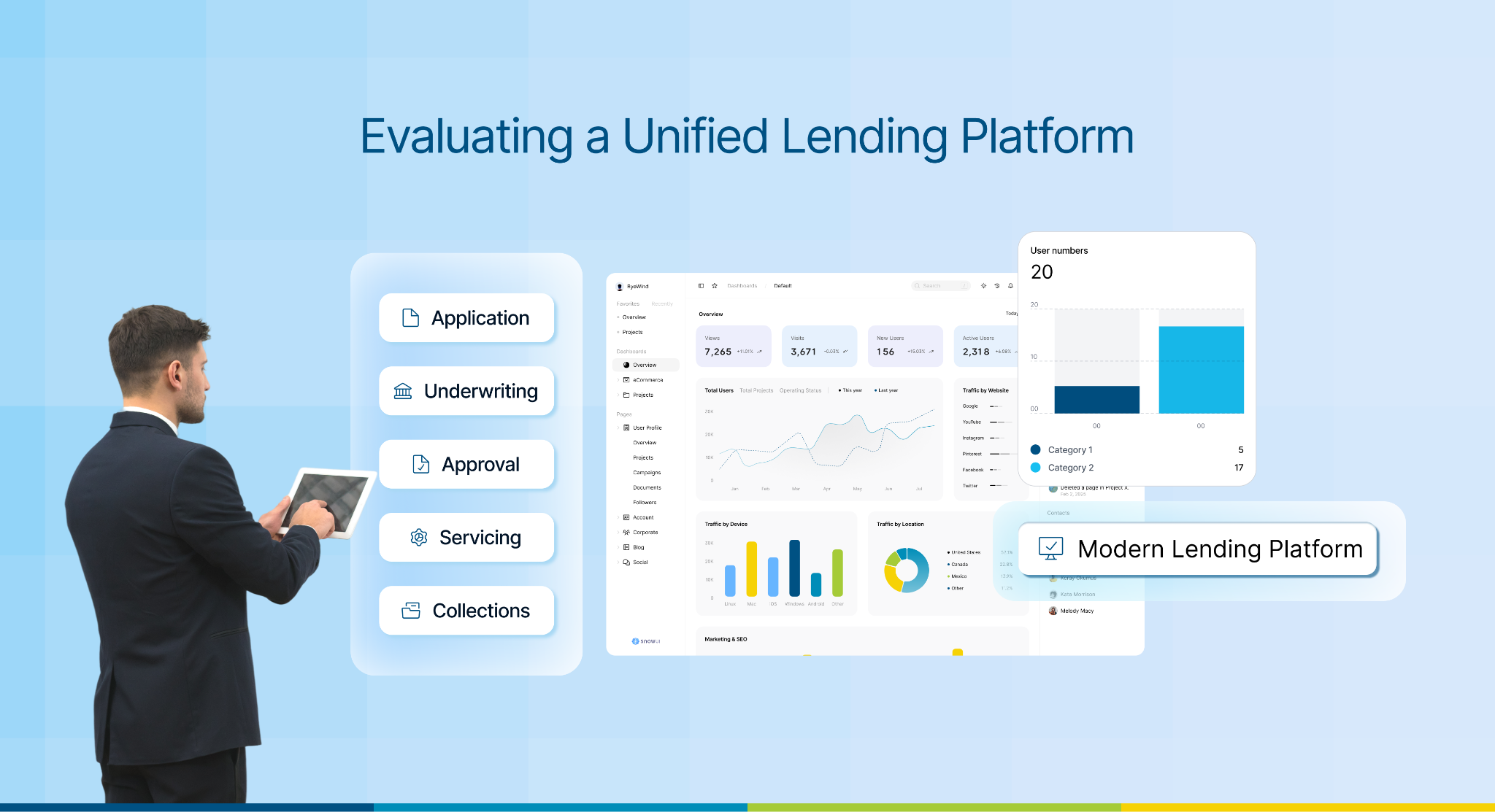
This is where the conversation around a unified lending platform becomes particularly relevant. Rather than treating lending as a series of isolated processes, a unified approach connects every stage of the borrower journey through a common architecture, shared data model, and consistent operational framework.
The difference may seem technical on the surface, but the business implications are significant.
Looking Beyond Origination: Evaluating the Entire Lending Journey
When technology evaluations begin, origination often receives the majority of attention.
That focus is understandable. Origination is where customer acquisition begins. It is also where lenders can create visible improvements in turnaround times and borrower experience.
However, the true cost of fragmented technology often emerges after origination.
A borrower approved through a modern digital application process may still encounter disconnected servicing experiences. Risk teams may struggle to access portfolio-wide insights. Operations teams may spend considerable time reconciling information across multiple systems.
These inefficiencies are often symptoms of deeper data fragmentation. For a closer look at how disconnected systems affect lending performance, read The True Cost of Data Silos in Lending: NPAs, Delays, and Compliance Risks.
These inefficiencies rarely appear during vendor demonstrations. They become apparent only after implementation.
Organizations evaluating a unified lending platform should therefore look beyond front-end capabilities and assess how the platform supports the entire loan lifecycle.
Can servicing teams access the same borrower information as underwriting teams?
Can operational leaders track performance across products from a single source of truth?
Can compliance teams generate audit trails without stitching together data from multiple applications?
These questions often reveal more about long-term platform value than a feature comparison ever could.
What High-Performing Lenders Evaluate Differently
The most successful lending transformations tend to share a common characteristic. They evaluate technology through a business lens rather than a purely technical one.
The broader banking industry is already moving in this direction. McKinsey’s Global Banking Annual Review 2026 reported that global banking net income reached $1.3 trillion in 2025, while institutions continue accelerating investments in AI and modernization initiatives to improve speed, efficiency, and customer ownership. Against this backdrop, platform decisions are increasingly viewed as business strategy decisions rather than standalone technology purchases.
Instead of asking what the platform can do today, they ask how it will support the organization three, five, or even ten years from now.
They Prioritize Configurability Over Customization
Many technology projects begin with extensive customization requests.
At first glance, customization appears attractive because it allows a platform to mirror existing processes. The challenge emerges later.
Every heavily customized workflow introduces complexity. Product launches become slower. Upgrades become more difficult. Maintenance costs increase.
Leading lenders increasingly prioritize configurability instead. They look for platforms that allow business teams to adapt workflows, modify approval rules, launch new products, and refine operational processes without extensive development effort.
This flexibility becomes particularly valuable as lending portfolios evolve and market conditions change.
They Evaluate Future Underwriting Needs, Not Just Current Ones
The underwriting process is undergoing significant change.
Alternative data sources, automated decisioning, AI-assisted risk assessment, and embedded finance models are reshaping how credit decisions are made. A platform that supports current policies may not necessarily support future lending strategies.
When evaluating vendors, lenders should assess whether the platform can accommodate new data sources, changing risk models, evolving decision rules, and increasing automation requirements without requiring a complete redesign.
Equally important is access to a consistent borrower view across functions. Our article on How Unified Customer Profiles Improve Underwriting and Collections explores how shared customer data can strengthen both credit decisioning and portfolio management.
A future-ready underwriting framework is often a stronger indicator of platform longevity than any individual feature.
They Think in Terms of Product Expansion
Many lenders begin with a narrow use case and later expand into adjacent products.
A financial institution offering personal loans today may enter SME lending tomorrow. A lender focused on one geography may expand into additional markets. New partnership models may create opportunities for embedded lending or co-lending arrangements.
The platform selected today should support these possibilities without introducing significant operational complexity.
This is where enterprise lending solutions often differentiate themselves from point solutions designed for a single use case.
The Practical RFP Checklist: Questions That Matter
Once strategic priorities are clear, the RFP process becomes far more effective.
Rather than evaluating hundreds of individual features, lenders can focus on a smaller set of questions that reveal how well a platform aligns with long-term business objectives.
These questions help shift vendor conversations from functionality toward business outcomes.
Unified vs Legacy Lending Systems: A Comparison Worth Making
One useful exercise during the evaluation process is comparing how a potential platform differs from the organization’s existing technology landscape.
The objective is not simply to modernize technology. It is to reduce operational friction and create a foundation that can support future growth.
A Real-World Evaluation Scenario
Consider a mid-sized lender operating separate systems for origination, underwriting, servicing, and reporting.
At first glance, each system appears to function adequately. Loan applications are processed. Credit decisions are made. Customer accounts are serviced.
Yet every new product launch requires coordination across multiple teams and vendors. Reporting requires manual reconciliation. Customer information exists in several different places. Changes to business rules often trigger development projects.
When the organization begins evaluating a unified lending platform, it discovers that the primary challenge is not missing functionality. The challenge is fragmentation.
The evaluation process shifts from comparing features to assessing how effectively different platforms can simplify operations, improve visibility, and support future growth.
This shift in perspective often produces better technology decisions because it focuses on business outcomes rather than software capabilities alone.
Red Flags to Watch for During Vendor Evaluations
Not every platform marketed as unified delivers true end-to-end capabilities.
Several warning signs should prompt deeper investigation.
One is excessive dependence on customization. If routine business changes require significant development effort, long-term agility may be limited.
Another is fragmented architecture presented as a unified solution. A platform may appear integrated during demonstrations while relying on multiple loosely connected products behind the scenes.
Lenders should also be cautious when vendors struggle to explain how data moves across the lending lifecycle. True unification is reflected not only in functionality but also in architecture, governance, and operational consistency.
Finally, implementation deserves as much scrutiny as product capabilities. A powerful platform that cannot be deployed efficiently may create more challenges than it solves.
Final Thoughts
Technology evaluations have traditionally focused on features. The most successful lending organizations are taking a broader view.
They recognize that platform selection is ultimately a business decision. It influences product innovation, operational efficiency, compliance management, customer experience, and future growth.
A strong RFP process therefore goes beyond comparing functionality. It examines whether a unified lending platform can support the operating model the organization wants to build over the coming years.
The best platform is rarely the one with the longest feature list. It is the one that enables lenders to adapt faster, operate more efficiently, and grow without creating new silos along the way.
FAQs
What features should a unified lending platform have?
A unified lending platform should support the entire lending lifecycle, including origination, underwriting, servicing, collections, analytics, compliance, workflow automation, and integrations through a single operating environment.
What are the key criteria for selecting a lending platform?
Key evaluation criteria include lifecycle coverage, scalability, integration capabilities, configurability, compliance support, analytics, implementation expertise, and long-term alignment with business objectives.
How long does it take to implement a lending platform?
Implementation timelines vary depending on the complexity of existing systems, migration requirements, integrations, and organizational readiness. The scope of deployment often has a greater impact on timelines than the platform itself.
Can a unified lending platform support multiple loan products?
Yes. Modern platforms are designed to support multiple lending products, allowing organizations to manage different workflows, underwriting requirements, pricing structures, and servicing models within a single environment.
.png)

.png)
.png)


