
Salesforce Meets Claude: What Does This Mean for Your Lending Workflows?

If your lending business runs on Salesforce, the partnership between Salesforce and Anthropic changes what your CRM can do. Claudeforce, announced on 26 August 2026, brings Claude’s reasoning into Salesforce data and workflows. An AI assistant can now read records, answer questions and take governed actions inside the system your teams already use.
That is a real step forward, but AI that can reason over CRM data is not the same as AI that understands a loan file. Assessing serviceability, applying your credit policy or handling a hardship request depends on lending data, institution-specific rules and regulatory context. A general-purpose assistant doesn’t bring those on its own.
This article explains what the partnership delivers today and where Salesforce already supports lending use cases. It then covers where the gaps in Claudeforce lending workflows remain, and what a lending-specific AI layer has to do to close them.
Quick Summary
- AI moves closer to enterprise data. The Salesforce and Anthropic partnership places Claude’s reasoning inside Salesforce products and lets Claude act on live Salesforce data through governed rules.
- The launch skills are built for sales. The 37 prebuilt skills in Salesforce in Claude don’t cover underwriting, serviceability or hardship management.
- Lending needs domain knowledge. Lenders need AI agents that understand loan data, credit policies and regulatory requirements, not just CRM records.
- Humans stay accountable. A lending-specific AI layer can work alongside Salesforce, preparing the work while people keep responsibility for every final decision.
What the Salesforce and Anthropic Partnership Means for Lenders
Claudeforce is the expanded strategic partnership between Salesforce and Anthropic, announced on 26 August 2026. It works in two directions. Claude’s reasoning runs inside Salesforce products such as Agentforce and Slack, and Salesforce data and actions are available inside Claude through a plugin called Salesforce in Claude. For lenders, the result is that a capable reasoning model can now reach the CRM where many loan records already live.
Three parts of the partnership matter most to lending teams:
- Claude powers Salesforce’s own agents. Claude is now a reasoning model for the Atlas Reasoning Engine behind Agentforce, the default for Agentforce Vibes and Agentforce Coworker, and the default model for Slack and Slackbot. Any agent you deploy on Salesforce may already be reasoning with Claude.
- Data stays inside the Salesforce Trust Boundary. Claude runs within the Trust Boundary through Amazon Bedrock. Salesforce says this lets customers in regulated industries deploy domain-specific AI while keeping data and workloads secure (Salesforce announcement). For lenders bound by privacy and prudential obligations, that is a prerequisite rather than a feature.
- Users can act on Salesforce data from Claude. Salesforce in Claude lets a user query, update and act on live Salesforce data from inside Claude. It opened to pilot customers on announcement day and entered beta on 15 September.
Marc Benioff described the logic as a pairing. Reasoning models and rule-bound enterprise systems each fall short alone, and the value comes from combining them. That idea is the most useful lens for lenders. A lending decision needs both flexible reading and drafting, and strict, auditable rules.
What Claudeforce Actually Ships With Today
As of 27 October 2026, Salesforce in Claude is built for one persona: the seller.
Salesforce in Claude vs Agentforce for Financial Services
Two Salesforce offerings are easy to confuse, and lenders should keep them apart.
Salesforce in Claude includes 37 prebuilt sales skills covering meeting preparation, deal health review, pipeline review and related seller work. A seller can prepare a call, review a deal or send a forecast without leaving Claude. Salesforce says more skills begin launching in late 2026, naming service, marketing, commerce and industries among the areas to come, without dates for each (Salesforce Claudeforce page).
Agentforce for Financial Services, introduced in 2025, is a separate offering. It includes lending-related templates such as Loan Product Assistance and Collections Assistance (Trailhead), which firms tailor to their own policies and workflows.
So Salesforce does have lending-related AI capabilities. What neither offering provides out of the box is a complete lending-specific AI layer. That means one that interprets your credit policy, runs underwriting and serviceability calculations, and carries a loan from application through to collections. The opportunity sits in that end-to-end gap, not in an absence of lending AI on Salesforce.
The Agentforce + Claude Architecture
The architecture deserves more attention than the skill list. Salesforce in Claude runs on AIforce, which Salesforce describes as a trusted harness that exposes business data and workflows to any agent through MCP servers, APIs and command-line tools. MCP, the Model Context Protocol, is a standard way for an AI agent to connect to a system and use its data and actions. Actions route through Salesforce, so business rules are enforced when an agent acts, and an administrator connects the plugin once with permissions managed centrally instead of user by user.
The pattern is to read from the system of record, reason, and act through governed rules. For a lender it means an AI layer can work with loan records without bypassing the controls your Salesforce org already enforces. The practical door this opens is a Salesforce integration between your lending platform and an agent that can use its data, and it makes the quality of your lending software integrations a first-order buying criterion for any AI integration in financial services.
Why This Matters If You’re a Lender on Salesforce
The architecture for AI on Salesforce is arriving quickly, but the lending-specific intelligence on top of it is still left to each lender.
Where Lending Workflows Still Need Domain-Specific Intelligence
Salesforce already supports parts of the lending journey. Agentforce templates can help with loan product questions and collections conversations, and Salesforce in Claude can summarise records and act within permissions. The limits show up where the work depends on rules unique to your institution:
- Credit policy interpretation: applying your lending criteria, exceptions and delegated authorities to a specific file
- Underwriting decisions: reading financial statements, security and covenants, then building a recommendation
- Serviceability calculations: running your own buffers, expense benchmarks and DTI or LVR limits deterministically
- Hardship assessments: applying statutory timelines and borrower-vulnerability duties
- Regulatory workflows: compliance checks, including NCCP and APRA compliance requirements, with an audit trail
- Settlement preparation: assembling the documents and conditions a loan needs before funding
A template gives you a starting point, but the lending logic still has to come from your team or a specialised layer. Hardship and collections show why. They carry regulatory obligations that need structured workflows, which is why Prizm Collections treats them as dedicated processes rather than conversations.
What Lending Teams Actually Need From an AI Layer
An AI layer for lending has to answer to the loan record, the credit policy and the regulator, in that order. The table compares the existing Salesforce ecosystem with a lending-native AI layer.
n short, Salesforce supplies the platform and starting templates, and Claudeforce supplies the reasoning. A specialised lending layer adds the loan data model, the credit policy and the regulatory rules, with a human approving the outcome.
What a Lending-Native AI Layer Looks Like
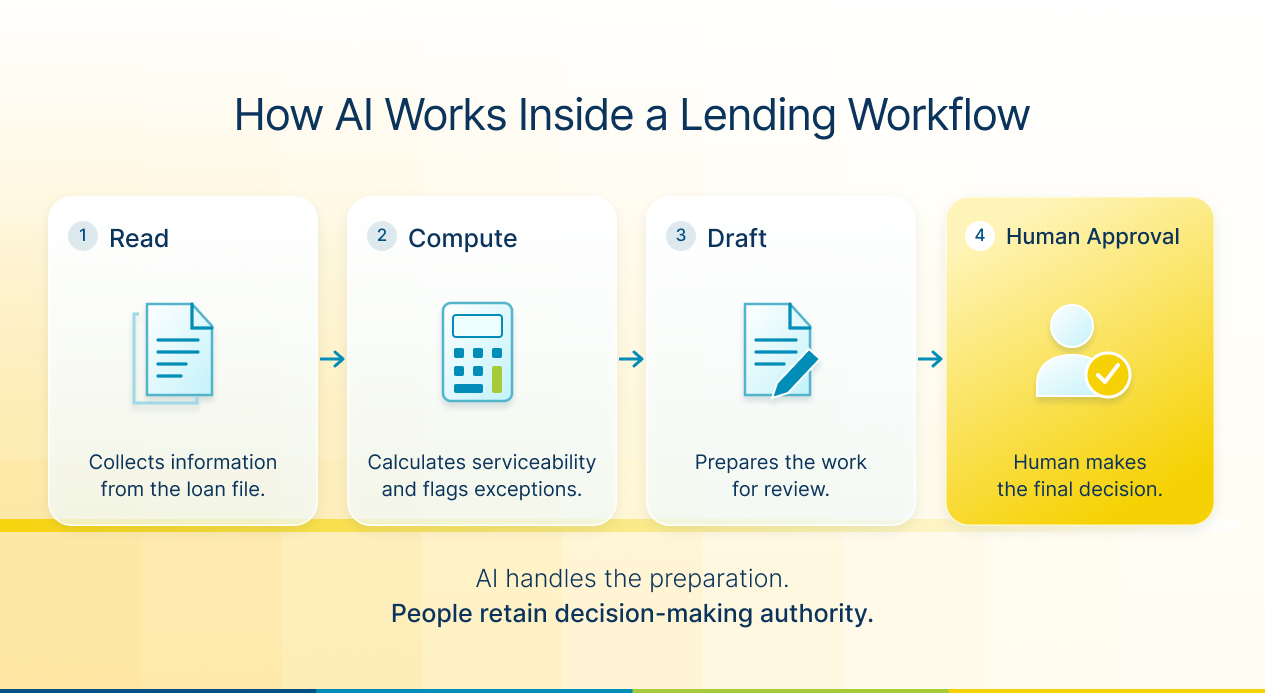
A lending-native AI layer is an agentic layer that knows the loan record, the borrower’s position, the credit policy and the regulator’s rules, and works beside each person who touches the file.
From Generic CRM Intelligence to Lending-Specific Agents
Compare two requests. A generic CRM assistant is asked to summarise an account and returns a tidy paragraph on activity and contacts. A lending agent is asked to review this loan file against our credit policy, flag exceptions, calculate LVR and DTI and draft the credit memo for the underwriter. It returns a memo with the numbers, the exceptions and the policy clauses behind them.
In practice, a lending-native AI layer handles the preparation work that fills most of a lending team’s day. Four examples:
- Financial statement review. AI: extracts income, expenses, assets and liabilities from statements and tax returns. Human: checks the extracted figures. Decision: the analyst decides whether the evidence is sufficient.
- Serviceability. AI: calculates serviceability with your predefined policy settings and flags exceptions. Human: reviews each flag and its policy reference. Decision: exceptions go to whoever holds the delegated authority.
- Credit memo. AI: drafts the memo with supporting figures and cites the policy clauses behind each finding. Human: the underwriter edits and validates it. Decision: approval stays with the credit team.
- Hardship applications. AI: reviews the application against your hardship rules and statutory timelines, then prepares a recommendation. Human: the hardship officer reviews the borrower’s circumstances. Decision: the outcome and the borrower communication stay with the lender.
Commercial lenders feel this gap most, because AI-powered commercial lending software has to read financial statements, security and covenants before it drafts anything. AI loan origination software that stops at intake leaves credit, compliance and settlement to manual assembly.
Read, Compute, Draft, Commit
The cycle has four steps. The agent reads the records. It computes against policy, running the maths and rules deterministically. It drafts the next step in plain language, whether that is a credit memo, a hardship response or a settlement checklist. A person then reviews and commits it, and nothing changes on a loan without a named person approving it.
That is the probabilistic and deterministic pairing Benioff described, specialised for credit: language models handle reading and drafting, rules handle the numbers, and humans hold the authority. Human-in-the-loop lending is also how the regulatory record reads. Australian enforcement cases involving automated assessments ended with regulators asking for testing and human review, a theme covered in our guide to NCCP and APRA compliance.
Where Finspectra Fits: Prizm on Salesforce
A lending-specific AI layer is only as good as the lending data and workflows underneath it. That foundation is what Finspectra builds.
The Prizm Lending Suite is a Salesforce-native lending platform covering origination, servicing, collections and a self-serve borrower portal. It holds the loan record, the borrower’s position and the workflow history inside your Salesforce org as structured, permissioned data.
That structure is what lets AI on Salesforce do real lending work. Claudeforce shows that the market wants an AI layer on Salesforce, but an AI layer can only apply credit policy, calculate serviceability or prepare a hardship response when the loan data, rules and approval steps are modelled properly underneath it. Prizm provides that system of record, so lending-specific AI has governed data to read from and governed workflows to act through.
Consider Sam, a sole trader financing a refrigerated van. One loan, eight people in seven teams: sales, origination support, credit, compliance, settlements, servicing and collections, with two people in credit. Each of them touches Sam’s file at a different point, and each spends part of the day assembling information before they can make a decision.
A lending-specific AI layer working on that loan record could support each of them. For origination support it would read the uploaded documents and check them against the application. For the credit analyst it would compute serviceability against policy and draft the memo. For compliance it would check the file against the rules that apply. For settlements it would assemble the pack, and for servicing and collections it would read the account position and draft the next step. In every case the person reviews and commits. The point of the example is the shape of the work: AI does the assembly, people keep the decisions.
If you want to see how a Salesforce-native lending platform gives AI the structured loan data it needs across underwriting, servicing and collections, book a demo to walk through a loan file in Prizm.
What Lenders Should Do Now
If you’re evaluating AI on Salesforce, three steps will show where you stand.
- Check that your Salesforce environment and lending data are ready for AI. Confirm that loan, borrower and security data sit in structured Salesforce objects rather than spreadsheets and attachments. Check that your permissions model reflects real delegated authorities, and that every action leaves an audit trail an agent would also have to respect.
- Find your highest-effort lending workflows. List the tasks where staff spend the most time assembling information before they decide, such as credit memo preparation, document checks, serviceability and hardship triage. Rank them by volume and effort; those are the first candidates for agentic automation.
- Test whether an AI solution understands lending. Give it one anonymised loan file and ask it to review the file against your credit policy. It should cite the policy clause behind each flag, show its calculations and route the outcome to a named person for approval. If it can’t, it’s a general-purpose assistant connected to your CRM, not lending-specific intelligence.
Claudeforce shows the direction. Claudeforce lending workflows will take shape through Salesforce, its partners or your own build, and as of late October 2026 the choice of lending-specific layer is still yours.
Key Takeaways
- The partnership changes enterprise AI adoption. Salesforce and Anthropic have put a reasoning model directly on top of the system of record, acting through governed rules.
- Generic AI isn’t enough for lending. General-purpose AI and prebuilt CRM skills don’t cover complex lending workflows such as underwriting, serviceability and hardship.
- Lending needs domain intelligence. Credit policy interpretation, underwriting, serviceability and compliance require lending-specific data models and rules.
- The stack works in layers. Salesforce, a lending platform and a specialised AI layer together can support end-to-end lending automation, with people approving every decision.
FAQs
What is Claudeforce and how does it affect lending?
Claudeforce is the expanded Salesforce and Anthropic partnership announced on 26 August 2026. It puts Claude inside Agentforce and Slack and puts Salesforce inside Claude through a plugin with 37 prebuilt sales skills. For lenders it confirms the AI-layer-on-Salesforce direction, but none of the launch skills cover lending workflows. Lending-related templates are available separately in Agentforce for Financial Services.
Does Claudeforce work with loan management systems on Salesforce?
Claudeforce reaches Salesforce data through MCP under each organisation’s existing permissions, so a loan management system built on Salesforce can in principle be exposed to it. The 37 prebuilt skills are sales skills and do not cover loan objects, so lending logic has to come from your own build or a lending-specific agentic layer.
What lending workflows can AI agents automate on Salesforce?
AI agents can take on application intake, document verification, serviceability calculation, credit memo drafting, hardship triage, delinquency follow-up, compliance checks and settlement preparation. The pattern that works is for the agent to read the file, compute against policy and draft the next step, with a named person approving the result.
What is the difference between Claudeforce and a lending-specific AI agent?
Claudeforce pairs a general reasoning model with Salesforce data and sales skills. A lending-specific AI agent adds the loan data model, credit policy and regulatory rules, and it produces lending outputs such as credit memos and serviceability results. Both can run on Salesforce, so they address different layers of the same stack.
Can Claudeforce handle loan origination and underwriting?
Not with the prebuilt skills it launched with, since all 37 are sales skills. Salesforce’s Agentforce for Financial Services offers templates such as Loan Product Assistance that firms tailor to their own policies. Underwriting against your credit policy still needs lending-specific logic and human approval. A reasoning model on Salesforce is the foundation, and lending-specific data and workflows are what make it useful to a credit team. Book a demo to see how Prizm brings origination, servicing and collections together on Salesforce, so AI can support your team while your people approve every decision.


