
Agentic AI in Lending: Separating Real Automation From Marketing Hype

In April 2026, three US bank regulators, the Federal Reserve, the Office of the Comptroller of the Currency (OCC) and the Federal Deposit Insurance Corporation (FDIC), issued revised model risk management guidance (Federal Reserve SR 26-2, OCC Bulletin 2026-13 and FDIC FIL-15-2026) and placed generative and agentic AI outside its formal scope. Read that from the lender’s side of the table and it explains the market: vendors are calling nearly everything agentic, while the people who examine banks have not yet written down what the word should mean.
Lending operations leaders have a reasonable response to this, which is fatigue. Lending automation has been promised for years, and the people who run the desks have learned to discount the pitch. They have sat through chatbot pilots, RPA rollouts and a decade of intelligent automation decks, and the demos have always looked better than the production outcomes. Gartner put numbers on the gap in a June 2025 announcement. It predicts that over 40 percent of agentic AI projects will be cancelled by the end of 2027, a forecast driven by escalating costs, unclear business value and inadequate risk controls, not a count of projects already cancelled. In the same announcement, Gartner estimated that only about 130 of the thousands of vendors claiming agentic AI offer genuine agentic capability, with many of the rest engaged in what it calls agent washing.
This article offers a practitioner’s way through it. It defines agentic AI in lending in plain terms, tests the three most common vendor claims against what is actually shipping, shows where agents earn their keep at each stage of a loan, compares them with traditional automation and ends with five questions to put to any vendor.
Key Takeaways
- Agentic AI in lending plans and carries out multi-step work toward a goal, using rules, models and system data as tools. It sits on top of credit policy rather than replacing it.
- Much of what is sold as agentic is rebranded RPA, chatbots or assistants, so ask vendors to demonstrate on your own files rather than a prepared demo.
- Agents deliver the most value today in preparation work: document intake, data extraction, policy checks and drafted credit memos.
- Oversight should match risk. Low-risk operational steps can run within approved limits, while material credit decisions and exceptions stay with people who hold delegated authority.
- Regulation B still requires accurate, specific reasons for adverse action, and agentic AI remains subject to general risk management and governance expectations.
- Results depend on readiness: data access, integration with your LMS, document stores and CRM, and validated rules and controls.
What “Agentic AI” Actually Means in Lending
In lending, agentic AI is software that is given a goal, such as getting a loan file ready for credit review, and works out the steps itself: it reads the documents, checks them against policy, flags what is missing and prepares the next action for a person. Traditional automation follows a fixed script and stops when reality leaves the script. An agent adapts its steps to the file in front of it.
The Technical Definition
Under the hood, an agent combines a language model that reads and reasons with tools it can call, such as a calculator, a policy engine or the lending system’s own API, and a loop that plans, acts, checks the result and adjusts. Rule-triggered automation, including RPA, has no planning step. If field X equals Y, do Z. Generative AI in lending produces text, such as a summary or a draft letter. Agentic AI uses that ability to take a sequence of actions toward a goal.
The practical test is whether the system can handle a case its builders did not script. Lenders also need to separate three layers that vendors tend to blur: deterministic rules that hold policy thresholds, predictive models such as scorecards, and agents that orchestrate the work between them. Agents sit on top of the first two layers. They do not replace them.
Why Lending Is a Natural Fit
Lending is one of the few domains where the work is both document-heavy and rule-bound. Workflows have clear stages, data is largely structured, and every decision has an owner whose authority is written down in policy. That structure lets lenders match oversight to risk, which means keeping three categories of work apart. Preparation, such as reading documents, running checks and drafting memos, can be delegated to an agent. Low-risk operational actions, such as requesting a missing document or updating a task queue, can run automatically within limits the lender has approved, with every action logged. Material credit decisions and exceptions stay with the person who holds delegated authority. Blurring those categories is where agent projects tend to collide with risk teams and examiners.
The Hype: What Vendors Are Claiming vs. What’s Shipping
Gartner has a name for the main problem, which is agent washing: rebranding AI assistants, RPA and chatbots as agentic without adding substantial agentic capability. Three vendor claims show up again and again.
Claim 1: “Fully Autonomous Loan Processing”
The reality is that a lender still has to explain its decisions. Regulation B, which implements the Equal Credit Opportunity Act, requires creditors to give applicants a statement of specific principal reasons for adverse action (12 CFR 1002.9). The CFPB circular that applied this to complex algorithms was withdrawn as guidance in May 2025, but the withdrawal notice calls the action non-final, and the regulation it interpreted did not change (CFPB withdrawn guidance). Those reasons must be accurate and specific, reflecting the factors the lender actually relied on, whatever technology produced the decision. Human approval does not by itself make an AI-generated decision compliant: if a person signs off on reasons that do not match what drove the outcome, the notice still falls short. The prudent reading of autonomy in lending is machine assembly with explainable, verifiable outputs, and accountable people making material credit decisions.
Claim 2: “AI That Replaces Your Underwriting Team”
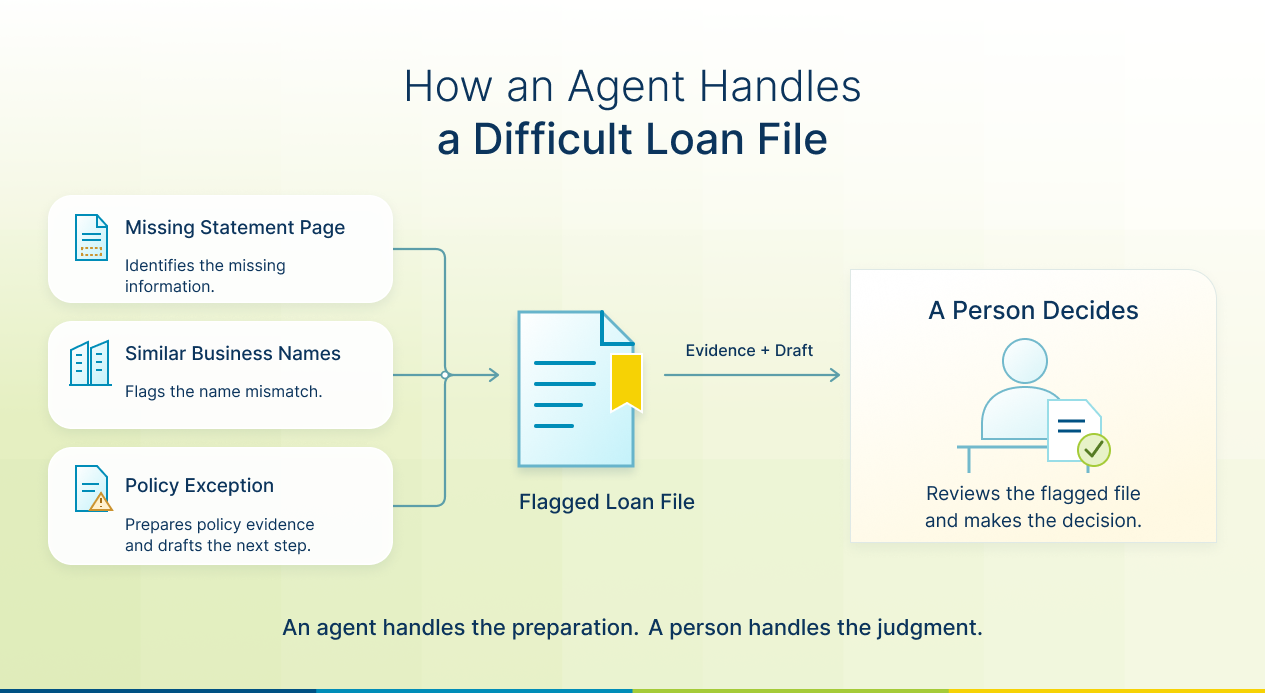
What agents handle well is assembly. They extract income lines, reconcile statements, test policy thresholds and draft the memo. What they do not handle is the judgment about an exception, a borrower whose story does not fit the template, or a relationship that changes the risk. Agent-assisted underwriting works when the underwriter spends the day on those judgments instead of on gathering the inputs. A vendor who says otherwise is describing the demo, not the desk.
Consider the demo, where the loan file is clean, every document is a crisp PDF and the agent sails through. In production, a borrower photographs a bank statement at an angle, two entities share a similar name and one policy clause has an exception that lives in a credit manager’s head. Agents earn trust by how they behave at that point, which is why exceptions get their own question later in this article. The gap between a demo and a desk is the most useful thing to measure when buying any agentic system.
Claim 3: “Drop-In AI That Works on Day One”
Time to value depends on data architecture and system connectivity. An agent that cannot read your loan management system, document store and CRM is a chat window with opinions. Gartner notes that integrating agents into legacy systems can be technically complex and can require costly modifications. Readiness is not glamorous, but a separate guide on data architecture readiness covers what has to be true before an agent has anything useful to read.
Where Agentic AI Delivers Real Value Today, By Lending Stage
Across the lending lifecycle the pattern holds: agents take assembly work and people keep decisions. That is the realistic scope today, and it is large, but none of it works out of the box. Each capability below depends on the agent having the right data access, validated rules and controls, and results vary by implementation. Every step should also be one a person can check.
Origination and Intake
Here is how agentic AI works in loan origination. An application arrives with attachments. The agent classifies each document, checks the package for completeness against the product’s requirements, detects duplicates and prior applications, and requests the missing items. Nothing here involves a credit judgment, and all of it consumes hours. Well-built loan origination workflows put this work in a queue that is already sorted when a person opens it.
Underwriting Prep
For underwriting prep the agent extracts data from statements and returns, runs policy-rule checks, performs serviceability calculations and drafts the credit memo with the figures and policy clauses attached. A credit analyst opens a prioritized queue where each application is already verified, calculated and summarized, and the first decision of the day is an exception on one file with the evidence beside it. For commercial lenders, AI agents for commercial lending workflows apply the same pattern to financial spreading, covenant checks and security summaries.
Servicing and Payments
In servicing, an agent with access to payment and account data can match payments to accounts, gather evidence on exceptions such as misapplied or returned payments, and draft allocation corrections for a person to approve. This is repetitive, high-volume work with a clear audit requirement, which makes it a natural place for agents once the data connections and reconciliation rules are in place.
Hardship and Collections
In hardship and collections, an agent can flag possible vulnerability indicators in payment patterns and contact history, check a hardship request against documented policy and draft an action plan, but only where those indicators and policies have been defined, validated and approved by the lender. A flag is a prompt for a trained person to look closer, not a conclusion. Collections communication is bounded by the Fair Debt Collection Practices Act and Regulation F, so the person who commits the action is also the person who answers for it. Agents earn their place in collections when they shorten the preparationu and leaves the contact to a trained person. A drafted plan that a hardship officer reviews in two minutes is a good outcome. An unsupervised message to a vulnerable borrower is not.
See how Prizm handles origination, servicing, and collections on one platform → Explore Prizm Lending Suite
Agentic AI vs. Traditional Lending Automation: A Practical Comparison
Agentic AI versus traditional loan automation is less a contest than a layering question, and the table shows where each approach fits.
The two are not rivals. Deterministic rules still hold your credit policy, and the agent calls them. For a deeper look at where each belongs, this comparison of rule-based vs AI decisioning covers what changes when volumes grow.
How to Evaluate Agentic AI Claims: Five Questions Every Lender Should Ask
These five questions separate agentic capability from rebranded automation, and they apply to any vendor that uses the word agentic. Each has a demonstrable answer, so ask to see it rather than hear it.
- Which actions can the system take on its own, and which need a named person to approve? Regulators, funders and boards expect clear accountability, and review should match the risk: routine, low-risk operational steps can run within approved limits, while credit decisions, policy exceptions and customer-impacting changes wait for a person with delegated authority. Some platforms follow a read → compute → draft → commit model in which consequential changes are committed only by a named person.
- What specific tasks does it perform end-to-end, and which still need manual steps? A credible vendor can list both. Vague coverage claims usually mean the manual steps are many.
- Does it work with your existing LMS and CRM, or does it require a platform replacement? Replacement changes the project from adding an AI layer to rebuilding your stack.
- What happens when it meets an exception it has not seen before? Give it your worst file. The answer should be a flag, a drafted next step and a named owner, not a silent guess.
- How is every AI-drafted action logged for audit and compliance? The log should show what the agent read, what it calculated, what it drafted and who approved it. A guide to explainable AI and regulatory risk explains why this record matters when an examiner asks.
What the Next 12 Months Look Like for AI in Lending
Three shifts are worth planning around over the next year.
The first is connectivity. The Model Context Protocol (MCP) is a standard that lets an AI agent discover and use a system’s data and actions. Salesforce, for one, announced in August 2026 that its AIforce harness exposes business data and workflows to agents through MCP servers, and lending platforms built on that kind of infrastructure become far easier for agents to work with. The second is scope: the market is moving from single-task bots, such as a document reader, toward multi-step workflow agents that carry a file from intake to a drafted decision.
The third is regulation, which is catching up unevenly. In April 2026, the Federal Reserve, OCC and FDIC issued revised interagency model risk management guidance, published as Federal Reserve SR 26-2, OCC Bulletin 2026-13 and FDIC FIL-15-2026. It replaced the agencies’ earlier model risk guidance, including the Federal Reserve’s SR 11-7 and SR 21-8 and the corresponding OCC and FDIC issuances, and takes a more risk-based approach. Generative and agentic AI are outside its formal scope, and the agencies have said they anticipate a request for information on AI models. Excluded does not mean exempt. The agencies expect such systems to follow a bank’s established risk management and governance practices, and third-party risk, fair lending and consumer protection requirements still apply. Credit unions and community lenders evaluating AI-powered lending platforms should expect examiners to ask the same questions they always ask about control, explainability and accountability. For the longer arc, see the evolution of credit decisioning systems.
On market size, The Business Research Company estimates the AI in lending market at about $14.7 billion in 2026 and $37.3 billion by 2030. Estimates vary widely between research firms, so treat any single figure as directional.
FAQs
What is agentic AI in lending?
Agentic AI in lending is software that pursues a goal, such as preparing a loan file for credit review, by planning its own steps, using tools like calculators and policy engines, and handing a drafted result to a person. It differs from rule-based automation because it adapts to the file in front of it, so a missing page or an unusual document produces a drafted next step instead of a failure. In regulated lending it works best when oversight matches risk, with people deciding on credit and exceptions, and the log records what the agent read, calculated and drafted.
How is agentic AI different from traditional loan automation?
Agentic AI differs from traditional loan automation in how it handles variation. Rules and RPA handle predefined exceptions and trigger fixed escalation paths, but cases nobody anticipated go to a queue. An agent can use its tools to investigate less predictable cases and prepare a context-specific next step for a person to review, within the permissions and controls the lender sets. Traditional automation remains the right tool for fixed policy thresholds, such as a maximum loan-to-value ratio, and agents typically call those rules rather than replace them. The two layers work together, with rules holding policy and agents handling the messy work between steps.
Can agentic AI replace human underwriters?
No, agentic AI cannot responsibly replace human underwriters today. Agents handle the assembly work, which includes data extraction, policy checks, serviceability calculations and a drafted credit memo, so the underwriter starts from a finished package. Underwriters keep judgment on exceptions, unusual borrowers and relationships, and Regulation B still requires accurate, specific principal reasons for any adverse action. The realistic change is where underwriters spend their time, not whether they are needed.
What does a lender need before implementing agentic AI?
A lender needs accessible data, a connected core lending system and clear decision rights before implementing agentic AI. Practically, that means loan records in structured form, API access to the loan management system and document stores, documented credit policy and defined approval authorities, because an agent can only follow rules that are written down. A scoped pilot on one workflow, such as document verification or credit memo preparation, is a sensible first step, with success measures agreed before it starts.
Is agentic AI in lending compliant with regulations?
Agentic AI in lending can be compliant when it operates within existing lending law and the lender’s own governance. Regulation B still requires specific principal reasons for adverse action, fair lending obligations still apply, and interagency third-party risk guidance still covers AI vendors. The April 2026 interagency model risk guidance places generative and agentic AI outside its formal scope, but the agencies expect banks to manage them through established risk management and governance practices, which in practice means a clear audit trail of AI-drafted actions and human approval for consequential decisions.


