%201.avif)
Why Data Architecture Matters More Than AI in Lending Transformation
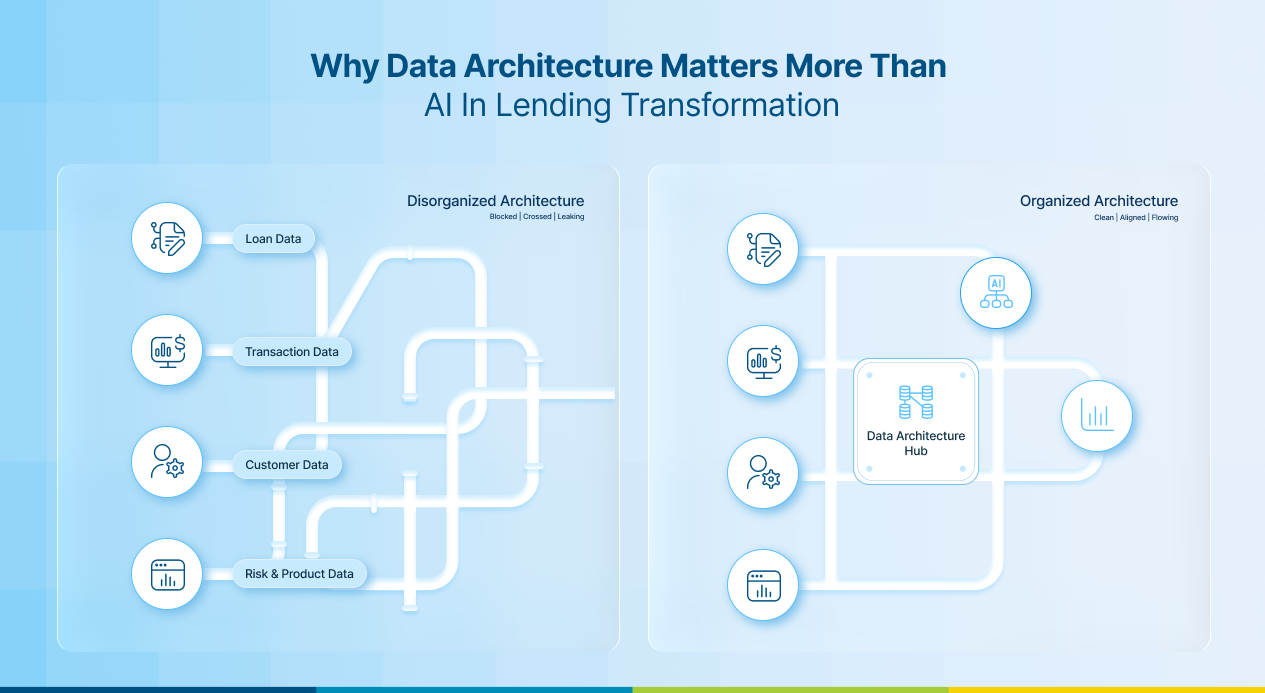
Every lender wants to talk about AI. Fewer want to talk about the data architecture underneath it, even though that's the part deciding whether the AI works at all. Data architecture is the structured framework that governs how financial data is collected, stored, connected, and made available across systems, and it is the real foundation of any lending transformation effort. Without it, even the most advanced models make decisions on incomplete or inconsistent information.
This matters because lenders are under pressure to modernize fast. Boards want AI in financial services rolled out this quarter, and vendors are happy to promise instant results. But an AI model bolted onto fragmented systems will only automate bad decisions faster. The lenders getting real results in their lending transformation journey are the ones who fixed their data foundation first, then layered automation on top of it.
What Is Data Architecture in Lending?
Data architecture in lending is the blueprint that defines how loan, borrower, and transaction data moves between origination, servicing, and collections systems, and how it stays accurate and accessible at every stage. This same blueprint decides whether credit decisioning happens in minutes or days.
Think of it as the plumbing behind a bank. Customers never see it, but if a pipe is blocked or two pipes are crossed, nothing downstream works properly. A lender's underwriting team, collections team, and compliance team all pull from the same well. If that well holds duplicate records or outdated fields, every team downstream inherits the problem.
Most lenders don't lack data. They lack a coherent enterprise data architecture that connects it. Loan applications sit in one system, credit bureau pulls in another, repayment history in a third, and collections notes in a spreadsheet nobody updates consistently. Each system might work fine on its own. Together, they create blind spots that no AI model can see past, no matter how much money is spent on the model itself.
Weak financial data management is rarely a technology gap on its own. It is usually an organizational one, where departments built their own systems for their own needs without a shared plan for how records would connect. Fixing that is slower than buying an AI tool, but it is the step that actually determines whether AI in financial services delivers results or just adds another dashboard nobody trusts.
Why AI Alone Cannot Drive Lending Transformation
AI is only as reliable as the data feeding it. A credit risk model trained on incomplete borrower histories will produce confident, wrong answers, and confidence is exactly what makes bad automated decisions dangerous. Lenders that skip straight to AI in financial services without addressing their underlying data structure often end up automating errors at scale rather than solving them.
This is why lending transformation efforts that lead with AI tend to stall. The pilot works in a demo environment with clean sample data. It breaks the moment it touches production systems where records are duplicated, fields are missing, and definitions of "active loan" or "delinquent account" differ from one department to the next.
Gartner has pointed out that a large share of generative AI projects get abandoned after the proof-of-concept stage, citing poor data quality as one of the leading reasons. Stitching AI onto fragmented lending systems does not fix that underlying problem. It just adds a faster engine to a car with a cracked frame.
How Enterprise Data Architecture Powers Credit Decisioning
Credit decisioning depends entirely on the quality and completeness of the data behind it. This strong foundation gives underwriters a single, reliable view of a borrower instead of forcing them to reconcile numbers across five different systems.
Here's what that data foundation typically needs to support accurate credit decisioning:
- A single source of truth for borrower identity, income, and repayment history across origination and servicing
- Real-time data synchronization so risk scores reflect the borrower's current standing, not last month's snapshot
- Standardized data definitions so "default," "delinquency," and "restructured loan" mean the same thing across every team
- Audit-ready data lineage so regulators and internal risk teams can trace exactly where a number came from
- Scalable storage and access controls so growing loan volumes do not slow down decisioning or compromise security
When these pieces are in place, credit decisioning becomes faster and more consistent, and any AI layered on top actually has something reliable to work with.
Financial Data Management and the Real Cost of Getting It Wrong
Financial data management is not a back-office concern. It is a direct driver of loss rates, compliance exposure, and customer experience. Disconnected systems create hidden costs tied to non-performing assets, processing delays, and compliance risk, and these costs of data silos in lending compound the longer they go unaddressed.
Two examples make this concrete.
A regional commercial lender ran loan origination, servicing, and collections on three separate platforms with no shared data layer. Underwriters manually re-entered borrower details that already existed elsewhere in the business, which meant transposition errors slipped into credit files. When the lender consolidated these systems onto one unified system, average time to decision dropped significantly because underwriters stopped chasing information that already existed somewhere in the organization.
An asset finance company managing equipment loans found that its collections team had no visibility into recent payment modifications made by the servicing team. Borrowers who had already renegotiated terms were still receiving collection calls, damaging trust and creating unnecessary compliance risk. A connected system closed that gap by giving both teams access to the same live record.
Neither fix involved AI. Both involved rebuilding the financial data management layer so the right information reached the right team at the right time.
Building a Data Architecture That Actually Supports Lending Transformation
Lenders serious about lending transformation should treat this foundation as the first project, not the last. A few practical steps make the difference between a modernization effort that sticks and one that stalls.
Start by mapping every system that touches loan data, from origination through collections, and identify where the same borrower record exists in more than one place. Then standardize data definitions across departments so risk, compliance, and operations work from the same vocabulary. From there, prioritize real-time connectivity between origination, servicing, and collections so decisions reflect current information rather than outdated snapshots. Finally, build in audit trails from day one, since regulators increasingly expect lenders to explain what a model decided and what data it decided on.
Centralized loan management systems eliminate the fragmentation that data silos create across origination, servicing, and collections, giving lenders a foundation that any future AI investment can actually build on. Platforms like Prizm Lending Suite are built around this principle, connecting origination, servicing, and collections on one shared foundation instead of layering automation over disconnected systems.
McKinsey's research on core banking modernization found that choosing the right data architecture can cut a bank's implementation time roughly in half and lower costs by around 20 percent, which underscores why this groundwork matters before scaling any AI initiative.
Signs Your Lending Data Architecture Needs Fixing First
Before adding any AI tool, it helps to know whether the underlying data foundation can actually support it. Here are five signs that this foundation, not AI, should be the next investment:
- Underwriters re-key the same borrower details that already exist somewhere else in the business
- Risk and collections teams disagree on a borrower's current status because they are looking at different systems
- Reports take days to compile because someone has to manually reconcile numbers from multiple platforms
- New products or regulatory changes require IT tickets across five separate systems instead of one update
- Past AI or analytics pilots stalled after the demo stage because production data did not match the clean sample data used to test them
If two or more of these sound familiar, the priority is fixing enterprise data architecture, not shopping for another model. Financial data management that is fragmented at this level will undermine any AI in financial services investment layered on top of it, regardless of how sophisticated the model is.
The Order Matters: Architecture First, AI Second
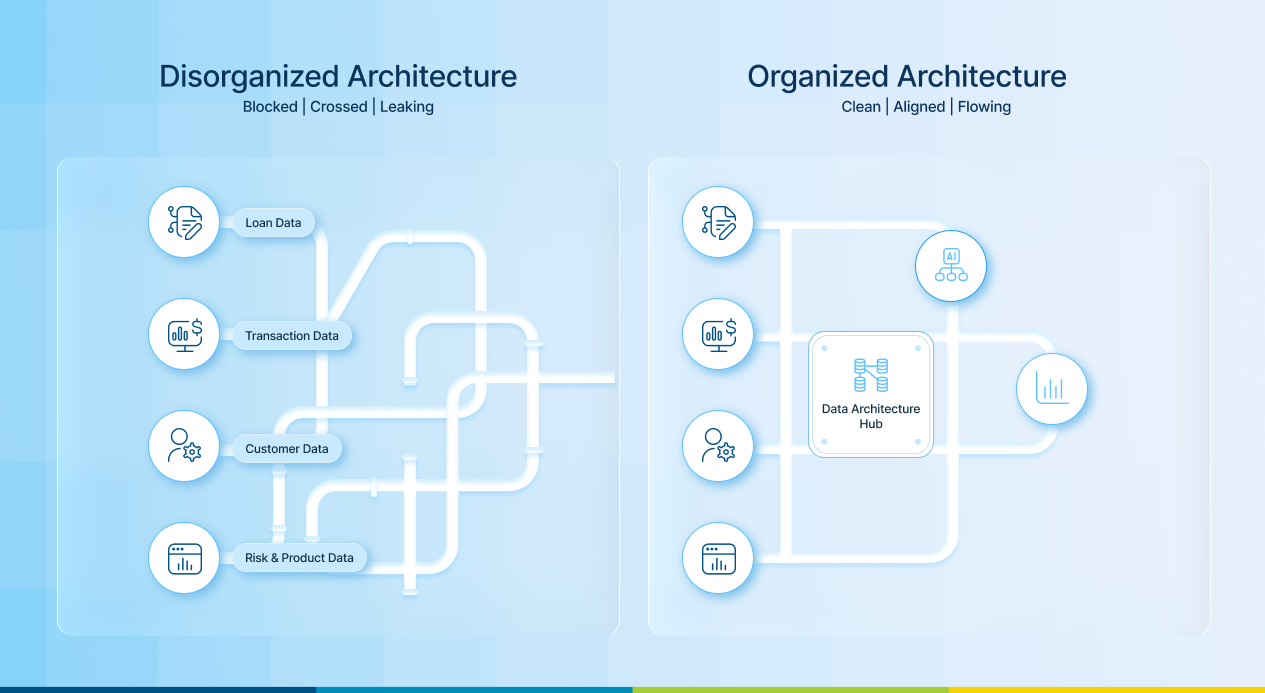
Lending transformation is not a race to add AI features. It is a disciplined rebuild of the data foundation that makes AI trustworthy. A fragmented data foundation is consistently among the root causes cited when AI initiatives stall after the pilot stage. Lenders that invest in enterprise data architecture first give every future AI initiative, from credit decisioning models to fraud detection, a real chance of working as intended.
Getting this order right also changes how quickly a lender can respond to new regulatory requirements or market conditions. A lender with a connected data foundation can update a policy once and see it reflected everywhere. One without it has to chase the same change across five disconnected systems, often introducing new inconsistencies in the process.
Better visibility into unified customer profiles also improves underwriting and collections outcomes at the same time, since both teams work from one accurate borrower record instead of separate versions of the truth.
If your lending transformation roadmap starts with AI tools before your data foundation is ready, it is worth pausing to fix that first. Getting this right is what separates lenders who see real returns from AI in financial services from those still stuck in pilot mode. Book a demo to see how a connected lending platform can bring your origination, servicing, and collections data together before you scale AI on top of it.
FAQs
What is data architecture in lending?
Data architecture in lending is the structured framework that defines how loan and borrower data is collected, stored, and shared across origination, servicing, and collections systems. It ensures every team works from the same accurate, up-to-date information rather than isolated versions of the truth.
Why does data architecture matter more than AI in lending transformation?
Data architecture matters more than AI because AI models are only as accurate as the data they are trained on. Without a solid enterprise data architecture, AI in financial services amplifies existing data problems instead of solving them, which is why so many pilots never reach production.
How does enterprise data architecture improve credit decisioning?
Enterprise data architecture improves credit decisioning by giving underwriters a single, real-time view of borrower data instead of fragmented records spread across multiple systems, which reduces errors and speeds up approvals. This detailed <a href="https://finspectra.com/blog/loan-management-system-guide">guide to loan management systems</a> covers how this connectivity works in practice.
Can financial data management reduce compliance risk?
Financial data management can reduce compliance risk by creating clear audit trails and standardized data definitions, making it easier for lenders to show regulators exactly how and why a decision was made.
Do lenders need to fix data architecture before adopting AI?
Lenders need to fix data architecture before adopting AI because clean, connected data is what allows AI models to produce reliable, explainable outcomes rather than fast but flawed decisions.
.png)

.png)
.png)


