%201.avif)
Why Gig Worker Income Is Becoming One of the Hardest Things to Underwrite
.png)
More than a third of the US workforce now earns some income outside a single traditional paycheck. Freelance work, platform gigs, contract projects, side income stacked on top of a regular job.
Most lending systems still run on a much older assumption. One employer. One steady paycheck. One W-2 at tax time.
For lenders modernizing their technology stack, consumer lending software can help bring alternative income verification into the underwriting workflow.
Gig worker income verification isn't a paperwork inconvenience off to the side of underwriting. It's a verification problem, a fraud problem, and a turnaround-time problem, all at once, in the same application. Get it wrong, and a lender either rejects good borrowers by default or opens the door to exactly the kind of income misrepresentation fraud teams worry about most.
This piece looks at why traditional verification rejects otherwise qualified applicants, what needs to change in how lenders check income, and why doing gig worker income verification well means more rigor, not less.
Key Takeaways
- Gig worker income verification fails most often because underwriting systems are built around one steady paycheck, not several irregular income streams.
- Alternative income verification through bank statements and consumer-permissioned data can qualify real income a pay stub never shows, but it needs its own fraud and consistency checks.
- Income and employment misrepresentation is already a major source of lending fraud, so faster gig income verification has to mean more scrutiny, not less.
- Open banking rules under Section 1033 are finalized on paper but currently blocked in court, so consumer-permissioned data access still runs through private aggregators, not a federal mandate.
- Lenders who solve gig worker income verification well pick up qualified applicants their competitors are still rejecting by default.
How Many Borrowers Now Have Gig or Multi-Source Income
The scale of this shift depends on which definition you use. That's worth being upfront about.
- The Bureau of Labor Statistics' Contingent Worker Supplement uses a narrow, official definition. It found that 10.2 percent of US workers held an alternative work arrangement as their main job in 2023, including 7.4 percent working as independent contractors.
- McKinsey's research takes a broader view. Its 2022 American Opportunity Survey found 36 percent of employed respondents, roughly 58 million Americans, identify as independent workers, up from 27 percent in 2016.
- Upwork's Freelance Forward research goes broader still, counting any paid freelance work in the past year, including side income alongside a full-time job. That measure puts 64 million Americans, 38 percent of the workforce, doing some form of freelance work in 2023.
None of these numbers are wrong. They're measuring different things. What they agree on is the direction. Fewer borrowers fit neatly into the single-employer, single-paycheck box most underwriting systems were built around. Gig worker income verification has quietly become a mainstream underwriting problem instead of a niche one, and it keeps growing every year.
Why Traditional Income Verification Rejects Otherwise Qualified Applicants
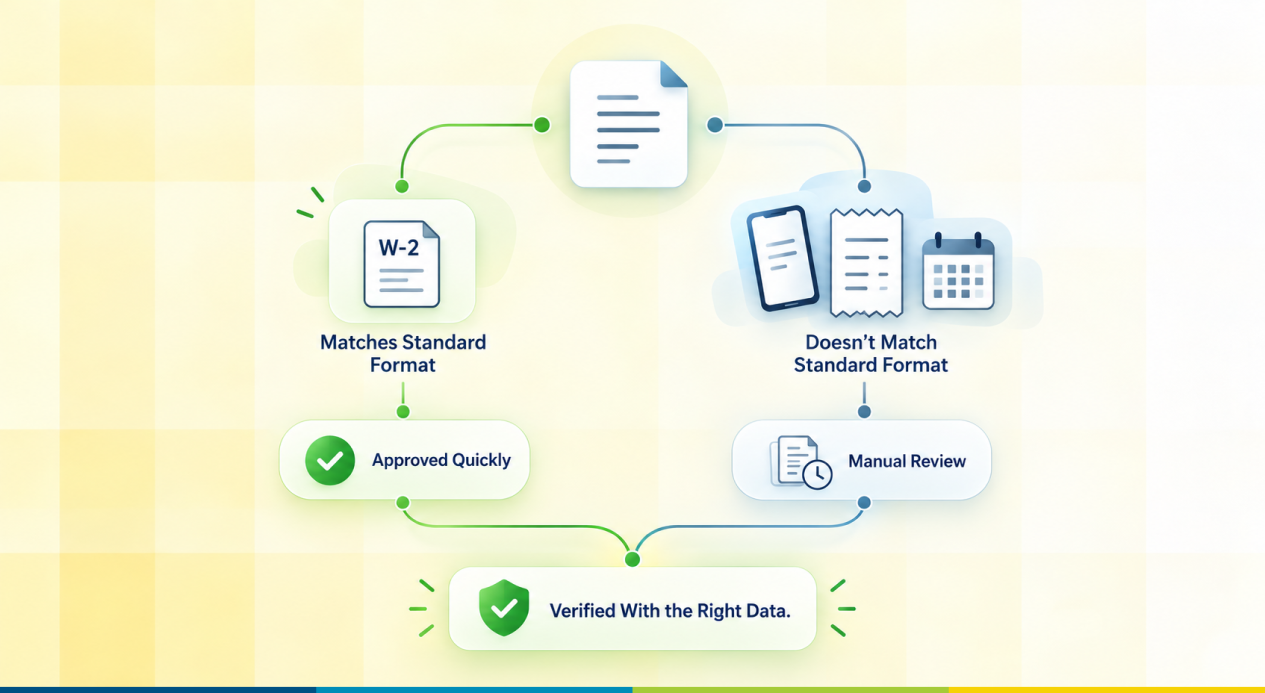
Standard income verification wants one thing above all else: a clean, predictable number. A W-2 and two recent pay stubs answer that question in seconds.
A borrower with three income sources doesn't fit that format at all. Say a rideshare gig, a freelance design contract, and a part-time retail shift. Their combined monthly income might comfortably cover the loan. The paperwork still doesn't match.
The rejection usually isn't a credit decision. It's a documentation mismatch. The underwriting system has no clean field for "average monthly income across three variable sources." So the file gets kicked to manual review, or declined outright for lack of standard proof.
That mismatch is a large part of why loan approvals still take days for applicants who don't fit the traditional mold. The application isn't more complicated to evaluate. It's just harder to document in a system that was never built to hold that kind of income. That's the exact gap gig worker income verification has to close.
Bank Statement and Consumer-Permissioned Data as Alternatives to W-2s
Effective gig worker income verification usually starts with bank statement income verification. Instead of asking for proof from an employer, it looks at what actually moved through a borrower's accounts. Direct deposits, recurring transfers, and payment patterns that show real, sustained income, even without a single traditional paystub.
Consumer-permissioned data goes a step further. With the borrower's consent, a lender can pull verified account and transaction data directly through an aggregator, instead of relying on the borrower to upload statements manually.
It's worth being precise about where the regulatory framework for this stands today. The CFPB finalized its Section 1033 open banking rule in 2024. A federal court has since enjoined the CFPB from enforcing it while the rule goes through reconsideration. In practice, consumer-permissioned data sharing today runs through private aggregator agreements, not a binding federal mandate. Lenders should treat it that way in their compliance planning.
None of this works well bolted onto a system built for pay stubs. It works when a lender has unified customer profiles that improve underwriting, pulling bank data, gig platform data, and traditional documentation into one view instead of three disconnected checks.
Fraud and Consistency Checks Irregular Income Actually Needs
This is the part of gig worker income verification that gets skipped most often, and it's the one that matters most for risk. Alternative income verification and 1099 income verification only work if they come with fraud and consistency checks built for irregular income, not the same checks used for a salaried applicant.
Point Predictive's 2026 Auto Lending Fraud Trends Report found that income and employment misrepresentation now accounts for 45 percent of total lending fraud exposure, up 21 percent year over year. That's not a reason to avoid serving gig applicants. It's a reason to build verification that actually holds up.
Gig worker income verification done properly runs a few checks that matter more here than in traditional underwriting:
- Consistency across sources. Does the income reported on the application match what's actually landing in the bank account, month over month?
- Platform-level verification. Where possible, confirm income directly with the gig platform, not just the borrower's own statement of earnings.
- Pattern stability over time. A three-month snapshot can look very different from a twelve-month one. Irregular income needs the longer window to be read accurately.
Lenders who skip this and rely on whatever documentation a borrower happens to submit are the same lenders who end up managing exceptions in spreadsheets outside the core system. That creates its own compliance exposure down the line. A file that slips through weak gig worker income verification today tends to surface again later, usually as a delinquency or a fraud loss nobody flagged at underwriting.
How This Affects Approval Rates and Turnaround Time
Weak gig worker income verification creates two problems at once. Files are more likely to get flagged for manual review because they don't match a standard documentation template. Manual review takes longer than automated verification, by definition.
The result is a slower process on top of a higher rejection rate for applicants whose actual income may be perfectly sound.
This is fixable without cutting corners. Lenders who cut turnaround time and eliminate processing delays for standard applications can apply the same automation logic to alternative income verification, as long as the underlying data and fraud checks are built for it. Faster doesn't mean looser here. It means moving manual effort away from data gathering and toward the judgment calls that actually need a human.
What Lending Software Needs to Verify Non-Traditional Income at Scale
Handling gig worker income verification at real volume, not as an occasional exception, takes a few specific capabilities. Most loan origination software and loan underwriting software weren't built with these from the start.
- Configurable income aggregation. The system needs to combine multiple income sources into one usable figure, instead of forcing every source into a single-employer field.
- Native bank statement analysis. Automated parsing of transaction data, not a PDF someone reviews by hand.
- Consistent, documented decisioning rules. The kind of consistency covered in rule-based vs AI credit decisioning at scale, so two similar gig applicants get evaluated the same way regardless of who reviews the file.
- Fraud checks built for variable income patterns, not repurposed from salaried-borrower fraud models that were never designed to catch income inflation on a freelance file.
None of this is unprecedented. Fannie Mae's own selling guide already lays out standards for documenting self-employed and alternative income through bank statements and cash flow analysis. The real question for most lenders isn't whether alternative income verification is legitimate. It's whether their loan underwriting software can actually run gig worker income verification at scale, instead of one manual exception at a time.
Summary
- Gig and freelance income now touches somewhere between one in ten and nearly four in ten US workers, depending on definition, and every measure points in the same direction.
- Traditional income verification rejects gig applicants for documentation mismatches, not for genuine credit risk.
- Bank statement and consumer-permissioned data can verify real income, but only when paired with fraud and consistency checks built for irregular earnings.
- Faster gig worker income verification has to mean more rigorous checks, not fewer, given how much lending fraud already comes from income misrepresentation.
- The lenders solving this well aren't lowering their standards. They're building systems that can actually see income that already exists but doesn't fit the old format.
Getting gig worker income verification right isn't about relaxing underwriting. It's about giving the underwriting system a way to see income that's already real, just structured differently than it used to be. As gig and multi-source income keeps climbing, gig worker income verification stops being an edge case. It becomes a core underwriting function every consumer lender needs to get right. Our 10-point readiness checklist is a useful place to start for lenders assessing whether their current stack can handle this at volume.
FAQs
What is gig worker income verification?
Gig worker income verification is the process of confirming a borrower's income when it comes from freelance, contract, or platform-based work rather than a single traditional paycheck. It typically uses bank statements, platform data, or consumer-permissioned account access.
Why do gig workers get rejected more often for loans?
Gig workers often get rejected because their income doesn't fit standard documentation formats, not because their income is insufficient. Underwriting systems built for single-employer pay stubs frequently flag or decline files that don't match that template.
Is bank statement income verification reliable?
Yes, when paired with proper fraud and consistency checks, which is exactly what good gig worker income verification requires. Bank statement analysis over several months can verify real, sustained income patterns, but it needs longer observation windows and platform-level checks to catch inflated or misrepresented figures.
Does open banking data sharing apply to lenders today?
Not as a binding federal requirement. The CFPB finalized its Section 1033 rule in 2024, but a court has enjoined enforcement while the rule is reconsidered. Consumer-permissioned data access currently runs through private aggregator agreements instead.
.png)

.png)


