%201.avif)
How Commercial Lending Software Helps Banks Compete With Faster-Moving Private Lenders
.png)
Every credit committee has heard some version of the same story by now. A borrower took the bank's term sheet to a private credit fund, and the fund closed first. The private credit vs bank commercial lending comparison gets framed as a simple story: private credit is faster, banks are slower, end of discussion.
That framing skips the more useful question. Some of that gap is permanent, tied to capital rules banks can't opt out of. Some of it is just a slow process, and that part is fixable. That is the key issue in the private credit vs bank commercial lending debate.
This piece is written for the lender's side of that decision, not the borrower's, and it looks at exactly where the private credit vs bank commercial lending gap comes from and what a bank can actually do about it.
Key Takeaways
- The private credit vs bank commercial lending speed gap has two separate causes. One is regulatory and permanent. The other is operational and fixable.
- Private credit deals often close in four to six weeks. Comparable bank commercial loans commonly take eight to fourteen weeks. That gap comes mostly from fragmented, sequential internal processes, not from banks being inherently slower institutions.
- Federal Reserve research shows banks are also a major funder behind private credit, and that lending performs well for them. The two sides aren't purely rivals.
- Commercial lending software closes the timing gap by parallelizing review and automating routine underwriting steps. It does not, and cannot, close the leverage or covenant flexibility gap tied to bank capital requirements.
- Private credit AUM estimates vary by thousands of billions depending on which firm you ask, because "private credit" itself gets defined differently across reports.
How Private Credit Pulled Ahead on Speed
Private credit funds aren't bound by the same capital and underwriting infrastructure that shapes a bank's commercial lending process. A single credit team can originate, underwrite, and close a deal with far fewer internal handoffs, because there's no separate risk committee, no core banking system to reconcile against, and often no regulator reviewing the file after the fact.
Growth estimates for private credit vary depending on what each source includes. Moody's expects assets under management to exceed $2 trillion in 2026 and approach $4 trillion by 2030. PwC's 2026 survey puts the 2030 figure at about $3.4 trillion, while IQ-EQ, citing Preqin, estimates $4.5 trillion.
The difference comes down largely to how private credit is defined. Some sources count only direct lending, while others also include asset-backed finance, distressed debt, mezzanine capital, and other strategies.
That is why there is no single AUM figure that everyone uses. For banks, that growth has made private credit vs bank commercial lending a bigger strategic issue.
Whatever may be the precise figure, the direction is the same. Private credit has become a real destination for the kind of mid-market commercial deals banks used to originate almost by default, and that shift is what's driving the private credit vs bank commercial lending comparison into boardroom conversations at institutions that used to ignore it.
Private Credit vs Bank Commercial Lending: A Side-by-Side Comparison
The private credit vs bank commercial lending comparison is easier to understand when the key differences are set out side by side.
Factor
Private Credit Funds
Bank Commercial Lending
Typical time to close
4 to 6 weeks
8 to 14 weeks
Underwriting process
Single team, fewer handoffs
Sequential review across credit, risk, and compliance
Leverage and covenant flexibility
Higher, not capital-constrained
Limited by regulatory capital requirements
Regulatory oversight
Lighter, less standardized
Heavy, subject to bank supervision
Cost of capital to borrower
Typically higher
Typically lower
Funding source
Institutional investors, and often bank credit lines
Deposits and wholesale funding
The table makes the private credit vs bank commercial lending comparison look simple. In practice, the two rows aren't as separate as they look, which is exactly what the next section gets into.
The Nuance Everyone Skips: Banks Are Also Financing Private Credit
Most coverage of this topic treats private credit as a threat eating into bank market share. That's an incomplete picture. Federal Reserve research from Berrospide, Cai, Lewis-Hayre, and Zikes found that bank credit lines extended to private credit vehicles carry higher interest rates, lower default probability, and lower delinquency than the lending banks extend to other nonbank financial intermediaries.
In plain terms, banks are quietly one of the biggest funders standing behind the private credit boom, and that funding performs well for them.
This changes the private credit vs bank commercial lending narrative in a meaningful way. Banks aren't purely losing ground to private credit. In many cases, they're financing it from the other side of the balance sheet, collecting attractive, well-collateralized returns on the credit lines that let private credit funds move fast in the first place.
The two channels are increasingly interconnected rather than strictly competing for the same dollar. That makes private credit vs. bank commercial lending more complex than a simple bank vs private credit story.
Why Some of the Gap Can't Be Fixed With Software
Part of private credit's advantage is structural, and no amount of automation changes it. NBER research comparing bank and private credit fund balance sheets found that equity typically funds 65 to 80 percent of a private credit fund's balance sheet, compared with roughly 10 percent for a US commercial bank.
That difference reflects capital regulation, not operational choice. Banks hold far less equity per dollar of assets because deposit funding is cheaper, and that same regulatory framework caps how much leverage and covenant flexibility a bank can extend on a single deal.
This is an important part of the private credit vs bank commercial lending gap, but it is not a software problem. Better commercial lending software will not let a bank match private credit's leverage or covenant terms.
That gap is regulatory capital, not technology, and pretending otherwise won't survive contact with a credit committee that actually understands capital requirements.
Why Loan Approvals Still Take Weeks at Most Banks
The part of the gap that is fixable comes down to how a bank's internal process is built, not what it's allowed to lend. When underwriting and legal review run sequentially instead of concurrently, each stage can leave the next team waiting.
That adds time to a deal without changing the underlying credit decision. In private credit vs bank commercial lending, this is the part banks can change.
A few patterns show up consistently in banks still working through this:
- Manual handoffs between teams. A file moves from credit to risk to compliance to legal, each step waiting for the last one to finish instead of running in parallel.
- Underwriting logic that lives in people, not systems. Two similar deals can get inconsistent treatment depending on who's reviewing the file that week.
- Committee structures built for a slower era. Multiple sign-off layers that made sense for a smaller loan book start to strain once volume and deal complexity increase.
This is exactly why commercial lending breaks down at scale, and it's also why loan approvals still take days at institutions that haven't addressed it directly.
What Commercial Lending Software Can Actually Fix
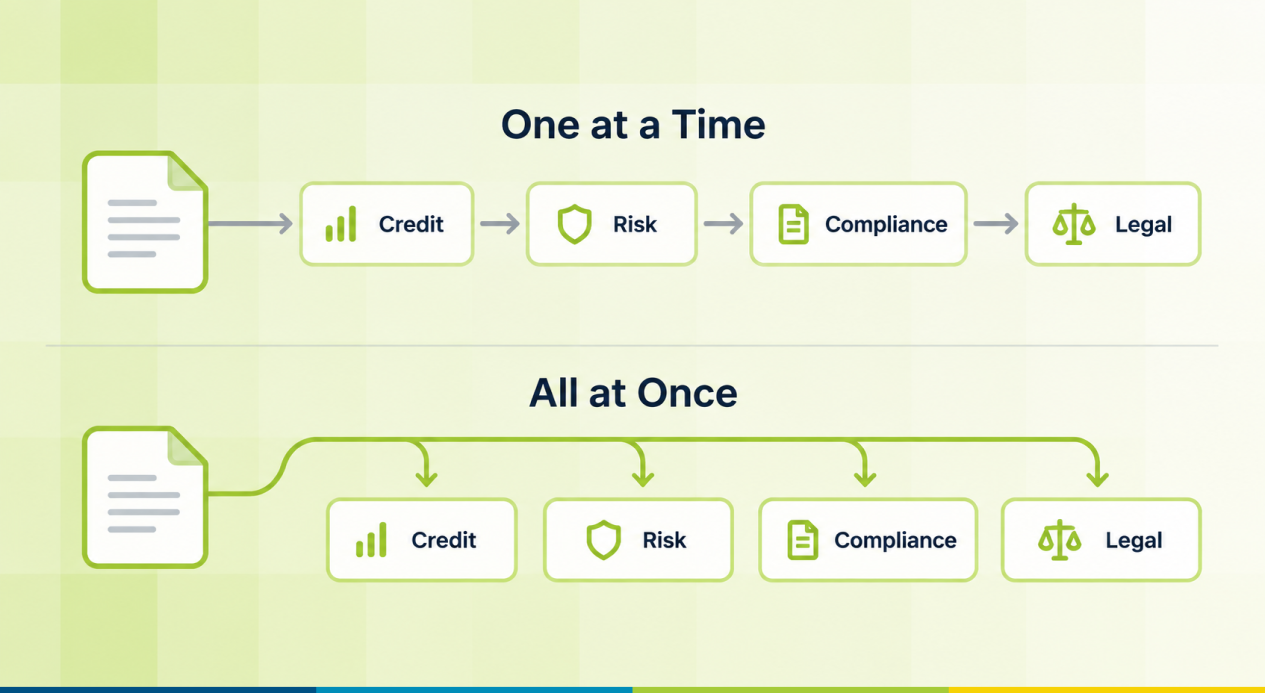
This is the part of the private credit vs bank commercial lending gap that's actually within a bank's control. Modern commercial lending software addresses the timing problem in a few concrete ways, without touching the capital constraints that are genuinely fixed.
- Parallel review instead of sequential handoffs. Credit, risk, and compliance can work from the same file at the same time instead of waiting in line.
- Configurable, rules-based underwriting. Consistent decisioning that doesn't depend on which underwriter happens to pick up the file.
- Automated document and data collection. Less time spent chasing financials and verifying inputs by hand.
- Real-time pipeline visibility. Leadership can see where every deal actually stands instead of asking for a status update.
This is where technology can make a real difference in private credit vs bank commercial lending.
Banks that have made this shift report meaningfully shorter turnaround times. Our piece on how lenders cut TAT and eliminate processing delays covers the mechanics in more depth, and our guide to how banks reduce approval turnaround without increasing credit risk addresses the concern credit committees raise most often: that speed and risk discipline are a trade-off. They don't have to be, if the automation is applied to process, not to judgment.
A Practical Path for Banks to Close the Timing Gap
Closing this gap doesn't require matching private credit's capital structure, since that's not on the table. It requires treating the operational side of the private credit vs bank commercial lending gap as solvable, because it is.
A reasonable starting point for improving the private credit vs bank commercial lending process looks like this. Map the current approval path end to end, and mark every point where a file sits waiting on a handoff rather than moving. Identify which underwriting decisions can run on consistent, documented rules instead of individual judgment, drawing on the tradeoffs covered in rule-based vs AI credit decisioning at scale.
Pilot parallel review on a single loan segment before rolling it out across the full commercial book. Our 10-point readiness checklist is a useful gut check before starting that process.
Summary
- The private credit vs bank commercial lending gap has a regulatory piece that's permanent and an operational piece that isn't.
- In private credit vs bank commercial lending, speed often comes from fewer handoffs and faster review, not from better information.
- Federal Reserve data shows banks are also a major financier behind private credit, earning strong risk-adjusted returns on that lending.
- Software can close the timing gap through parallel workflows and consistent decisioning. It cannot close the leverage gap tied to bank capital rules.
- Banks that treat the fixable part of this gap seriously can compete on speed without taking on capital risk they aren't built to carry.
Closing the private credit vs bank commercial lending gap isn't about becoming a private credit fund. It's about removing the internal friction that has nothing to do with regulation and everything to do with process design that hasn't been revisited in years.
Commercial lending software can help banks address that operational gap with faster workflows, consistent decisioning, automated processes, and better visibility across the lending lifecycle. Book a demo to see how Finspectra helps lenders reduce the process delays that stand between a sound credit decision and a faster close.
FAQs
Why is private credit growing faster than bank commercial lending?
Private credit funds face fewer internal handoffs and lighter regulatory constraints, letting them close deals in weeks rather than months. Growth also reflects rising borrower demand for flexible, fast-closing capital that banks' current processes often can't match.
Can banks match private credit's deal speed without increasing credit risk?
Yes, in the areas where process, not capital, drives the delay. Parallel review, consistent rules-based underwriting, and automated documentation cut turnaround time without loosening credit standards or the judgment behind approval decisions.
What types of commercial lending software help banks compete with private lenders?
Platforms that support parallel workflow routing, configurable underwriting rules, automated document collection, and real-time pipeline visibility address the operational causes of slow approvals directly, without requiring changes to credit policy itself.
Are borrowers choosing private credit only because of speed?
No. Speed matters, but borrowers also value flexible structuring, higher leverage, and looser covenants, features tied to private credit's capital structure rather than to any technology bank commercial lending currently lacks.
.png)

.png)


