%201.avif)
How Banks Modernize Commercial Lending Without Replacing Core Banking
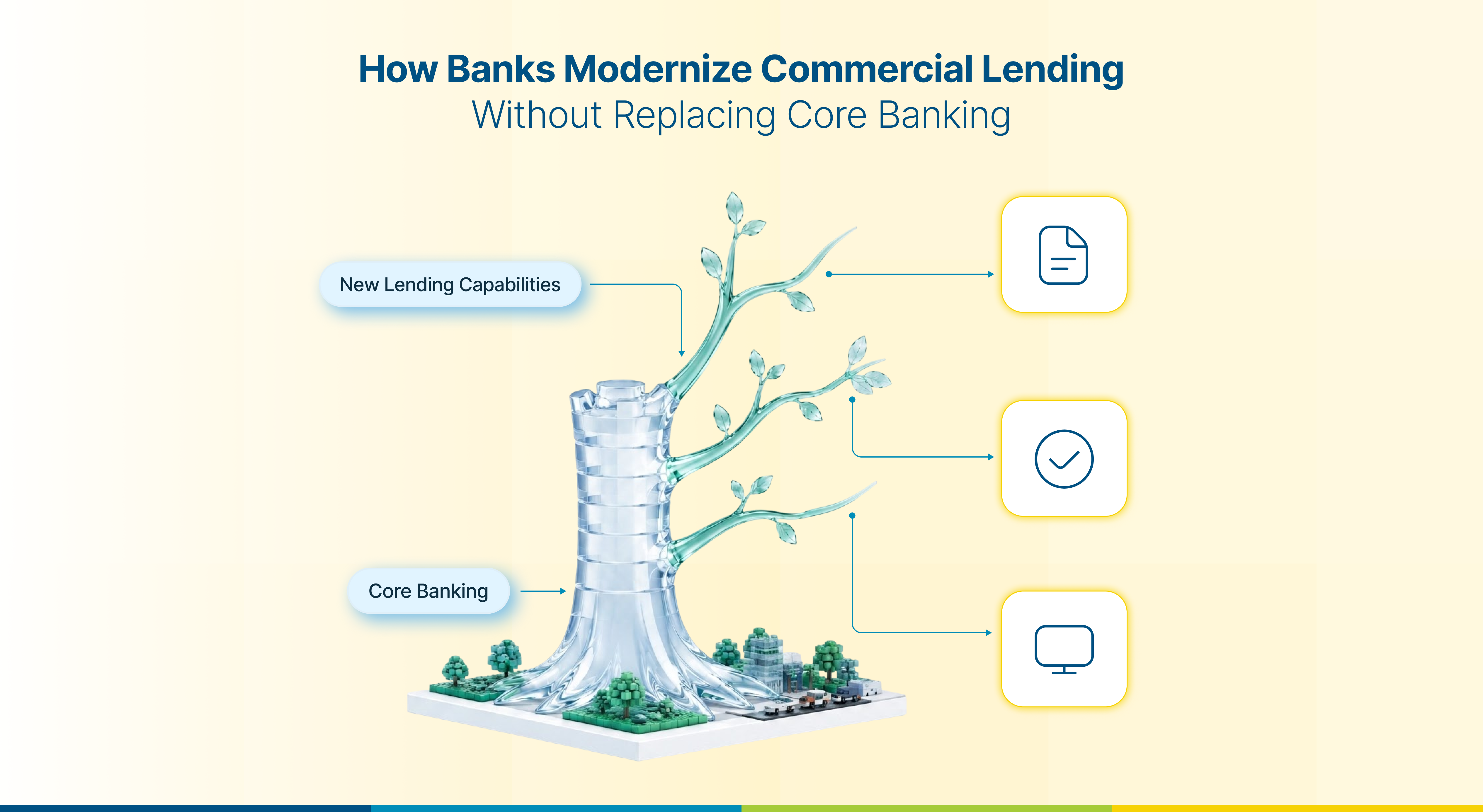
For many banks, the biggest obstacle to modernizing commercial lending isn’t the core banking system. It’s everything happening around it.
Applications still arrive through email or paper forms. Financial data gets entered into spreadsheets. Credit teams chase documents and approvals manually. Relationship managers have limited visibility into where a deal stands. None of these processes necessarily require a new core banking platform, but they can make commercial lending slower and harder to scale.
A modern commercial lending system can address these gaps while leaving the core in place. The lending layer handles applications, document collection, credit analysis, underwriting, approvals, and portfolio monitoring, while the core continues to manage accounts, transactions, and the general ledger.
For banks, this creates a more practical modernization path: improve the lending experience and operations without taking on the cost, disruption, and risk of replacing infrastructure that already performs its core functions.
Why Banks Are Modernizing Commercial Lending
Commercial lending has stayed manual longer than most other banking functions. Applications move through email. Financial statements get spread by hand into spreadsheets.
Approval routing depends on someone remembering to forward a file.
McKinsey's research on corporate loan operations found that email communication remains common in commercial lending, and spreadsheets are still widely used for financial modeling and data analysis, even at large institutions. That gap is exactly what a modern commercial lending system is built to close.
The pressure to fix this is coming from a few directions at once:
- Borrower expectations. Commercial clients increasingly compare their bank's process to consumer lending, where approvals happen in minutes, not weeks.
- Competitive pressure. Fintech lenders and non-bank commercial lenders are winning deals on speed alone.
- Internal cost. Manual spreading, manual routing, and manual document chasing all consume credit team hours that a commercial lending system can automate.
Why Replacing Core Banking Isn't Always the Answer
Core replacement sounds like the obvious fix, until you look at what it actually costs. TSB Bank's 2018 core migration is still cited as a cautionary example: a single cutover led to more than 230 days of disruption and roughly £400 million in total costs once losses, regulatory fines, and remediation were included.
Most banks don't have the appetite for that kind of risk, and most don't need to take it. The core banking system is built to handle accounts, transactions, and general ledger functions. It was never designed to run modern commercial loan origination, credit analysis, or digitized document collection well.
Asking it to do so, or replacing it entirely just to get those capabilities, both miss the point.
The more practical path is treating the core as the system of record it's meant to be, and building commercial lending capability in a separate layer that connects to it.
What a Modern Commercial Lending Stack Looks Like
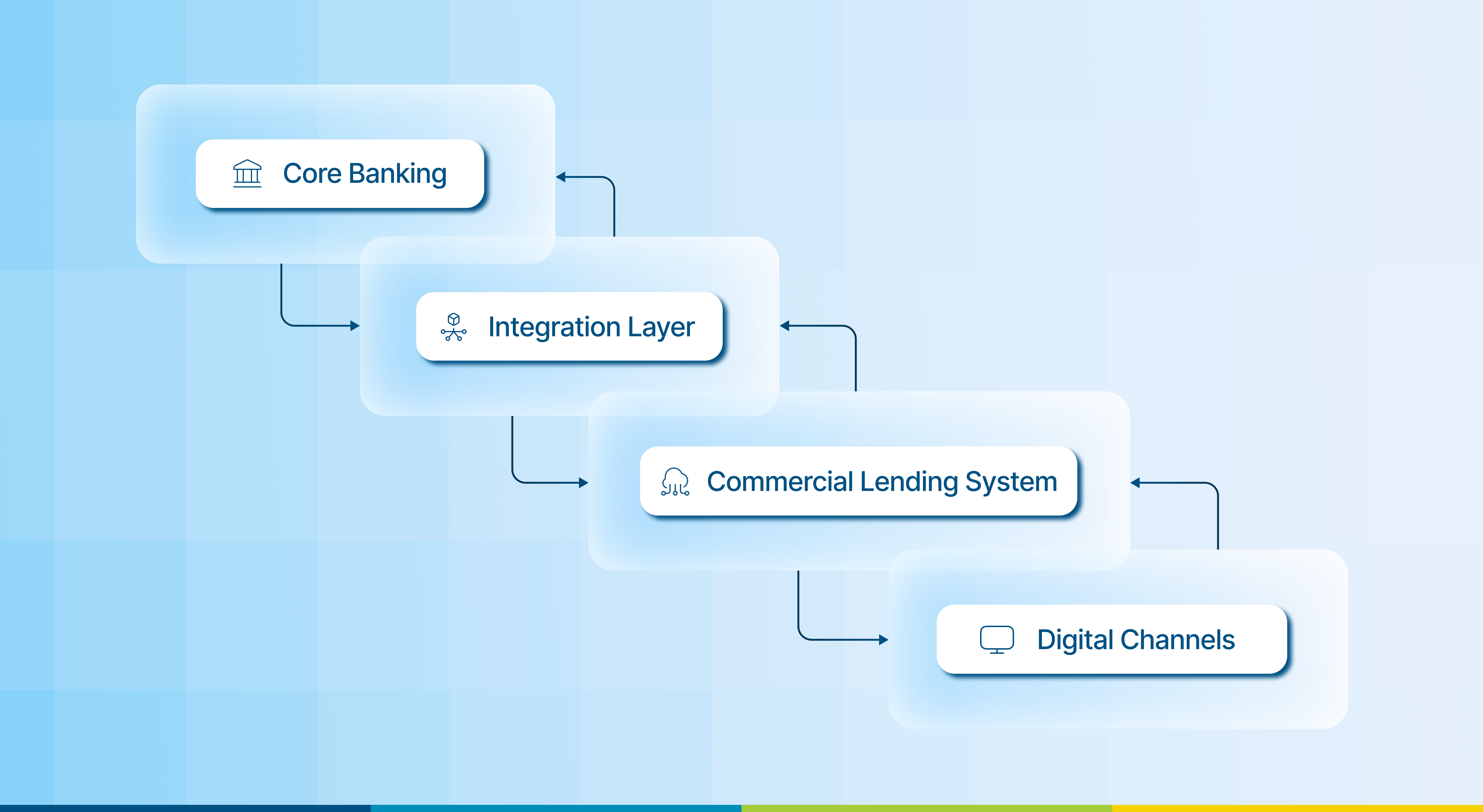
A modern setup separates responsibilities instead of asking one system to do everything. Instead of one platform trying to be the system of record, the origination engine, and the customer-facing portal all at once, the work gets split across four connected layers, each handling only what it's actually good at.
The core banking system stays exactly where it is.
It continues to manage accounts, ledgers, and transaction processing the same way it does today. Nothing about this layer needs to change, and that's the point.
The core has spent years, sometimes decades, being tuned for reliability and accuracy in exactly these functions.
There's no reason to disturb that just to add lending capability.
An integration layer sits between the core and everything else.
This is usually a set of APIs that let data move back and forth without either system needing to know the internal details of the other. Loan disbursement instructions flow from the lending system into the core once a deal is approved.
Account balances, transaction history, and customer data flow the other way, from the core into the lending system, so credit and servicing teams always have an accurate picture.
The commercial lending system handles origination.
This is where applications, credit analysis, underwriting, and approval workflows actually happen, purpose-built for commercial lending instead of retrofitted from a retail process that was never designed for the complexity commercial deals bring.
Multi-entity borrowers, covenant tracking, and committee approvals all live comfortably here in a way a retail-first system usually can't support.
Digital channels sit on top of all of it.
Borrowers and relationship managers interact through portals and dashboards that pull from the commercial lending system, without ever touching the core directly.
From the borrower's side, the experience feels like one connected platform, even though three distinct layers are working together behind it.
Each layer does one job well, and the integration layer is what keeps them working together without disruption. This is really the whole answer to the build vs replace debate: nothing about this design requires touching the core at all.
7 Capabilities Banks Can Modernize Without Replacing the Core
These are the areas where a commercial lending system delivers the most value, all without touching core banking.
1. Digital loan applications
Instead of routing borrowers through email or in-person paperwork, applications get submitted online with data captured directly at the source.
This alone removes a surprising amount of the back-and-forth that used to eat up the first few days of any deal.
2. Document collection
Centralized document management replaces scattered email attachments, giving both the bank and the borrower one place to track what's been submitted and what's still missing. Nobody has to dig through an inbox to figure out where a deal stands.
3. Credit analysis
Automated financial spreading pulls numbers directly from submitted financials instead of requiring an analyst to key them into a spreadsheet line by line.
What used to take hours of manual entry can happen in the background while the analyst focuses on judgment calls instead of data entry.
4. Underwriting workflows
Configurable rules route applications to the right underwriter based on loan size, product type, or risk profile, instead of relying on someone manually deciding who picks up each file.
Consistency improves simply because the routing logic doesn't have an off day.
5. Approval and decisioning
Multi-step approvals, including committee sign-off for larger loans, move through defined workflows instead of chasing signatures over email.
Everyone involved can see exactly where a deal sits in the process, rather than waiting on a status update.
6. Loan documentation
Templates paired with e-signature tools generate and execute loan documents far faster than waiting on physical paperwork to circulate.
A step that once took days can often close out the same afternoon.
7. Portfolio monitoring
Once a loan is booked in the core, a connected commercial lending system can still track covenant compliance, renewal dates, and portfolio performance in one place, long after the deal has technically closed.
How a Commercial Lending System Integrates With Core Banking
Integration typically runs through APIs that handle a defined set of exchanges rather than a full data merge between systems.
On loan booking, the commercial lending system sends disbursement instructions, account details, and loan terms to the core, which then handles the actual transaction and ledger entries.
On an ongoing basis, the core sends back account balances, payment history, and transaction data so the lending system has an accurate, current view of each borrower relationship.
This two-way exchange means the core never has to change what it does. It just needs to expose the right data through an API, which most modern core banking platforms, and even many legacy ones with a middleware layer, are able to support.
Build vs. Buy vs. Layer on Top of the Core
Banks generally choose between three paths when modernizing commercial lending.
Building in-house
This gives full control over the commercial lending system's design, but it means owning development, integration, and ongoing maintenance indefinitely. This suits banks with strong internal engineering teams and highly specific underwriting needs that off-the-shelf platforms can't accommodate.
Buying a commercial lending platform
This gets a bank to a working system faster, with the vendor maintaining updates, compliance changes, and integration support. This is the more common path for banks that want modernization without adding a permanent development team just to keep the platform running.
Layering a commercial lending system on top of the core
This is really the point of the entire approach, and it applies regardless of whether the system is built or bought. The core stays untouched, and the lending capability sits in a separate, connected layer.
This is the path that avoids the cost and risk of a core replacement while still delivering modern commercial lending capability.
Key Integration Challenges Banks Should Plan For
A few issues come up consistently during commercial lending system integration projects, and planning for them early avoids most of the disruption.
- Data quality. If account or customer data in the core is inconsistent, that inconsistency carries into the new system unless it's cleaned up first.
- API availability. Older core banking platforms may need a middleware layer to expose data through modern APIs, adding a step to the integration.
- Change management. Credit and underwriting teams need training on new workflows, not just system access.
- Parallel running. Most banks run the new commercial lending system alongside existing processes for a period before fully cutting over, which takes planning but significantly reduces risk.
A Practical Roadmap for Commercial Lending Modernization
A phased rollout tends to work better than an all-at-once switch.
- Map current state. Document how applications, credit analysis, and approvals actually move today, including every manual handoff.
- Define integration requirements. Identify exactly what data needs to move between the core and the commercial lending system, in both directions.
- Pilot with one loan segment. Start with a single product or portfolio segment rather than the entire commercial book.
- Expand incrementally. Add loan types and volume once the pilot proves out, rather than committing the whole portfolio on day one.
- Retire manual workarounds. Once the new system is handling volume reliably, formally sunset the spreadsheets and email threads it replaced.
Banks that have gone through this kind of transition without disrupting live operations often follow a similar sequencing. Our piece on how CIOs modernize lending systems without disrupting live loan operations covers this in more detail.
How to Measure the ROI of Commercial Lending Modernization
A few metrics make the business case clear once the new commercial lending system is live:
- Time to decision. How long it takes from application submission to credit decision, compared to the manual process.
- Analyst hours per loan. How much manual spreading and data entry time is eliminated per application.
- Application drop-off rate. Whether borrowers are completing applications faster and abandoning them less often.
- Portfolio visibility. Whether covenant tracking and renewal management happen proactively instead of reactively.
Legacy vs. Modernized Commercial Lending
The shift is not just about adding more technology. It changes how everyday lending tasks are handled, from applications and documents to approvals and reporting. Here’s what that difference looks like.
Final Thoughts
Modernizing commercial lending doesn't require betting the bank on a core replacement. A commercial lending system that integrates cleanly with your existing core delivers the speed, visibility, and automation borrowers and credit teams actually need, without the cost, timeline, or risk of touching the system of record.
Finspectra's commercial lending software is built to integrate with existing core banking systems through a dedicated API layer, so banks get a modern origination and underwriting experience without replacing infrastructure that already works.
Our broader modern commercial lending software guide covers the full feature set in more depth.
Book a demo to see how Finspectra's commercial lending system connects to your core without disrupting live operations.
FAQs
Can banks modernize commercial lending without replacing core banking?
Yes. A commercial lending system can integrate with an existing core banking platform through APIs, handling origination, underwriting, and document management separately while the core continues managing accounts and transactions as it always has.
How does a commercial lending system integrate with core banking systems?
Integration typically runs through APIs that exchange a defined set of data. The commercial lending system sends loan terms and disbursement instructions to the core, and the core sends back account balances and transaction history, keeping both systems synchronized without merging them.
What are the benefits of modernizing commercial lending?
Modernizing commercial lending reduces time to decision, cuts manual analyst hours spent on data entry and spreading, improves the borrower application experience, and gives credit teams real-time visibility into pipeline and portfolio performance instead of relying on static reports.
What should banks look for in a commercial lending system?
Banks should look for strong API support for core banking integration, configurable underwriting workflows, automated financial spreading, centralized document management, and portfolio monitoring, along with a vendor track record of integrating with systems similar to their existing core.
What is the difference between a loan origination system and core banking software?
Core banking software manages accounts, transactions, and the general ledger, while a loan origination system handles the application, underwriting, and approval process before a loan is booked. They serve different functions and are designed to work together rather than replace one another.
.png)

.png)
.png)


