%201.avif)
When to Replace Your Core Lending System (And When Modernization Is the Better Strategy)
.png)
Every lender eventually hits the same wall. Loan volumes grow, compliance rules pile up, and the lending system that once ran smoothly starts holding the business back. The hard part isn't noticing the problem. It's deciding whether the fix is a full replacement or a targeted modernization of what you already have. Get this decision wrong and you either overspend on a rebuild you didn't need, or you pour money into patches on legacy lending infrastructure that was never going to keep up.
This guide breaks down exactly how to tell the difference, using the operational, financial, and technical signals lenders actually rely on when making this call.
What Counts as a Core Lending System, and Why This Decision Matters
A core lending system is the software that manages loan origination, underwriting, servicing, and collections for a financial institution. It decides how fast a lender can process applications, how accurately it tracks risk, and how well it adapts to new products or regulations. The loan origination system component alone often determines how quickly a borrower moves from application to funded loan.
When this system is outdated, every department feels it. Underwriters re-key data between spreadsheets and portals. Compliance teams build manual workarounds for reporting. Customers wait days for decisions that competitors deliver in minutes using modern lending technology. Choosing between replacement and modernization isn't just a technology decision. It affects loan approval speed, audit readiness, and the lender's ability to launch new products.
Signs Your Legacy Lending System Needs a Full Replacement
A full replacement of your legacy lending infrastructure makes sense when the core architecture itself, rather than individual features, is blocking growth. Here are five signals that point toward replacement rather than patchwork fixes:
- The system can't integrate with modern tools. If connecting a credit bureau, e-signature tool, or fraud detection service requires custom code every time, the architecture is closed rather than API-first.
- Vendor support is disappearing. Systems running on outdated languages or unsupported databases become harder to staff and riskier to maintain each year.
- Compliance updates take months. When a single regulatory change requires a multi-month development cycle, the platform is too rigid for a market that shifts constantly.
- Scaling means buying more hardware, not more capacity. On-premise systems built decades ago often can't scale elastically the way cloud-native platforms can.
- The cost of workarounds exceeds the cost of a new platform. Once IT spends most of its budget maintaining old lending technology instead of building new capability, replacement usually pays for itself within a few years.
Research from McKinsey on next-generation core banking platforms found that legacy cores limit performance in four consistent areas: cost, agility, resilience, and the ability to compete with digital-first challengers. When most of these apply to your institution, modernizing pieces of aging lending technology usually won't close the gap. Only a full replacement will.
When Lending System Modernization Is the Better Strategy
Modernization is the right call when the core logic of your lending system is sound but specific components have fallen behind. This is usually the case for institutions with strong underwriting rules and compliance frameworks that just need a modern interface, better automation, or improved integrations, rather than a rebuilt loan origination system from scratch.
Modernization makes sense when:
- The core workflows still match how your business actually operates. If underwriting, approval, and servicing logic reflect your current risk appetite, you don't need to rebuild it.
- The gaps are specific, not systemic. Maybe document collection is manual, or reporting takes too long, but origination and servicing otherwise function well.
- Your team needs speed without the risk of a multi-year cutover. Modernization projects typically launch in phases, so lenders see improvements within months rather than years.
- Budget and change management capacity are limited. A full replacement asks staff to relearn everything at once. Modernization lets teams adapt gradually.
A regional credit union, for example, might keep its existing underwriting engine but modernize the borrower-facing portal and add automated document verification, without touching the rest of its lending system. A commercial lender might retain its servicing core but replace only the reporting layer to meet new regulatory requirements. Both are modernization projects, not replacements, because the foundation stays intact.
Replace vs Modernize: A Practical Decision Framework
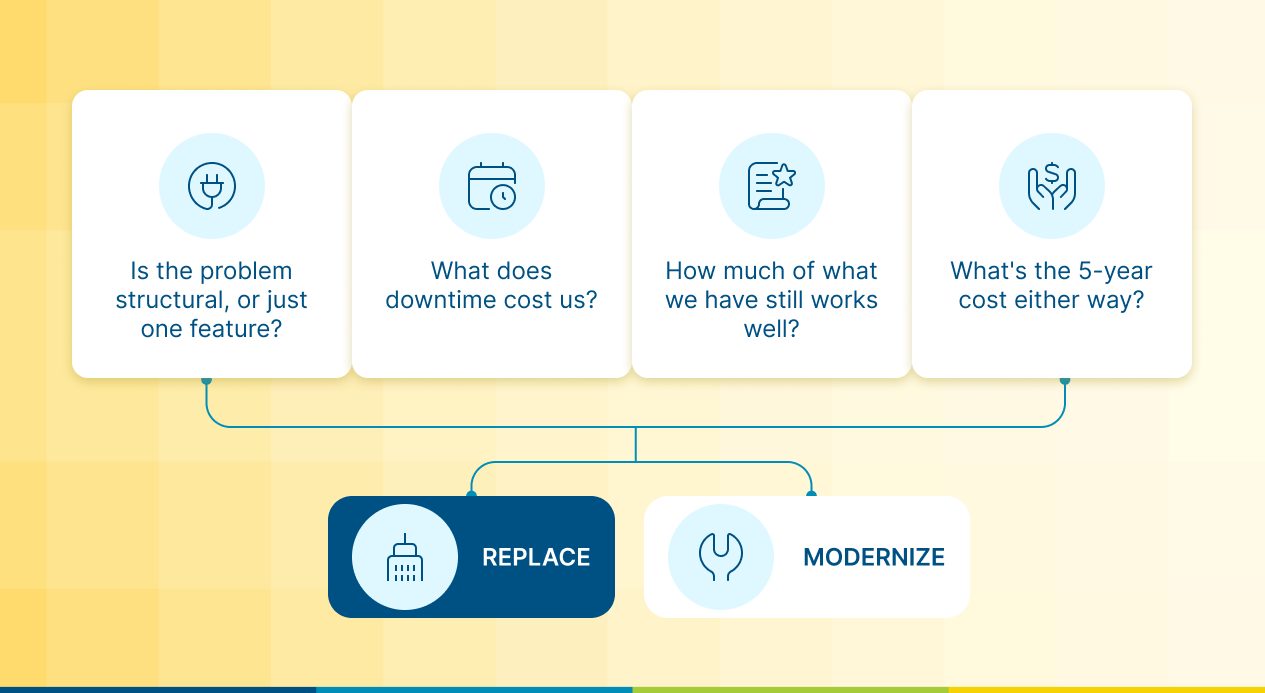
Before committing either way, run your institution through these four questions:
1. Is the limitation architectural or functional? Architectural limits, such as closed APIs, unsupported code, or no cloud option, usually require replacing outdated lending technology entirely. Functional gaps, like missing automation or weak reporting, are solvable through modernization.
2. What does downtime cost during a transition? High-volume lenders with strict SLAs often can't tolerate the disruption of a full core platform swap. Modernization in phases reduces that exposure.
3. How much of the current system still adds value? If underwriting rules, pricing logic, and compliance workflows are strong, don't discard them. Modernize around what works instead of discarding a functioning loan origination system.
4. What's the five-year total cost of ownership? Sometimes ongoing maintenance and workaround costs of legacy lending infrastructure exceed what a rebuild would cost over five years. McKinsey's analysis on modernizing core technology notes that institutions shifting toward lightweight, configurable core processors gain flexibility that legacy architectures simply can't match, regardless of how many patches are applied.
How a Digital Lending Platform Changes the Math
A modern digital lending platform doesn't just move paper processes online. It restructures how origination, underwriting, servicing, and collections connect, so data moves once instead of being re-entered at every stage. This is often where the replace-versus-modernize decision gets clearer, because a true digital lending platform depends on connected architecture, not isolated modules bolted onto old lending technology.
If your current setup already has this kind of connected architecture, even in an older form, modernization can bring it up to date without starting over. If your systems were never built to talk to each other, no amount of modernization closes that gap. That's an architectural problem, and outdated lending technology rarely solves it through patchwork fixes alone.
This is also where lending technology decisions intersect with growth plans. A lender expanding into new loan products, or into commercial and asset-based lending, needs a digital lending platform flexible enough to support new workflows without custom development for every addition. Our complete guide to loan management systems breaks down the core features that separate flexible platforms from rigid ones.
Why the Loan Origination System Often Decides the Outcome
The loan origination system is frequently the component under the most strain, since it's the first point of contact with borrowers and the most visible to regulators and auditors. If origination workflows are manual, slow, or disconnected from underwriting, that bottleneck alone can justify modernization even when the rest of the platform is stable.
We've covered this pattern in detail in our piece on why traditional loan management methods are failing lenders trying to compete on speed. The short version: origination delays compound. A slow intake process delays underwriting, which delays disbursement, which affects borrower experience and, eventually, retention. This is one area where legacy lending processes cost lenders the most, since a weak loan origination system rarely stays a problem for underwriting alone.
Making the Transition Without Disrupting Operations
Whichever path you choose, execution matters as much as the decision itself. Lenders that modernize or replace a lending system successfully tend to:
- Run the new and old systems in parallel during a defined transition window
- Migrate data in phases, starting with lower-risk loan portfolios
- Train staff on new workflows before full cutover, not after
- Set clear success metrics, such as approval time, error rates, and compliance turnaround, before starting
Our step-by-step resource on how to migrate to a new loan management system without disrupting operations walks through this process in more detail, including how to sequence data migration safely across a digital lending platform.
The Bottom Line
There's no universal answer to replace versus modernize. The right call depends on whether your limitations sit in the architecture or in specific features, how much operational risk your institution can absorb during a transition, and what the numbers say about long-term cost. What matters most is making the decision deliberately, based on a clear audit of your current lending system, rather than defaulting to whichever option feels less disruptive today.
If you're evaluating where your platform stands, Finspectra's Prizm Lending Suite is built to support both paths, whether you need targeted modernization of an existing loan origination system or a full origination-to-collections rebuild.
Book a demo to walk through your current lending system and get a clear recommendation for your institution.
FAQs
When should a lender replace its core lending system instead of modernizing it?
A lender should replace its core lending system when the limitations are architectural, meaning the platform can't integrate with modern tools, can't scale on demand, or runs on unsupported technology that makes every update slower and riskier. If the problems are limited to specific features rather than the foundation, modernization is usually the faster and cheaper path.
What is the difference between modernizing and replacing a lending system?
Modernizing a lending system means upgrading or extending specific components, like the borrower portal, reporting layer, or automation tools, while keeping the core underwriting and servicing logic intact. Replacing means rebuilding the entire platform from the ground up, which takes longer and costs more but resolves architectural limits that modernization can't fix.
How long does core lending system modernization usually take?
Core lending system modernization typically takes a few months to a year, depending on scope, since projects are usually phased by module or function. A full replacement, by comparison, often takes one to three years because it involves migrating the entire loan portfolio and retraining every team on new workflows. Our guide on migrating to a new loan management system outlines a realistic timeline for both approaches.
What are the biggest risks of delaying a legacy lending system upgrade?
Delaying an upgrade to a legacy lending system usually means rising maintenance costs, slower compliance response, and losing borrowers to competitors offering faster digital experiences through a modern digital lending platform. The longer a lender waits, the more expensive and disruptive the eventual transition tends to become, since technical debt in legacy lending infrastructure compounds year over year.
Can a digital lending platform be added on top of an existing core system?
Yes, a digital lending platform can often be layered on top of an existing loan origination system, particularly for origination, borrower communication, and document automation. This approach works well when the underlying servicing and compliance logic is sound, but the borrower-facing experience needs modernization without a full core rebuild.
.png)

.png)
.png)


