Grant and Relief Program Administration: Why Public-Sector Lenders Need More Than a Generic LMS
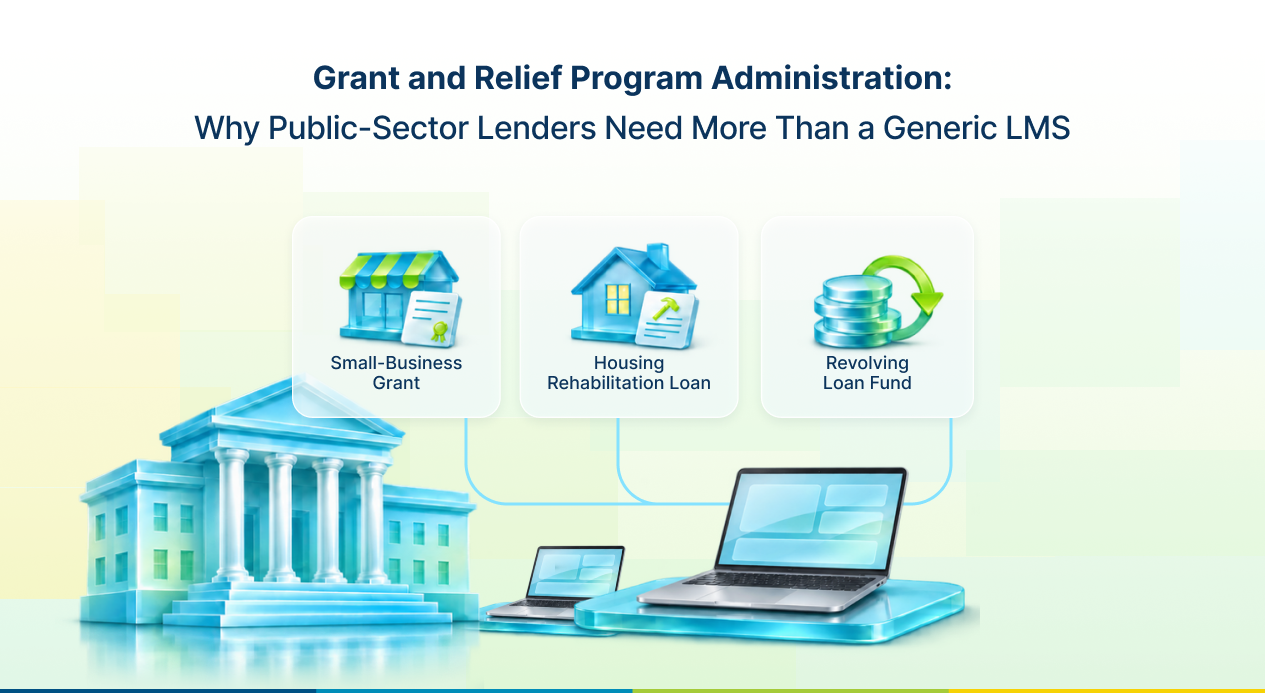
Consider a program director at a state housing agency on the first Monday of a new fiscal year. The director is a composite, but anyone who has held the job will recognize the desk. One program is a small-business relief grant. A second is a forgivable loan for housing rehabilitation. The third is a revolving loan fund seeded with federal block grant dollars and replenished by borrower repayments. Each has its own eligibility rules, its own funding source and its own overseer, and the agency’s loan system can see roughly one of the three clearly.
That gap is the subject of this article. Public-sector lenders and development finance institutions routinely run grants, forgivable loans, revolving funds and relief programs side by side while answering to regulators, legislatures and taxpayers at once. Most lending platforms were built for commercial lending, where a loan has one lender, one borrower and one repayment story. Grant program administration software exists because public funding follows a different logic, and CDFI loan management software that stops at the repayment schedule leaves the rest of government lending to spreadsheets.
What Makes Public-Sector Lending Different from Commercial Lending
Grant program administration software helps government agencies manage the full lifecycle of public funding, from applicant intake and eligibility screening through disbursement, compliance monitoring and closeout. When the same agency also lends, CDFI loan management software has to carry repayment, forgiveness and program income on the same record, which is where most commercial systems stop.
Four structural differences explain why.
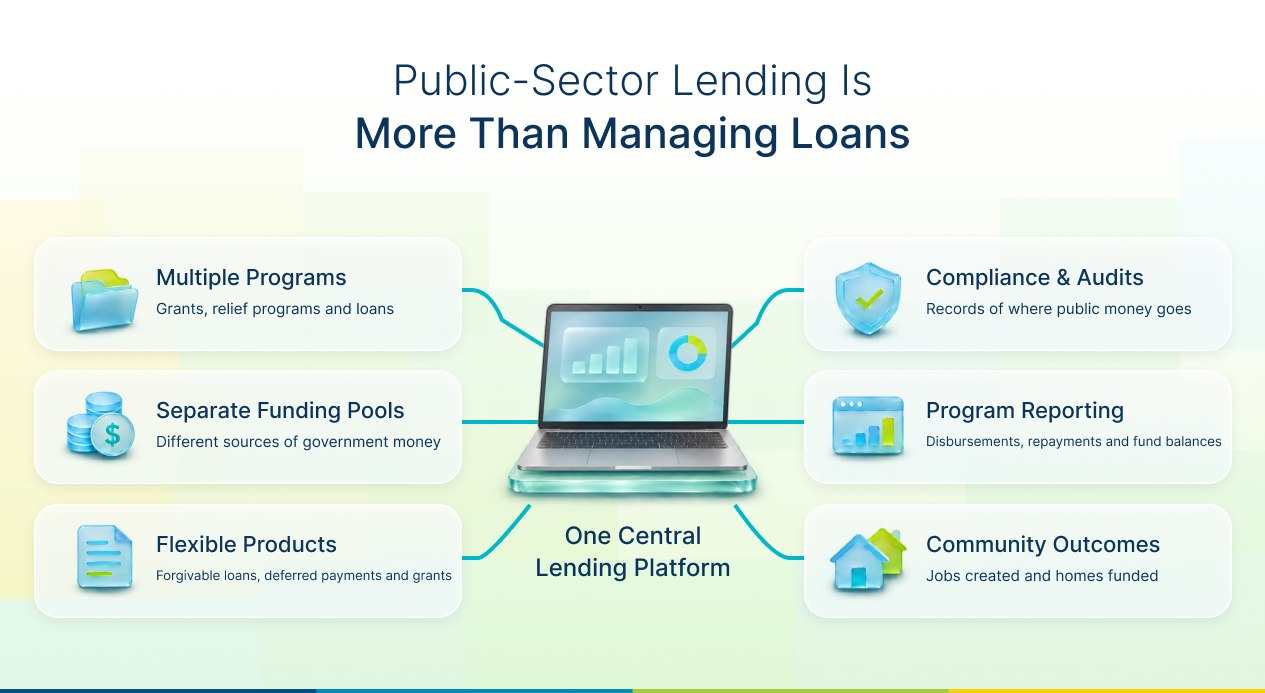
Multi-program complexity comes first. The agency in our example runs three programs, each with a separate funding pool, eligibility test and reporting calendar. Multi-program fund management means money from one source cannot drift into another program’s ledger, even when the same borrower qualifies for both.
Accountability layers come next. Federal dollars arrive with reporting duties to HUD, Treasury or the SBA, state audits sit on top of those, and legislative oversight sits on top of the audits. For federal awards the baseline is 2 CFR Part 200, which requires pass-through entities to monitor subrecipients and requires a Single Audit once an entity expends $1,000,000 or more in federal awards in a fiscal year, up from $750,000 for fiscal years beginning on or after October 1, 2024. The rulebook is also in motion. OMB published a proposed rewrite of Part 200 on May 29, 2026, and a continuing resolution signed on September 2 bars it from being finalized before December 11, 2026, so agencies administer today’s rules while planning for tomorrow’s.
Blended instruments complicate the ledger. A forgivable loan behaves like a loan until a milestone converts it into a grant. A deferred-payment loan, an interest-rate buy-down and a loan guarantee each divide cost between borrower and public funder in a different way.
Borrower outcome tracking completes the picture. A commercial lender measures repayment. A public lender also reports jobs created and housing units funded against the program’s statutory purpose. The sector doing that work is sizable: the New York Fed counts 1,378 certified CDFIs holding $446 billion in assets as of the second quarter of 2025, with loan funds the largest group by count at 41 percent.
Where Generic Loan Management Systems Fall Short for Government Programs
Our loan management system guide covers what these platforms do well. The trouble starts where public programs sit outside the design assumptions of CDFI loan management software adapted from commercial products.
Rigid Loan Product Configuration
Generic platforms assume a fixed repayment schedule, a standard interest calculation and a conventional borrower. Public programs need zero-interest periods, forgiveness triggers that fire on a milestone or compliance date, and disbursements released in tranches against documented progress. When CDFI loan management software cannot configure the product, staff run the exceptions in spreadsheets and the system of record stops being the record.
No Native Grant Lifecycle Support
A grant follows a different lifecycle than a loan: intake, eligibility screening, award, milestone disbursement, compliance documentation and finally the grant closeout process, which covers final reports, reconciliation of unspent funds and record retention for audit. A standard loan system has no object for those steps. Grant administration ends up elsewhere, and a borrower who holds both a grant and a loan exists as two unrelated records.
Inadequate Compliance and Audit Trail Architecture
Government audit trails attach to funding sources as well as accounts. Under the CDBG rules a revolving fund is a separate fund with its own accounts, its cash balance sits in an interest-bearing account, interest earned on grant funds goes back to HUD at least annually, and interest paid by borrowers counts as program income (24 CFR 570.500). Meeting that standard takes expenditure tracking by fund source, a regulatory audit trail that can be cut by program, and sub-recipient monitoring data. Most CDFI loan management software logs loan-level actions well and cannot produce those cuts, which is exactly what federal grant administration and grant compliance monitoring depend on.
Reporting Gaps That Create Real Risk
A program director who cannot see fund utilization, disbursement status and delinquency by program is managing blind. Generic reporting is built for portfolio metrics such as balances, delinquency and yield. Program-level reporting asks other questions: how much of this award is obligated, how much has been disbursed, what has returned as program income, and which subrecipients are late on their reports. Fund disbursement tracking at that resolution is rarely a configuration setting in a commercial system.
What Public-Sector Lenders Actually Need From Their Technology
The requirements follow directly from the gaps. For a CDFI or a state agency, CDFI loan management software should offer six capabilities.
Multi-program architecture. CDFI loan management software should run several programs with their own rules, funding pools and reporting requirements, and keep their ledgers apart. For a revolving fund, revolving loan fund software also has to treat repayments as program income that returns to the same fund.
Configurable loan and grant products. In CDFI loan management software, forgivable loans, deferred payments, milestone disbursements and interest subsidies should be settings an administrator changes, not tickets for a developer.
Built-in compliance workflows. Government lending compliance automation means audit trails that write themselves, sub-recipient monitoring schedules that generate their own tasks, and fund-source tracking that follows every dollar.
Applicant intake and eligibility automation. Digital applications should screen against each program’s criteria at submission. Government loan automation software earns its keep here, because it removes the screening step and leaves the judgment with the officer.
Outcome tracking and impact reporting. Borrower outcome tracking should connect each loan or grant to the jobs, housing units or infrastructure it funded, so the annual report draws from live records.
Integration with government systems. Treasury, accounting and reporting systems already exist inside public entities. A public sector lending software platform should exchange data with them instead of asking staff to rekey it.
See how Finspectra’s Prizm platform supports public-sector lending programs → Book a Demo
The Case for a Unified Lending Platform in Government Operations
Return to the program director’s three programs. If the grant lives in one system, the forgivable loan in a second and the revolving fund in a third, every borrower who touches two programs is entered twice, every month-end ends in reconciliation, and the figure reported to HUD is assembled by a person. Silos also create exposure. A loan converted to a grant in one system and still amortizing in another is the kind of discrepancy an auditor finds. The wider argument is laid out in our piece on why a unified lending platform is replacing patchwork systems.
The distinction between the two disciplines is worth stating plainly. Loan servicing software manages what happens after a loan is made, which means payments, interest and delinquency. Grant administration manages what happens before and around an award, which means eligibility, milestones, reporting and closeout. Public lenders need both, and CDFI loan management software has to let them share one borrower record.
That shared record is also the answer to a question program directors ask often: how to manage relief programs and loan programs in one system. Each recipient has a single profile, each program is a configuration with its own rules, and every disbursement, repayment and forgiveness event posts to the program and the fund it belongs to. When a relief loan goes delinquent, debt collection and recovery software working from the same record can apply the program’s hardship terms and report recoveries back to the right fund. A unified lending platform of this kind handles origination, servicing, collections and program administration without a reconciliation step between them, and modern lending suites built for the public sector are designed around that premise.
How Leading Public-Sector Lenders Are Modernizing Program Administration
The direction of travel is from spreadsheet-based grant tracking and legacy systems toward cloud-native lending platforms. The Finance Authority of Maine (FAME) shows why. Through Grow Maine, FAME deployed up to $62 million of State Small Business Credit Initiative funding across four programs, using direct loans, equity capital and guarantees, with community-based lenders and CDFIs as intermediaries. A structure like that has funds, programs, intermediaries and a federal reporting regime all drawing on the same set of borrowers, and it is hard to run without program-level records.
Finspectra works with public-sector lenders including Florida Commerce, Virginia and FAME on the Prizm Lending Suite. The pattern this points to is consolidation: grants, loans and funds move onto one platform, the audit trail follows the fund, and reporting comes from the CDFI loan management software instead of a month-end scramble. Configurable products and fund-level reporting also make it easier to adapt when federal rules change.
What to Look for When Evaluating a System for Grant and Relief Program Administration
Grant management software built for nonprofits handles intake and awards well and then stops at the loan. That is why grant management software alone is not enough for public-sector lenders who also manage loans. Our overview of government and public funding software shows how the two halves fit together. When you shortlist government-backed lending solutions, ask each vendor of CDFI loan management software to show the answer on screen:
- Can it handle both loans and grants in one system?
- Does it support configurable products beyond standard commercial lending?
- Are compliance workflows and audit trails program-level, not just account-level?
- Does it offer real-time program reporting and fund utilization dashboards?
- Can applicants apply, submit documents and track status digitally?
- Does it integrate with your existing treasury, accounting and government reporting systems?
- Is it built on a platform, such as Salesforce, that your IT team already supports?
Explore Prizm for Government & Public Funding → Learn More
FAQs
What is grant program administration software?
Grant program administration software manages the full lifecycle of public funding, from applicant intake and eligibility screening through disbursement, compliance monitoring and closeout. CDFI loan management software built for public lenders also handles loans, forgivable loans and revolving funds, so grants and repayable instruments share one borrower record and one program-level audit trail.
Can a loan management system handle both grants and loans?
A conventional loan management system usually cannot, because it has no objects for awards, milestones or closeout and no way to separate funds by program. CDFI loan management software built for public programs models grants, forgivable loans and standard loans in one system, with each instrument tied to its funding source and reporting requirements.
What compliance requirements apply to public-sector lending software?
Requirements depend on the funding source. Federal awards fall under 2 CFR Part 200, including subrecipient monitoring and the Single Audit threshold of $1,000,000. HUD-funded programs add rules such as CDBG program income and revolving fund treatment at 24 CFR 570.500 and 570.504. Treasury and SBA programs bring their own reporting. CDFI loan management software should keep an audit trail by fund source.
How is grant management different from loan servicing?
Grant management covers eligibility, awards, milestone disbursements, compliance reporting and closeout, and its goal is to show that public money reached its intended purpose. Loan servicing covers payments, interest, delinquency and payoff, and its goal is repayment. Public lenders that run both need CDFI loan management software that keeps the two functions on one record instead of two systems.
What should CDFIs look for in lending technology?
CDFIs should look for CDFI loan management software that supports configurable loan and grant products, multi-program fund tracking, program-level reporting, borrower outcome tracking and a regulatory audit trail by fund source. It should also offer digital intake with program-specific eligibility screening and integrate with the accounting and reporting systems the CDFI already uses.Public funding rarely arrives as a single instrument with a single rulebook, and CDFI loan management software should not assume otherwise. If your organization administers grants, relief programs or government-backed loans and your current system was not built for it, talk to our team about how Prizm handles multi-program lending.