%201.avif)
How Loan Monitoring Software Uses Early Warning Signals to Reduce NPAs
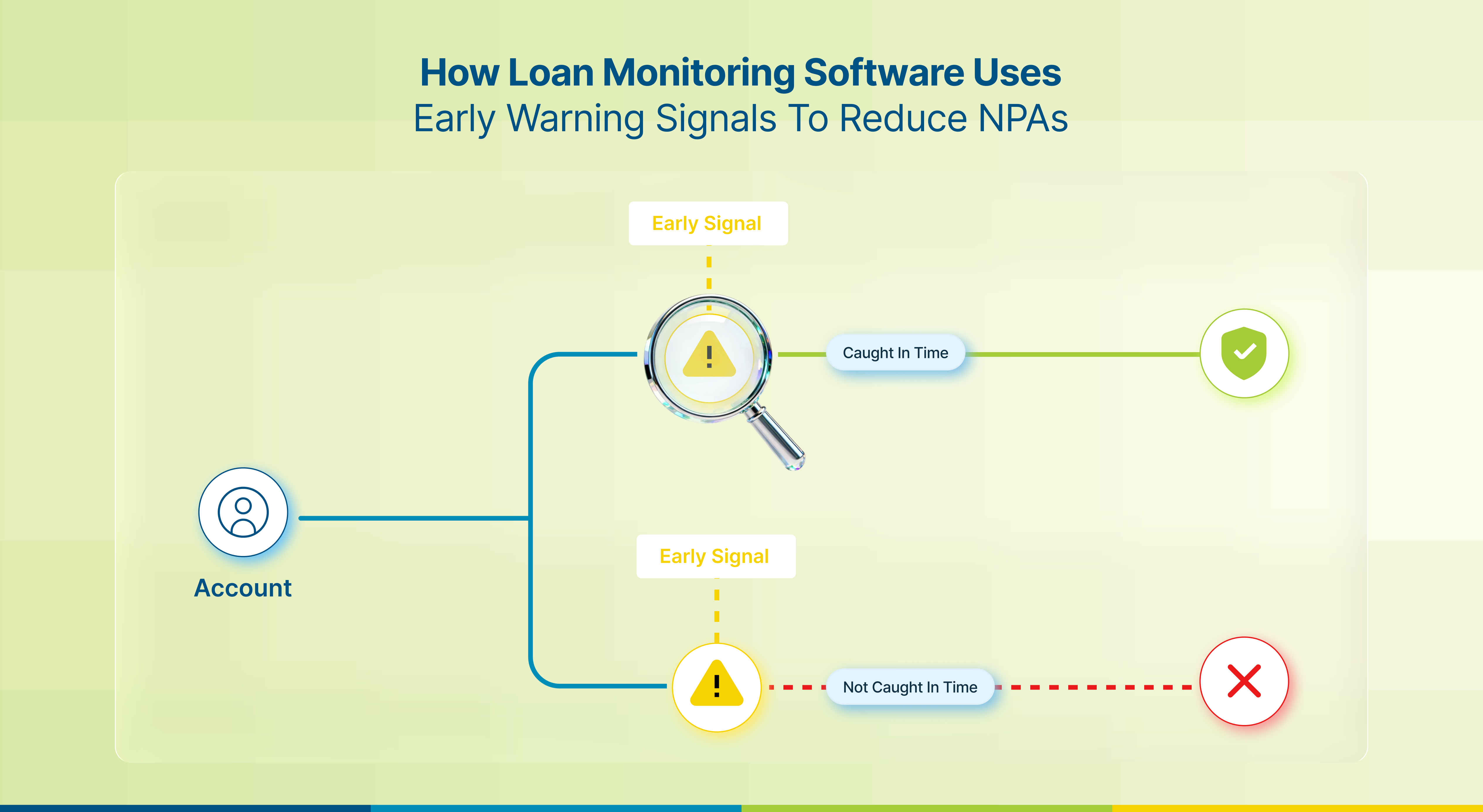
A borrower rarely goes from financially healthy to an NPA overnight. The deterioration usually starts much earlier: cash flows tighten, payments get delayed, credit utilization rises, financial statements arrive late, or the business starts showing signs of stress.
The problem is that lenders don’t always see these changes early enough. The information may be available, but spread across bank statements, bureau reports, servicing records, financial documents, GST filings, and other sources. By the time a clear repayment issue appears, the lender may already be dealing with a delinquent account.
That’s where early warning systems (EWS) come in. Loan monitoring software brings these signals together, tracks changes over the life of the loan, and alerts the relevant team when an account starts moving outside its normal risk profile.
The objective isn’t to predict every default. It’s to give lenders enough visibility and lead time to investigate a problem and intervene before a temporary cash-flow issue becomes a much harder recovery problem.
What Are Early Warning Signals in Lending?
Early warning signals are data points that suggest a borrower's ability to repay is weakening, well before a payment is actually missed.
They fall into a few broad buckets:
- Financial signals. Declining bank balances, irregular cash flow, delayed financial statements.
- Behavioral signals. Late payments on other credit lines, sudden requests for restructuring, changes in usual transaction patterns.
- Structural signals. Management changes, litigation, sector-wide stress, credit rating downgrades.
Each signal alone is weak evidence. A single late payment could mean nothing, but a pattern across five signals over three months means something very different.
Why NPAs Often Develop Before Lenders Detect Them
Most lenders don't miss early warning signals because the data doesn't exist. They miss them because the data lives in five different systems that don't talk to each other.
Bank statement data sits in one tool. Bureau data sits in another. Payment history sits in the core loan management system. Nobody is looking at all of it together, so a borrower can show three or four separate signs of stress without any single team member seeing the full picture.
By the time a payment is actually missed, the borrower has usually already been struggling for a while.
At that point, options for the lender are limited to collections and recovery instead of proactive support that could have prevented the loan from turning bad in the first place. Regulators have started pushing lenders toward earlier detection for this exact reason.
This is the exact gap loan monitoring software is designed to close
India's National Housing Bank, for instance, directed housing finance companies to adopt a formal early warning framework so that alerts trigger before an account turns into an NPA rather than after.
10 Early Warning Signals Lenders Should Monitor
Not every signal carries equal weight, but these ten consistently show up before accounts turn delinquent. This table maps each signal to how loan monitoring software identifies it in practice.
How Lending Software Detects Early Warning Signals
Loan monitoring software detects risk by pulling data from multiple sources into one view, then applying rules or models to flag what matters.
- Data aggregation. Bank statements, bureau reports, GST filings, payment history, and external news feeds are pulled into a single borrower profile instead of sitting in separate silos.
- Pattern matching. The system compares current borrower behavior against their own history and against similar borrowers, so a deviation stands out instead of getting lost in noise.
- Threshold triggers. Rules define what counts as a signal, like a balance drop of more than 30 percent, or two consecutive missed vendor payments.
- Continuous monitoring. Instead of a one-time credit check at origination, the system watches the account for the life of the loan.
This is the shift most lenders need to make. Monitoring can't be a quarterly review. It has to run in the background every day the loan is on the books.
McKinsey's research on credit risk digitization found that machine learning applied to early warning systems can uncover risk patterns in large, complex data sets that standard statistical checks tend to miss.
How Lending Software Turns Signals Into Alerts

This is the core loop that loan monitoring software is designed to run continuously. Once a signal crosses a defined threshold, the system can generate an alert for the relevant team, whether that's credit, servicing, or collections.
The alert should provide context around what changed, rather than simply flagging the account as risky.
This is where modern early warning systems move beyond static reporting. Instead of waiting for a periodic review to identify a problem, continuous monitoring allows the lender to see a developing risk while there is still time to respond.
How Lending Software Prioritizes Risk
Not every alert requires the same response. A single late payment may mean very little, while a late payment combined with falling bank balances, higher credit utilization, and delayed financial statements could indicate a much more serious deterioration.
Risk scoring helps weigh signals together and prioritize accounts based on the severity and number of concurrent indicators, as well as factors such as exposure size and portfolio segment risk.
This is where loan monitoring software earns its value, by making sure the right person sees the flag.
How Alerts Lead to Intervention
The final step is turning a risk score into a specific action. Depending on the severity of the signals, that could mean a check-in call, a request for updated financial documents, a review of restructuring options, tighter terms, or escalation to collections.
It creates the operating loop that modern lending intelligence platforms are increasingly designed to support, which is continuous monitoring to identify the signal, alerts surface it, risk scoring establishes priority, and the resulting assessment determines the intervention.
The goal is not simply to report that an account is becoming distressed, but to give the lender enough time and context to do something about it.
Our piece on how risk teams use real-time lending intelligence to reduce defaults covers this shift in more depth.
How EWS Helps Reduce Delinquency and NPAs
The value of loan monitoring software comes down to time. A borrower flagged three months before a missed payment gives a lender room to restructure, renegotiate, or simply check in, options that don't exist once an account is already 90 days past due.
Lenders using EWS effectively tend to see fewer accounts progress from early delinquency to full default, because intervention happens at a stage where the borrower relationship still has room to recover. This also reduces the volume that ends up in collections, where recovery costs are highest, and outcomes are least predictable.
Data Sources Used by Lending EWS
Effective monitoring pulls from more than just internal loan data:
- Bureau data. Credit scores, utilization, and inquiries across other lenders.
- Bank transaction data. Inflows, outflows, and balance trends.
- Tax and compliance filings. GST returns, income tax filings.
- Public records. Litigation, regulatory actions, news mentions.
- Internal servicing data. Payment history, restructuring requests, communication logs.
The more of these sources a loan monitoring software connects natively, the less manual work falls on the credit team to piece together a full picture.
Rule-based vs AI/ML-based early warning systems
Both approaches have a place, and most loan monitoring software today blends both approaches rather than relying on one exclusively.
Rule-based systems flag accounts based on defined thresholds, like a missed payment or a balance drop past a set percentage. They're transparent and easy to audit, which matters for regulated lenders, but they can miss subtler patterns that don't fit a predefined rule.
AI and ML-based systems learn from historical default patterns to identify combinations of signals that predict risk, even when no single signal crosses a hard threshold. They tend to catch risk earlier, but they need enough historical data to train on and require more oversight to explain their decisions.
Whichever mix a lender chooses, this is the layer where loan monitoring software either proves its worth or falls short.
Our breakdown of rule-based vs AI credit decisioning at scale goes deeper into this tradeoff.
How to Prioritize High-Risk Borrowers
Loan monitoring software generates flags constantly, so prioritization matters as much as detection.
Not every flagged account needs the same level of attention. A simple prioritization approach:
- Severity of signal. A bounced payment ranks higher than a delayed document submission.
- Number of concurrent signals. One signal may be noise. Three signals on the same account rarely are.
- Exposure size. A large-ticket loan showing early stress deserves faster review than a small one showing the same signal.
- Portfolio segment risk. Borrowers in already-stressed sectors get a lower threshold for escalation.
This keeps credit and servicing teams focused on accounts where intervention will actually change the outcome, instead of spreading attention evenly across every flag the system generates.
Integrating EWS With LOS, LMS and Collections
Loan monitoring software only delivers full value when it's connected to the rest of the lending stack. An early warning system that sits separately from origination, servicing, and collections creates the same problem it's meant to solve: fragmented visibility.
When EWS is connected to the loan origination system, risk flags can influence future underwriting decisions for repeat borrowers. Connected to the loan management system, alerts show up in the same place servicing teams already work.
Connected to collections, high-risk accounts can be routed for proactive outreach before they're formally delinquent, rather than waiting for a collections queue to pick them up.
Disconnected loan monitoring software systems also tend to create the hidden costs of data silos that show up as duplicated effort and missed signals, not just slower reporting.
A unified view of underwriting and collections built on one customer profile solves this more directly than layering a separate monitoring tool on top of existing systems.
Key Metrics to Measure EWS Effectiveness
The right loan monitoring software should be judged on outcomes, not just alert volume. These are the metrics to track:
- Signal-to-default conversion rate. What percentage of flagged accounts actually progress to delinquency?
- False positive rate. How often is the system flagging accounts that never become a real problem?
- Time between signal and intervention. Speed matters more than volume of alerts.
- NPA rate trend. The end goal metric, tracked over time against the period before EWS was implemented.
- Recovery rate on flagged accounts. How many flagged accounts return to good standing after intervention?
If false positives are high, teams start ignoring alerts altogether, which defeats the purpose of the system.
How to Implement an Early Warning System
Rolling out loan monitoring software works best in stages rather than all at once:
- Define the signals that matter for your portfolio. Not every signal applies equally to every loan type.
- Connect your data sources. Bureau, bank data, servicing history, and public records need to feed into one place.
- Set thresholds and scoring logic. Start with clear rules, then layer in predictive models once enough data exists.
- Build the alert-to-action workflow. Decide who gets notified, and what happens next, before the system goes live.
- Review and recalibrate. Use the metrics above to adjust thresholds every quarter, since a static system loses accuracy over time.
Lenders considering a broader upgrade alongside EWS often find it useful to look at loan servicing software as a complete system rather than bolting monitoring onto an already fragmented stack.
Closing Thoughts
Reducing NPAs isn't about predicting the future with certainty. It's about noticing the signs that are already there, early enough to act on them. Loan monitoring software makes that possible by connecting data that would otherwise sit in separate systems, and by turning that data into alerts a team can actually work with.
The lenders getting ahead of NPAs today aren't doing anything exotic. They've simply put loan monitoring software to work instead of treating monitoring as an afterthought.
Finspectra's Prizm Servicing brings monitoring, alerts, and servicing into one connected platform, so risk signals surface where your team is already working instead of in a separate tool nobody checks.
Book a demo to see how Prizm can help your team catch risk earlier and reduce NPAs across your portfolio.
FAQs
What are early warning signals in lending?
Early warning signals in lending are data points, like declining bank balances, delayed financial statements, or bounced payments, that suggest a borrower's ability to repay is weakening before a payment is actually missed. This is exactly the kind of pattern loan monitoring software is designed to surface.
How can lending software help reduce NPAs?
Loan monitoring software helps reduce NPAs by continuously monitoring borrower data across multiple sources and flagging risk signals early enough for a lender to intervene, whether through restructuring, outreach, or tighter terms, before the account becomes delinquent.
What data can lending software use to detect early warning signals?
Loan monitoring software can use bureau data, bank transaction history, tax and GST filings, public records like litigation or news mentions, and internal servicing data such as payment history and restructuring requests. Connecting these into a loan origination system also lets flagged risk inform future underwriting decisions for repeat borrowers.
What are the most important early warning indicators for lenders?
For teams relying on loan monitoring software, the most important indicators typically include declining bank balances, bounced payments, delayed financial disclosures, credit utilization spikes on other lines, and management or ownership changes. No single indicator is definitive, but multiple concurrent signals on one account are a strong warning sign.
Can early warning systems predict loan defaults before delinquency?
Early warning systems can't predict defaults with certainty, but they can identify meaningful increases in risk well before a payment is missed, giving lenders time to intervene while the borrower relationship still has room to recover.
.png)

.png)
.png)


